Experience the passion behind our farm by joining us at a relaxing picnic or our season finale – Asado. Take in views of the mountains, cows grazing, songbirds or catch up with your neighbor at Echo Farm this summer. Behind the dinner series is a team of professional chefs, bartenders and servers who are all inspired by the freshness and authenticity of ingredients. If something isn’t grown or raised here, you will know it! Rustic appetizer platters, dessert options and curated cocktails (as well as beer and wine) can be ordered at the greeting station or bar.
Each ticket provides you entry to Echo Farm and a rotating fixed menu that includes an entree and side dish. Vegetarian options will be available and effort will be made to accommodate allergies and sensitivities within reason. All menu items are built around ingredients grown and raised here and are 100% organic. Food will be served on compostable serviceware. Service pets on a leash are allowed.
To a student armed with a lunch tray and an appetite, a cafeteria line looks deceptively simple. The food magically appears, with no hint of the legalities, formulas and contracts that get it from the producers to the trays.
Behind the scenes, there’s a lot going on, including work with state and federal agencies and local producers to get children the food they need. It isn’t always easy, and adds nuance to an already complex system.
Sasha Pulsifer, Food Service Helper and Garden Club Lead at Boquet Valley Central School’s Lake View Campus. Photo by Isabella Susino.
The laws are in place to prevent sweetheart deals, favoritism and conflict of interest, but the process can be very cumbersome. Typically, the laws require schools to have three quotes from prospective local vendors to submit before moving forward with contracts.
North Country school districts participating in the Champlain Valley Educational Services (CVES) scratch-cooking program, which seeks to jettison sugar and ultra-processed foods in favor of whole foods grown closer to home, do have tools that can help.
Districts can, for example, prioritize geographic proximity or special criteria when ordering foods. But there are complexities. Geographically prioritized food must be in a raw state, which eliminates products like tomato sauce, even if it’s healthy tomato sauce. Cafeterias can write in criteria that help local farmers compete, but that just recalibrates the formula; it’s not a sure-fire way to guarantee cafeteria foods will be locally sourced.
“Geographic Preference bids have criteria that favors more localized producers, but there are still times when a statewide producer may have a product that’s cheaper, and even though they’re not hitting all of the criteria, they might still win the bid,” Dohman said.
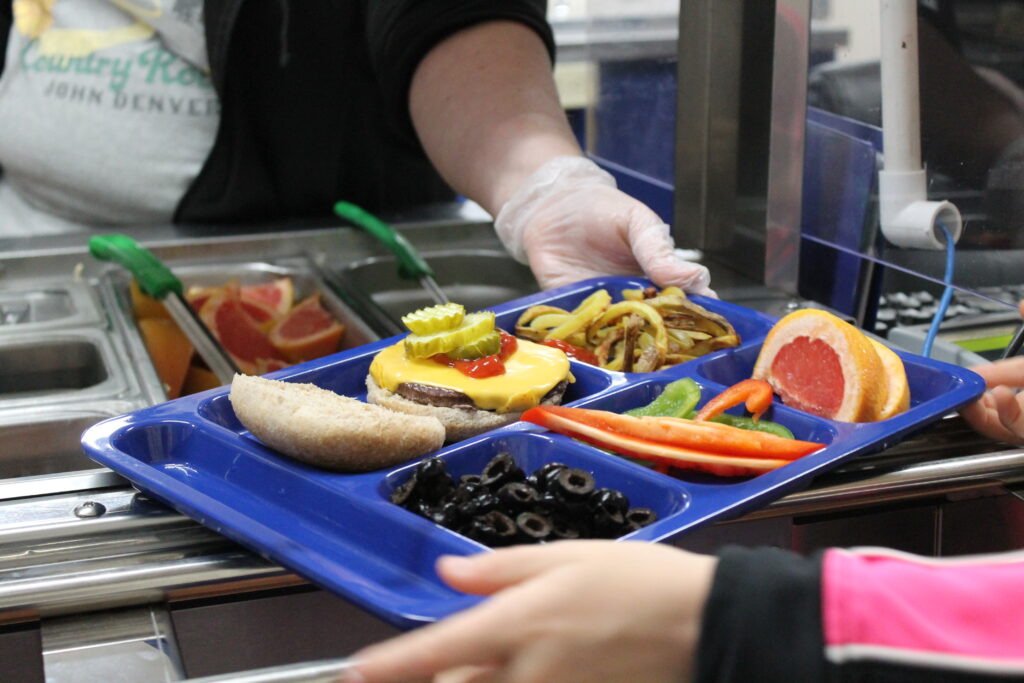
Boquet Valley CSD lunch tray given to a student. Photo by Isabella Susino.
School menus are as much about math as they are about food. Nice as it might be to get every element of a meal from healthy, local sources, federal funding presumes big commodity purchases from corporations that may not be in line with the mission but are necessary to lower the overall cost per meal.
Districts make tactical purchases of cheap products, knowing that it will allow them to work more healthy, local food into their menus and budgets.
“The cafeterias have their own budget line, and they have to be self-sufficient,” Dohman said. “So they’re putting meals together for pennies on the dollar, and a commodity allocation from the government is the only way that they can spend any money on local food and afford the meals they do.”
Along with the federal government, the state has a hand in the process, rewarding districts that obtain 30% of their food from New York — a goal CVES-affiliated districts exceed, said Julie Holbrook, Shared Food Service Director for CVES.
Once all the paperwork is done, cafeterias can focus on putting healthy foods into cafeteria meals.
“There are a lot of ways we can use local ingredients,” Holbrook said. “With the way that we do our program with scratch cooking, it allows us to incorporate local food, and not just fruits and salad bar items — we incorporate things into our recipes like local onions in all our sauces. All those things add up. We have a farmer who just reached out who said, ‘Hey, I’ve got a lot of butternut squash,’ so we have the ability with our ovens to actually bake down a lot of butternut squash, freeze it in sizable portions, and make muffins out of it, or serve it as a hot vegetable.”
Barrett Miller, school lunch manager at CEWW BOCES, whose territory includes four North Country counties, said the process must be focused enough to do long-term meal planning, but also flexible enough to account for what foods are available in-season and the popularity of foods among the kids — which can vary from school to school.
“We always try to listen to and allow the cafeteria staff that’s actually there every day to have their opinion on what they know that the kids are really enjoying, because they’re seeing it there firsthand,” Miller said. “Local food doesn’t do any good if the students don’t want to eat it.”
At the same time, cafeterias are enticing children to try new things, and there are multiple tricks of the trade to encourage them to do so. For example, they might not care much about nutritional values, Holbrook said, but if you suggest that a menu item is “brain food,” they are more apt to try — especially if they have a test coming up.
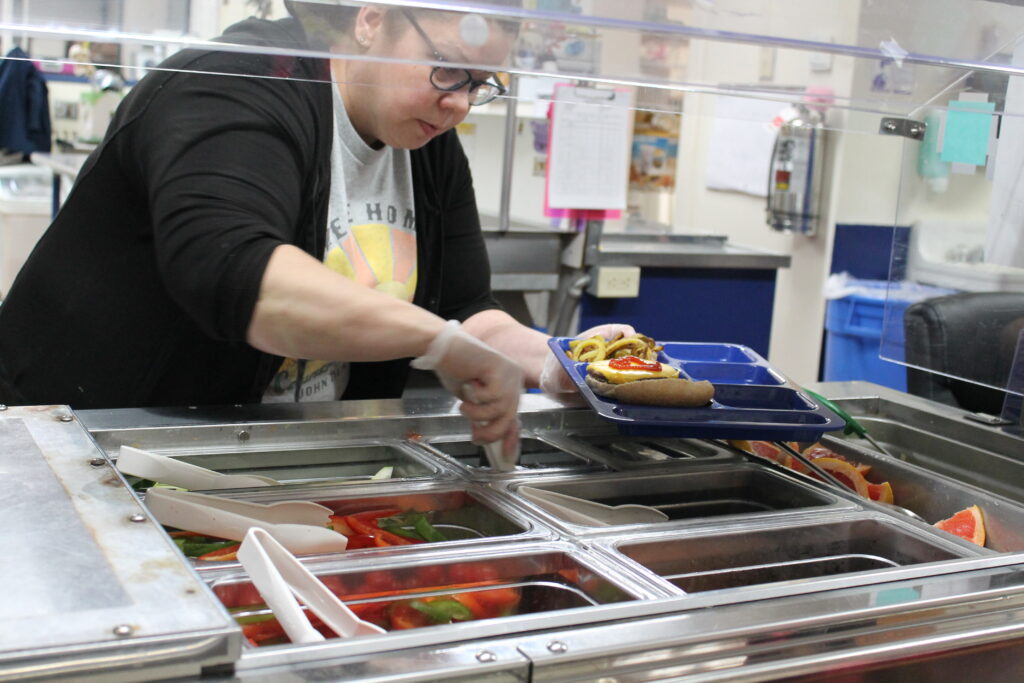
Lunch service personnel putting mustard on a student’s burger. Photo by Isabella Susino.
Those programs supplement cafeteria staff that are more aware today of the importance of good food — and feel empowered to do their part in educating students.
To get kids to try something new, little tastes or “bites” will be put on their trays. Even if students are reluctant to eat it, they can smell, touch, observe its color, and basically become more familiar with new things.
Because food directly contributes to educational outcomes, cafeteria staff find their work more rewarding.
“For us food is about more than what’s on the lunch tray,” said Sasha Pulsifer, a cook at Boquet Valley’s Lakeview campus in Westport. “We’re helping students learn that food fuels their bodies and connects them to our community. By serving local products whenever possible, we’re giving kids a chance to experience fresh foods, try new things, and build healthy habits — without pressure.”
Making the buy-in easier is the quality of local foods, Miller said. A carrot that’s just been pulled from a local field is sweeter, crisper and more colorful than those that show up in a box from a continent away. It also matters to students that it was grown a few miles from their school and makes them more curious about their local farms and agriculture.
“Our school lunch program supports learning beyond the classroom,” Pulsifer said. “When students see and taste local foods, they connect lessons from science, geography, and health to real life. Our goal is simple: create confident, curious eaters who feel good about food.”
Rather than an afterthought, the cafeteria becomes a classroom in its own right, inspiring discussion not just of food, but of all the things that food touches.
Pull up a chair where your food was grown and experience the Adirondacks authentically with a Wood-Fired Pizza Night at Triple Green Jade Farm. Open air venue, the event will be rain or shine!
Dinner is from 4-7 pm. Tickets are $25 per person. Event seating is limited, be sure to reserve your place at the table.
Address: 624 Mountain View Drive, Willsboro, NY
Find updates on the event and reserve your spot at triplegreenjadefarm.com/farm-events
Pull up a chair where your food was grown and experience the Adirondacks authentically with a Grassfed Burger Night at Triple Green Jade Farm. Open air venue, the event will be rain or shine!
Dinner is from 4-7 pm. Tickets are $25 per person. Event seating is limited, be sure to reserve your place at the table.
Address: 624 Mountain View Drive, Willsboro, NY
Find updates on the event and reserve your spot at triplegreenjadefarm.com/farm-events
Pull up a chair where your food was grown and experience the Adirondacks authentically with an Artisan Pasta Night at Triple Green Jade Farm. Open air venue, the event will be rain or shine!
Dinner is from 4-7 pm. Tickets are $25 per person. Event seating is limited, be sure to reserve your place at the table.
Address: 624 Mountain View Drive, Willsboro, NY
Find updates on the event and reserve your spot at triplegreenjadefarm.com/farm-events
Our species has gotten good at strolling through supermarket aisles, ordering off menus and even growing neat rows of peas in raised beds of perfectly fluffed compost. But somewhere, buried deep in our instinctual hardwiring, is a craving to paw around in the forest duff for sustenance, much as our hairy ancestors would have done thousands of millennia before DoorDash, or online foraging apps.
Most people who have developed a relationship with foraging have a natural-food origin story that happened when they were young and blossomed into the careers and kitchens of adult life.
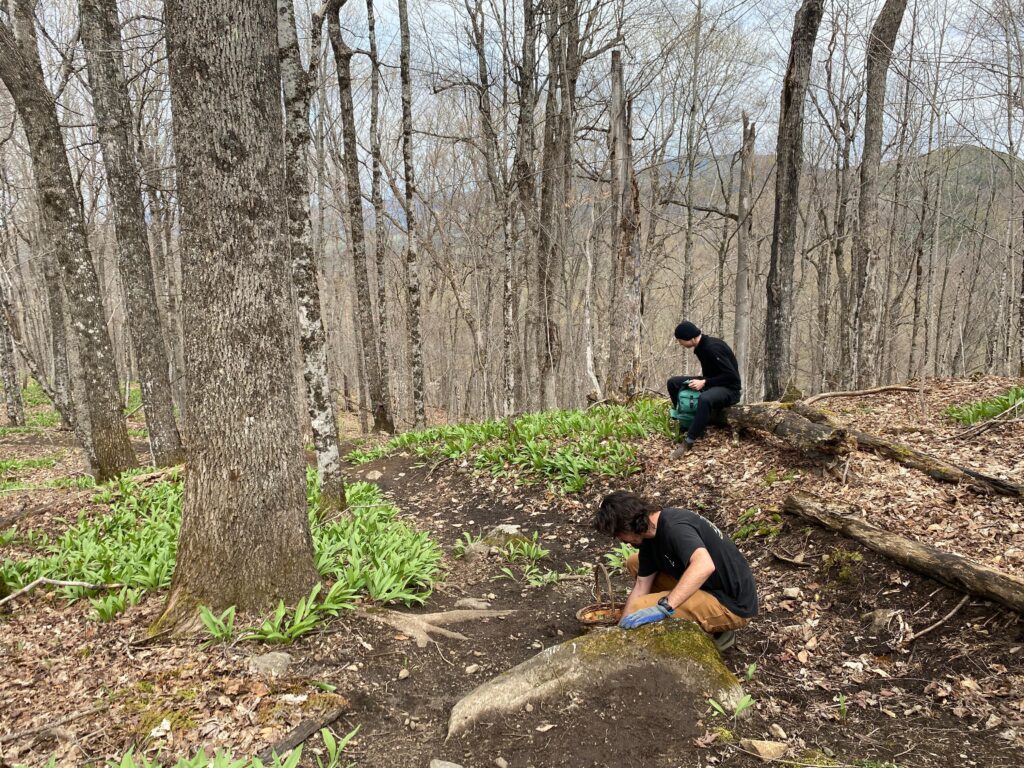
Foragers seek out ramps in the Adirondack High Peaks region. Photo by Joey Goliber.
“I was most certainly born with it; one of my earliest memories is foraging hazelnuts off a bush when I must have been under eight years old,” said Melanie Sawyer, a teacher of foraging, history and wilderness survival. “I remember realizing they were edible and foraging them off a bush on the way to school, and eating them and just really loving it. And then the more I got into the wild areas, the plethora of wild food is just absolutely incredible, but nobody really realizes what they’re walking past every day.”
Sawyer, who lives off-grid in Moriah, said she is “fascinated by the fact that you can find food that doesn’t have chemicals and steroids in it, because I just see processed food as the gateway to so many of the diseases that we suffer from these days.”
Spring foraging in the North Country rolls around each May, and offers a brief but bountiful array of plants that are not only super-nutritious but are something you would be proud to serve to the most discerning of dinner guests.
Responsibility, sustainability and ethics of foraging
Know before you go. Be sure to study up on your local environment, get guidebooks and other sources of factual information before you begin your foraging adventure. Wild edibles vary greatly region to region, season, and native/non-native plants (Baillargeon, Field Mag). Start easy, with wild foods that you’re 100% certain on and never bring anything home unless you’re that sure. Your local trails may have regulations and stipulations on foraging practices, be sure to find out what these are before harvesting.
Leave No Trace. Leave the forest cleaner than when you visited. Just like camping and hiking, following the Leave No Trace principles and holding yourself and others accountable positively impacts our environment. Being respectful of our Forever Wild places in the Adirondacks while foraging creates lasting impact, this also includes bringing another bag for litter or trash, in case you find any.
Respect traditional knowledge and Indigenous stewardship. Overharvesting can be a symptom of skill-based learning, rather than relationship building with our environment. “Collectively, we will ensure that we protect the plant, meet its needs, and help it thrive as it helps us heal. Food as medicine means taking care of plants just as they take care of us,” (North American Traditional Indigenous Food Systems).
Don’t reveal locations of foraging sites. Sharing on social media (yes, even Strava and other geolocational apps) and with others can lead to overcrowding, degradation and destruction of wild places (Baillargeon, Field Mag).
Harvest invasive species. “Invasive wild plant species can be a huge issue, leading to the endangerment or decline of native plants, so harvesting them is a great way to help out your native flora,” said Zoe Baillargeon in her article A Modern Guide to Ethical, Sustainable Foraging.
Harvest a small amount to allow for regeneration. Avoid digging up whole plants, and if you accidentally do – replant them, the seeds or seedlings (Waters, Environment).
Now onto the best part — finding what to forage in the Adirondacks during springtime.
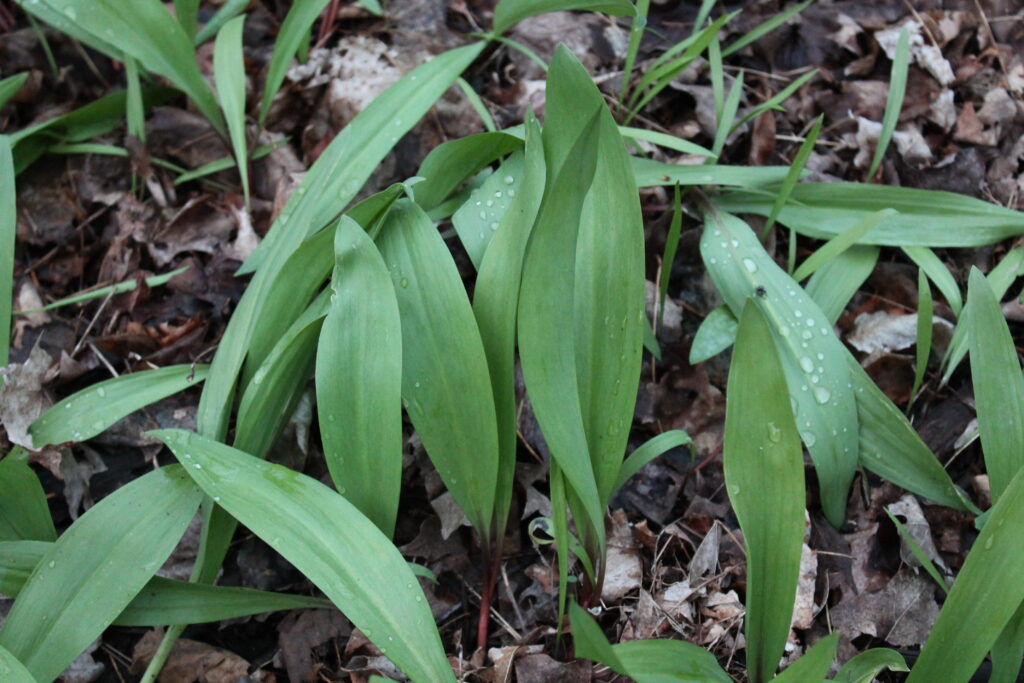
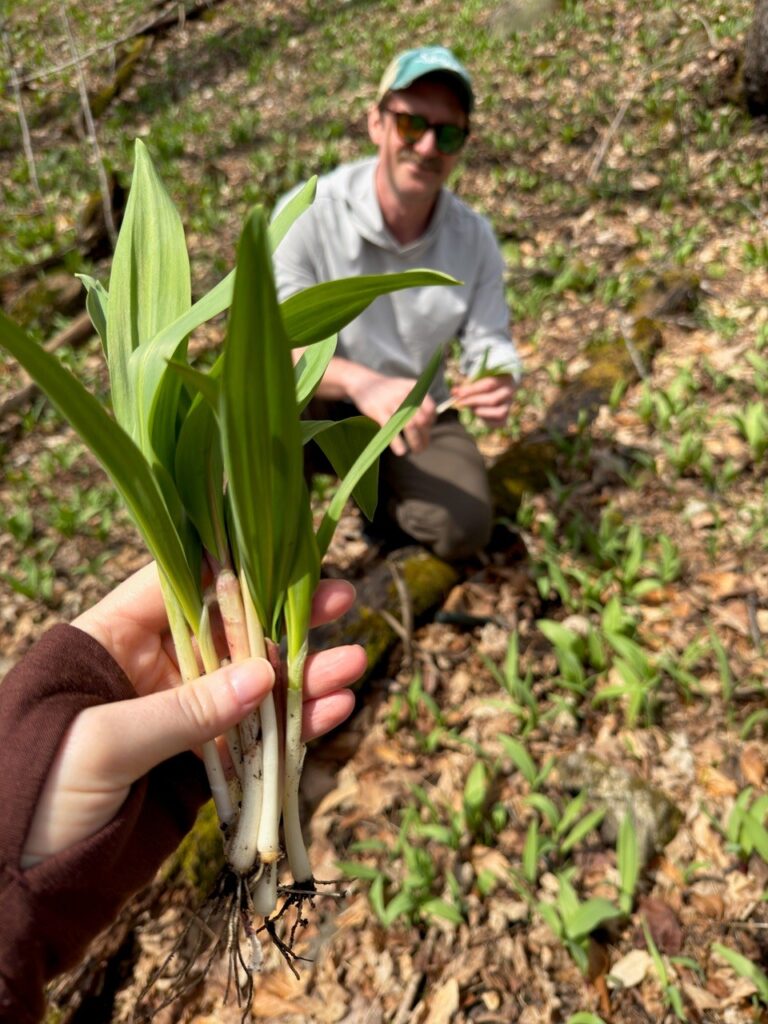
Ramps in their natural environment before harvesting.
Ramps: wildly grown and herbaceous spring onions, with a garlicky twist
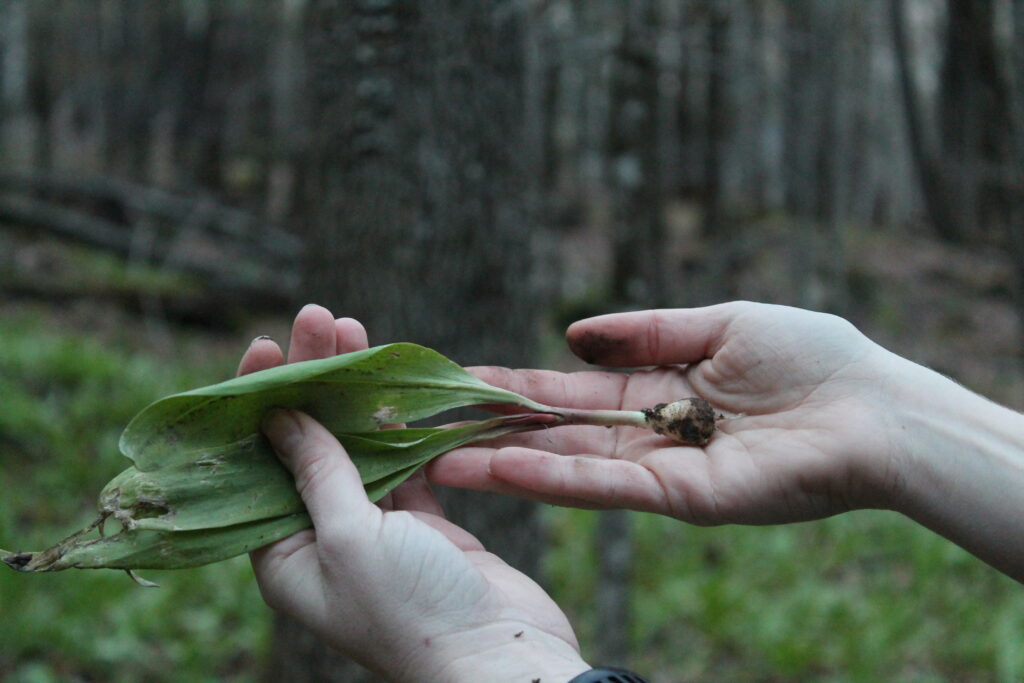
Perhaps Mother Nature planned it this way, but one of the earliest plants to pop from the forest floor is also among the most nutritious. Ramps, with broad edible leaves and a bulb like a small onion, are chock full of vitamins and minerals and are believed to be effective fighters against cancer and heart disease. Research at West Virginia University has confirmed their ability to lower blood pressure.
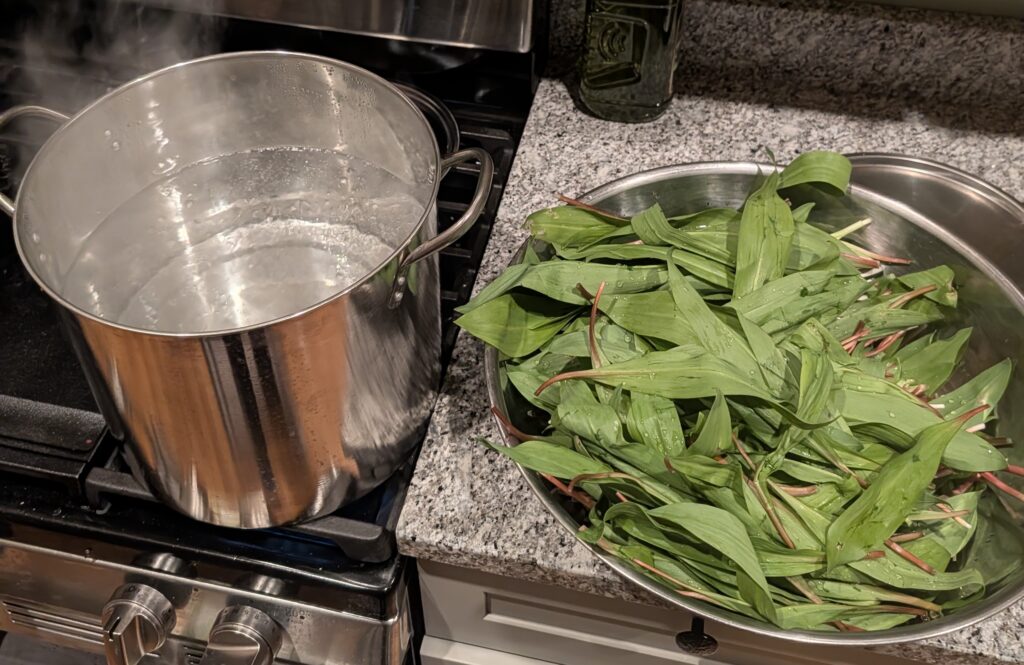
A whole ramp harvested to show the bulb, stem and leaf.Preparing to blanch harvested ramps. Photo provided by Alec Betancourt.
Chef Robert Dumas, director of the Institute of Adventure Hospitality and Food at Paul Smith’s College, incorporates ramps into a number of recipes — but the hunting can be just as appealing as the eating.
“I think there’s something really exciting about ephemeral spring greens,” Dumas said. “It’s the whole engagement of going outside and harvesting some food. It’s hard to describe the feeling that you get — it feels very right when you’re doing it, and I would assume that’s because humans fed themselves that way for millions of years.”
Ramps typically grow along rivers, or in low, damp areas, and resemble a broad-leafed spring onion. It’s important to harvest them decisively, either by clipping one of the three green leaves or digging a couple out of a cluster, which, as with dividing flower bulbs, can fuel future growth.
“I try to make it look like no one’s ever been where I picked,” he said. “And do yourself a favor and put clean ramps in your bag as best as you can. When you dig them out of the ground, take a second to kind of run your finger down the outside of it, stripping away any of the excess dirt; you’ll end up with a lot less gritty product once you’re back in the kitchen.”
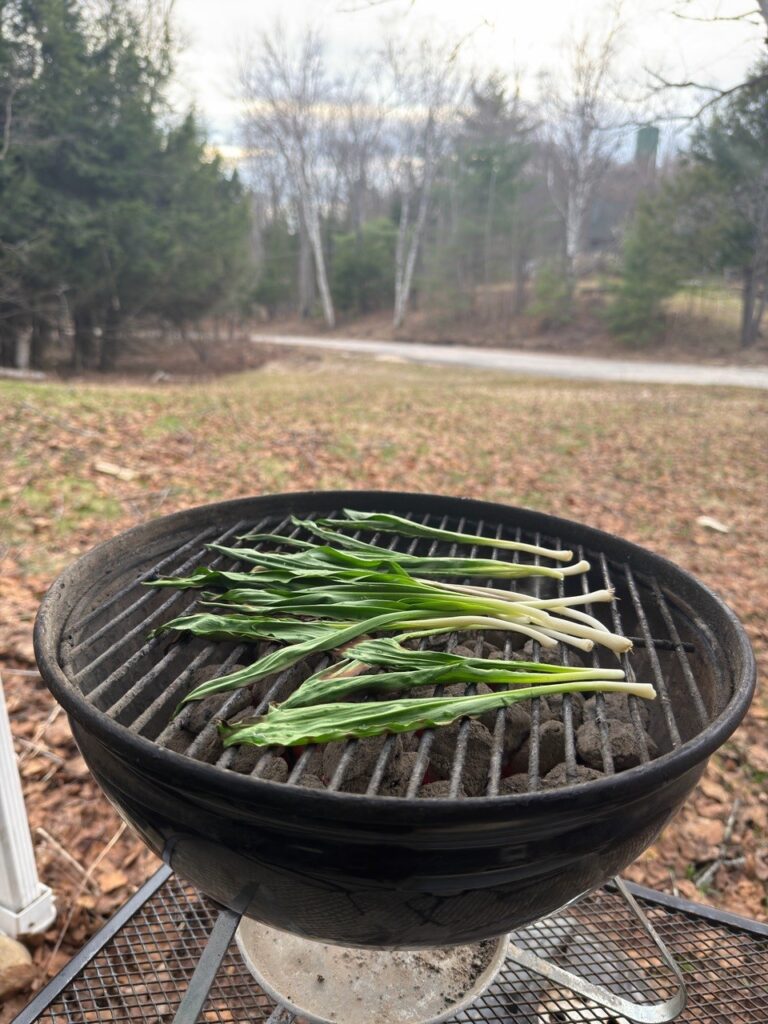
Like many foraged greens, washing and cooking is important, both from a food-safety standpoint and for palatability. Dumas will throw ramps on a barbecue grill or place them under a broiler for a little char and serve with “green goddess” dressing or a chimichurri.
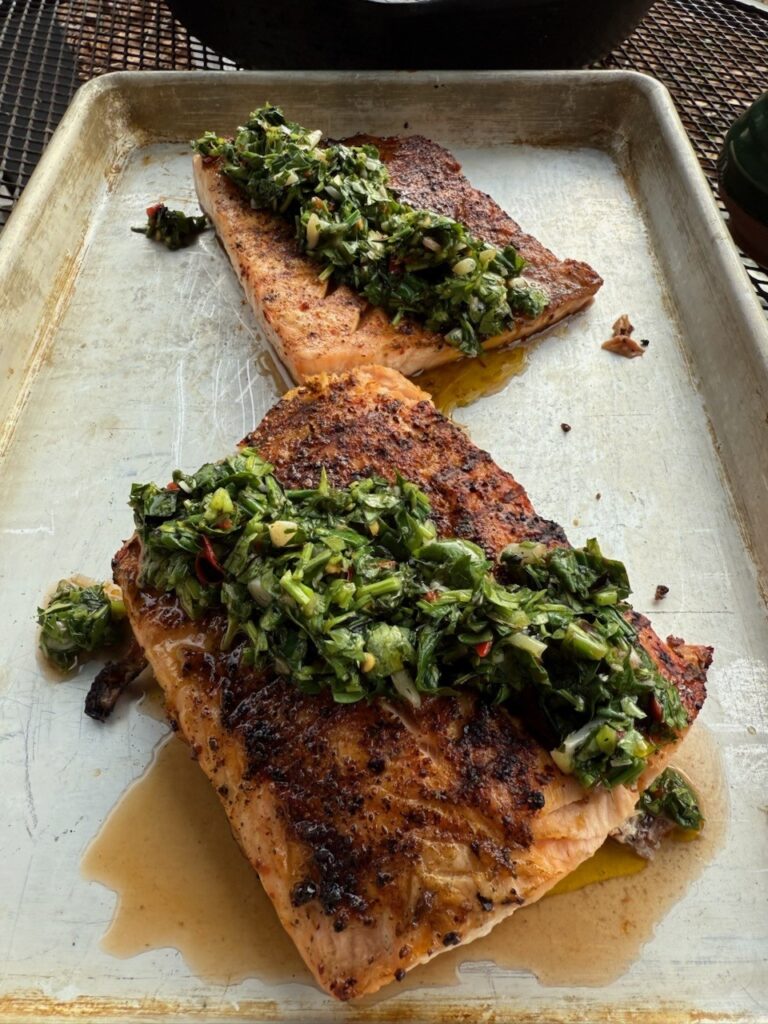
Robert Dumas exploring nature’s bounty of fresh ramp greens. Photo provided.Ramps being charred on a grill. Photo provided by Robert Dumas.Ramp chimichurri on salmon Photo provided by Robert Dumas.
Another method is to blanch the leaves — a quick boil in a pot of salted water followed by a plunge in an ice water bath — and using them in your favorite pesto recipe. Because of the intensity of ramps, Dumas cuts them with spinach leaves and prefers pistachios to pine nuts.
For chimichurri, “Once they come off the grill and cool down, give them a nice chop and then add in olive oil, a little bit of some sort of chili to add a little bit of heat, then add salt, pepper and red wine vinegar, and it’s a wonderful condiment to top things like grilled seafoods, grilled poultry, and it’s also really good on roasted potatoes.”
Fiddlehead ferns: the “asparagus” of the northeast forests
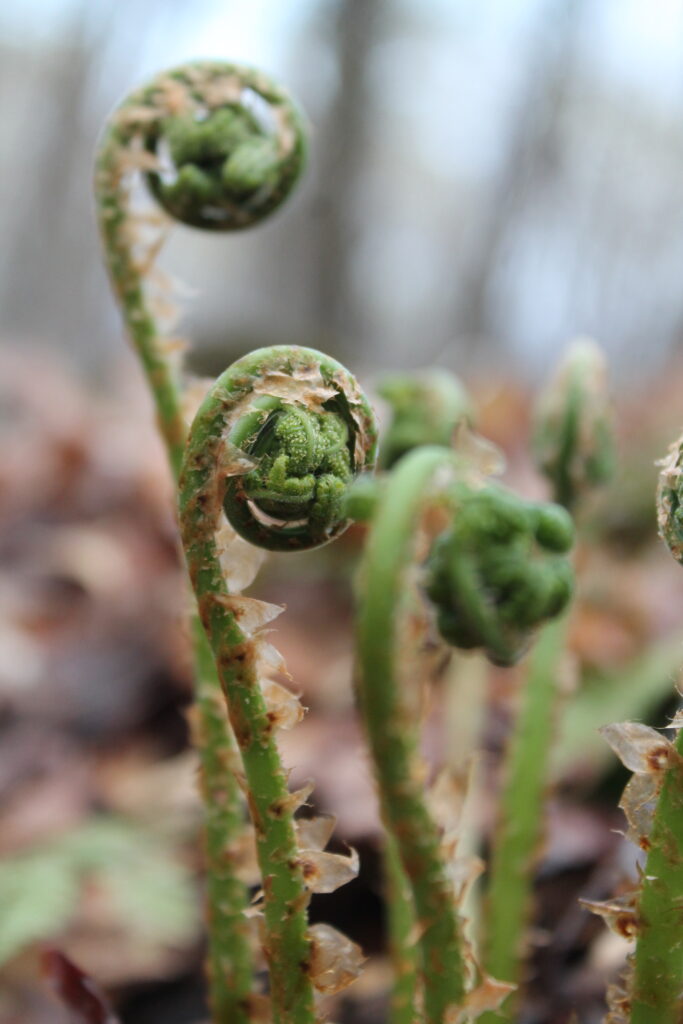
Fiddlehead ferns, which are the sprout of an ostrich fern, is another popular foraging target that also grows primarily on riverbanks. Dumas said it’s distinguished by a V-shaped stem and the brown papery layer covering the coil. Again, ethical harvesting is important — just cut a couple out of the bunch as they emerge from the ground.
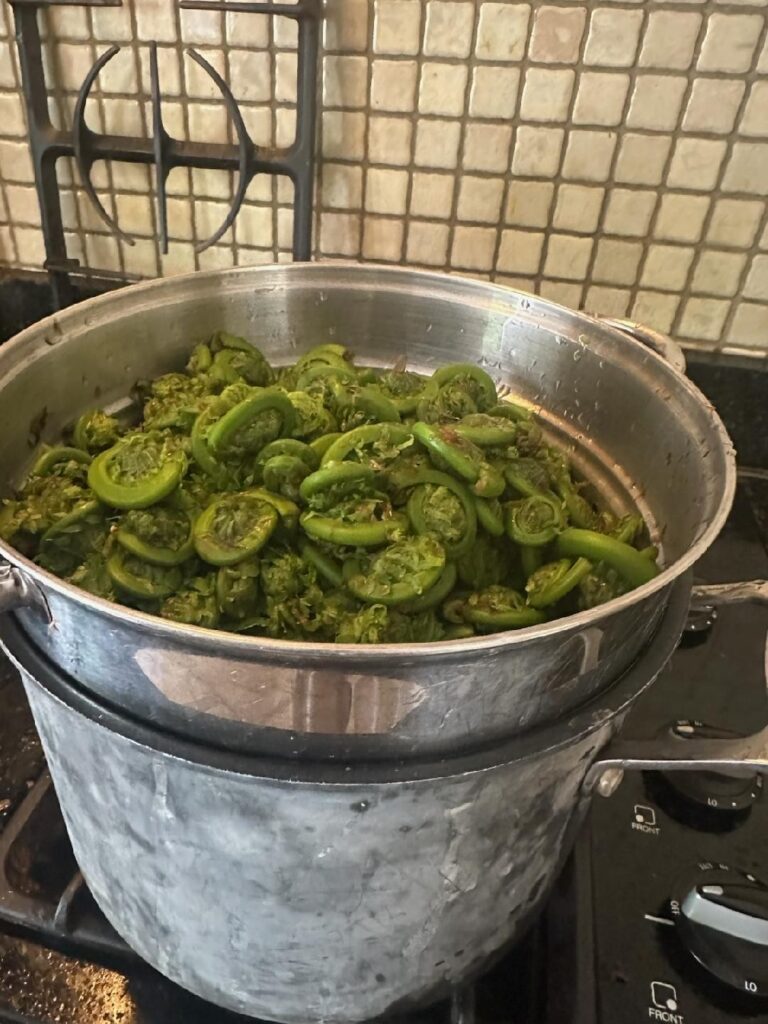
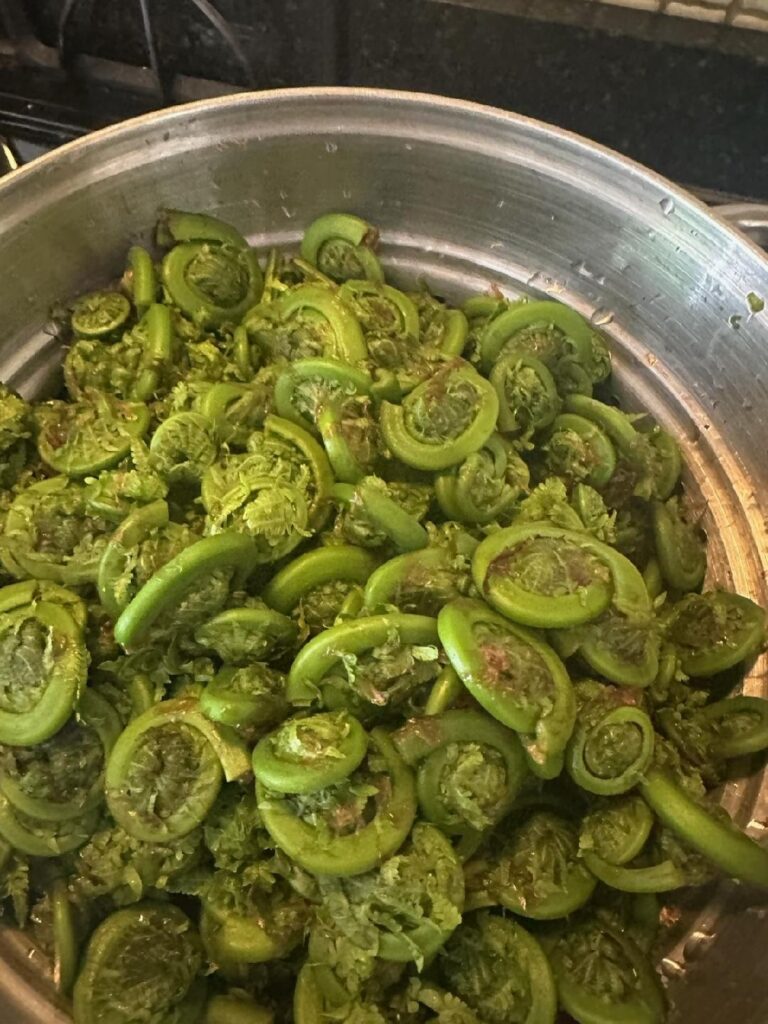
Wild fiddlehead ferns.Blanching fiddlehead ferns. Photo by Nicole Morgante-Wallis.Blanched fiddlehead ferns, ready for sautéing or freezing. Photo by Nicole Morgante-Wallis.
After blanching, the classic preparation is to sauté in butter and serve next to the trout that you’ve just pulled from the same stream. But they are also good pickled, or served in most any you would cook asparagus, which their flavor resembles.
Stinging nettles: a highly nutritious spinach alternative
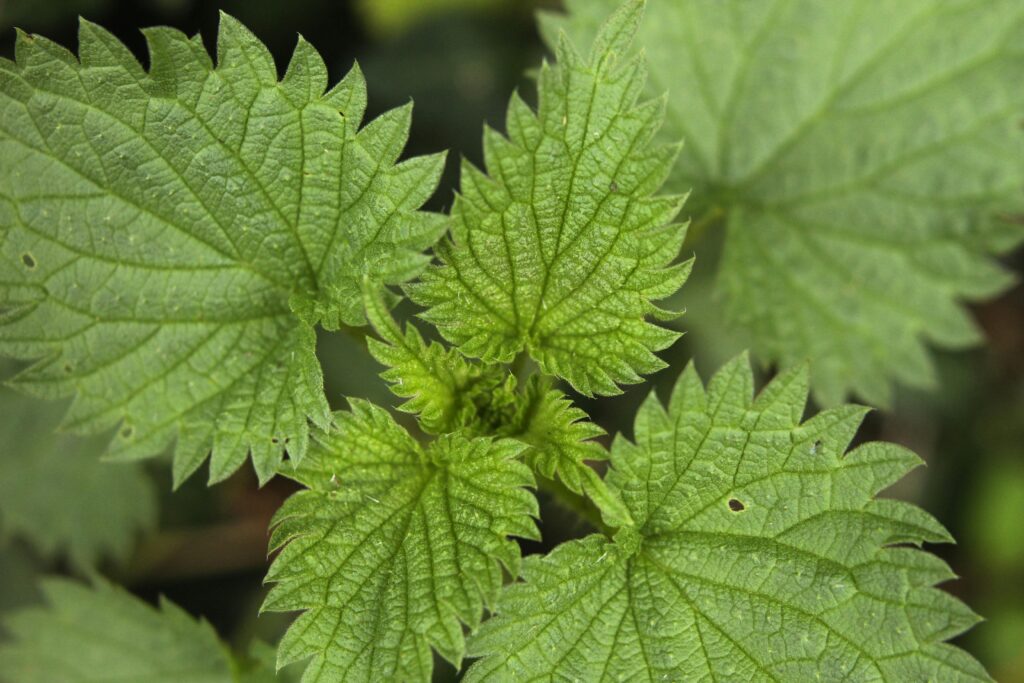
Dumas’ sneaky-good foraging target is stinging nettles, a plant most people go out of their way to avoid. “Stinging nettles are fantastic — they’re super nutritious and relatively easy to identify,” he said. “You’ve got to take a little bit of precaution in the harvesting of them, but as soon as you blanch them, the sting goes away, and you’re left with an ultra nutritious green that tastes a lot like spinach and is just as fantastic as a sauteed green, chopped up, mixed with ricotta and used as a pasta filling, in soups or omelets.”
Pick them when they’re about a foot high, plus overharvesting of this aggressive weed is not an issue. Dumas likes them so much he has even transplanted them to his own property to have a ready supply.
Propagation of nutritious and healing plants is an area of increasing public interest, but one that’s been around for a long time. Herbalist Jane Desotelle started in 1978 when her newly minted philosophy degree was proving unpopular with the hiring commercial sector.
Today, Underwood Herbs offers medicinal plants, dried and fresh herbs, oils, wreaths and sachets. She also leads workshops teaching people about the benefits of wild plants.
When she was a girl, Desotelle’s mom would send her into the backyard with a bowl to collect greens for the supper table, so she was open to the idea of wild plants when, during down time at a work-study job in the college library, she stumbled upon books of medieval recipes and potions.
In those pre-internet days, conferences, field guides and time spent walking old pastures translated into a business, selling to a co-op and New England gift shops that were beginning to discover the appeal of local products. That nascent interest has blossomed through the years, as Desotelle is finding plenty of takers for her tours.
“Food is getting more expensive, and people are worrying about what they get in the grocery stores,” she said.
Because of today’s emphasis on pills and chemicals, Desotelle said we’ve largely forgotten the catalog, hundreds of thousands of years old, of human healing experience using plants. Indeed, she said, more doctors are coming around to the “food is medicine” theory that suggests good or bad health is dictated by good or bad food. Our forebears may not have had the whiz-bang drugs of today, but neither did they have today’s range of diseases to treat. “I think a lot of the doctors are coming around to ‘Yeah, it’s all coming down to diet,’” she said.
Running an AirBnB farmstay alongside Ben Wever Farm in Willsboro, Pierre-Luc Gélineau said people without rural upbringings are showing an interest in wild foods — something that has the potential to be incorporated into agritourism. “We’ve had people look for mushrooms or other things, and it’s a big learning experience,” he said. “They don’t realize what’s accessible. And some of the edible or medicinal plants are typically what’s considered to be weeds. So you don’t really have to go to a remote place to find plants that are useful.”
Mushrooms: so many varieties to find in the Adirondacks
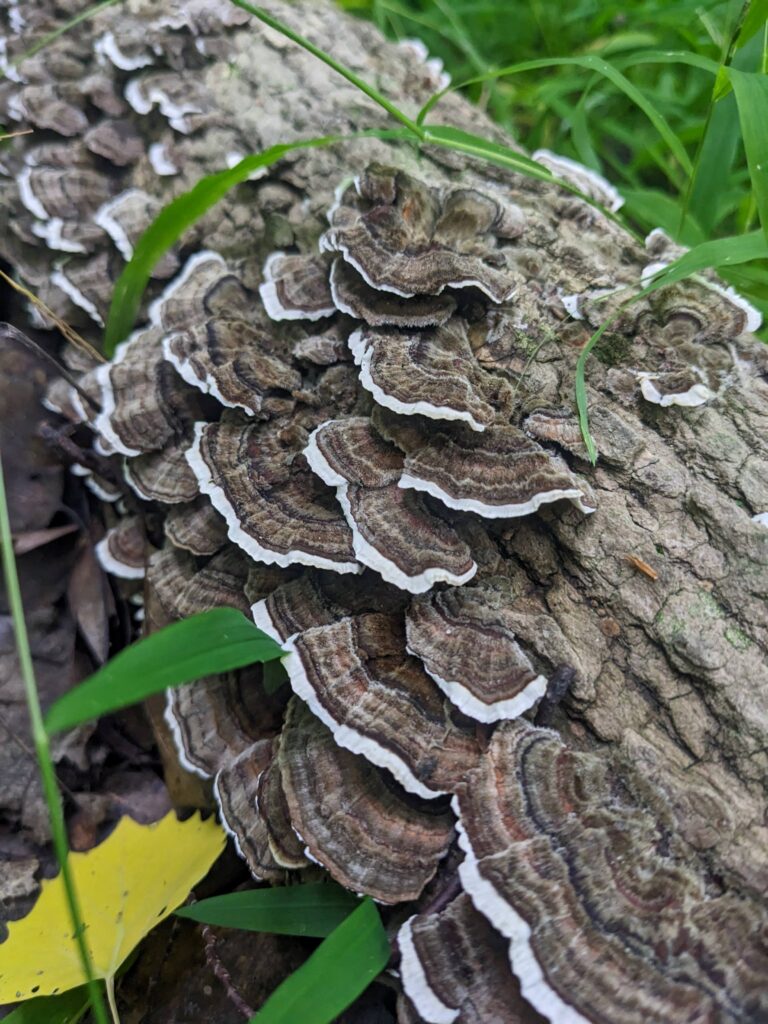
Turkey Tail mushrooms can be found between May and December, but are also be found year-round.
Mushrooms, a highly coveted spring delectable, are also a popular topic and people are amazed at how many there are, mainly because they’ve never taken the time to look. “A lot of people who stay here are from urban areas and don’t really have the opportunity to get out in nature that much, so to give them a chance to connect and understand how nature works, to me, means a lot,” Gélineau said. “If (farmers) could help complement their income streams with more demand from that, you are doing a good thing, but you’re also making a living out of it. It’s kind of a win, win.”
For Sawyer, learning — and that there is so much to learn — is part of the magic. George Washington learned it when his troops were starving in a harsh, northeastern winter. The Mohicans were surviving in that same environment, the general discovered, on rock tripe lichen and tree cambium, which could be harvested without expending a lot of energy, and provided basic carbohydrates and starches.
“Those two things were very prevalent, and they must have saved many, many lives,” Sawyer said.
Knowledge such as this has modern applications. Lyme disease, with which modern science has struggled to address, may be treated with Japanese knotweed, which in environmental circles, is a hated invasive. “There is definite link between the chemical makeup of the Japanese knotweed and its efficacy in being able to stop some of the inflammation flare ups associated with Lyme,” said Sawyer, who treats the springtime knotweed spears like asparagus when young and like rhubarb when the shoots get taller.
“I’m fascinated by what nature has to offer, and I am fascinated by the fact that you can find food that doesn’t have chemicals and steroids in it, because I just see processed food in any which shape or form as kind of the gateway to so many of the diseases that we suffer from these days,” Sawyer said. “For me, it’s just fascinating what you can do with nature.”