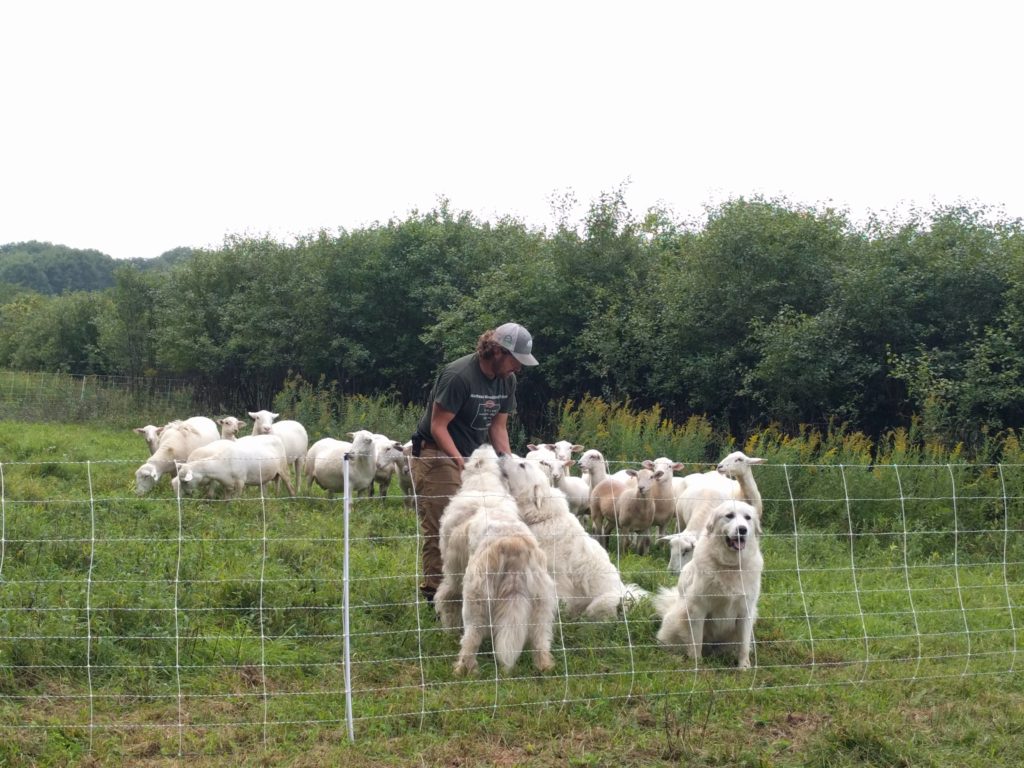
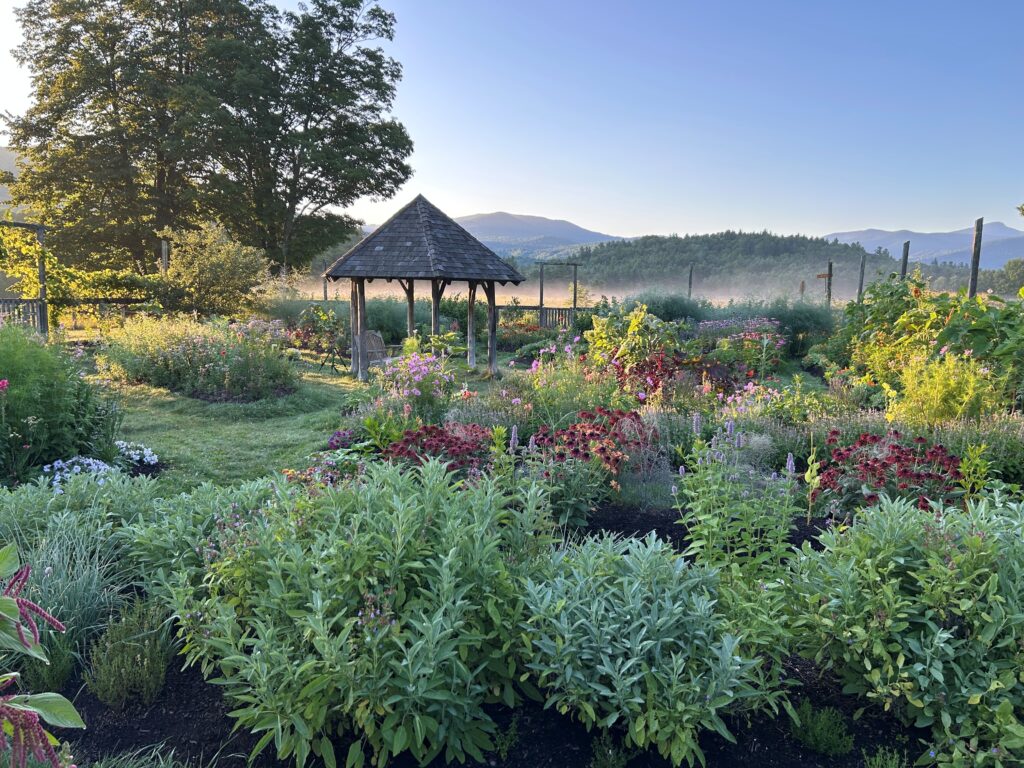
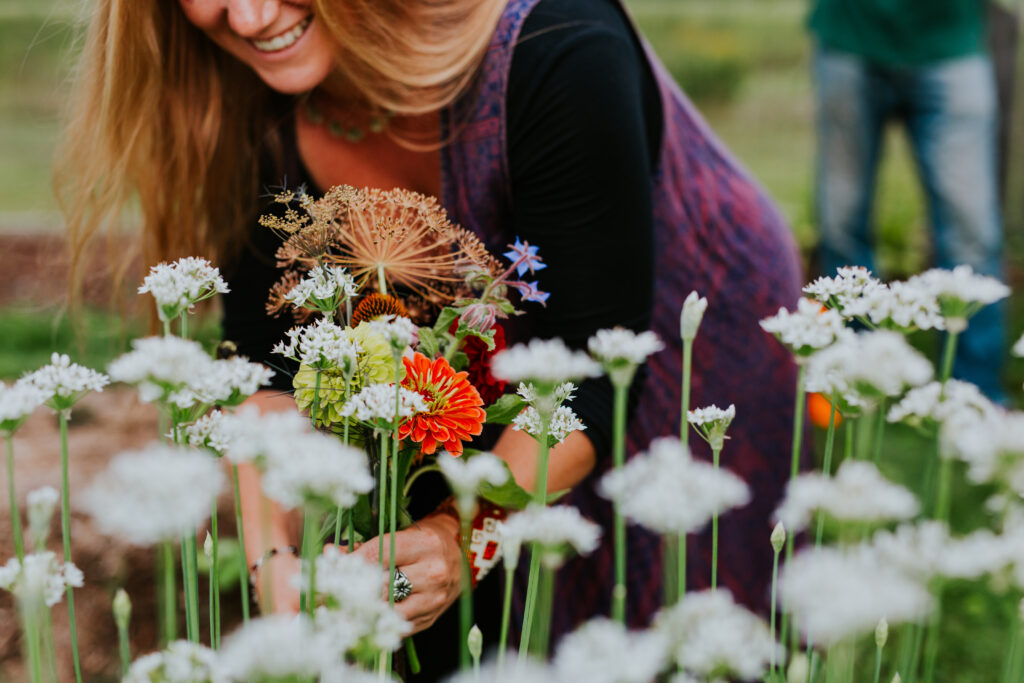
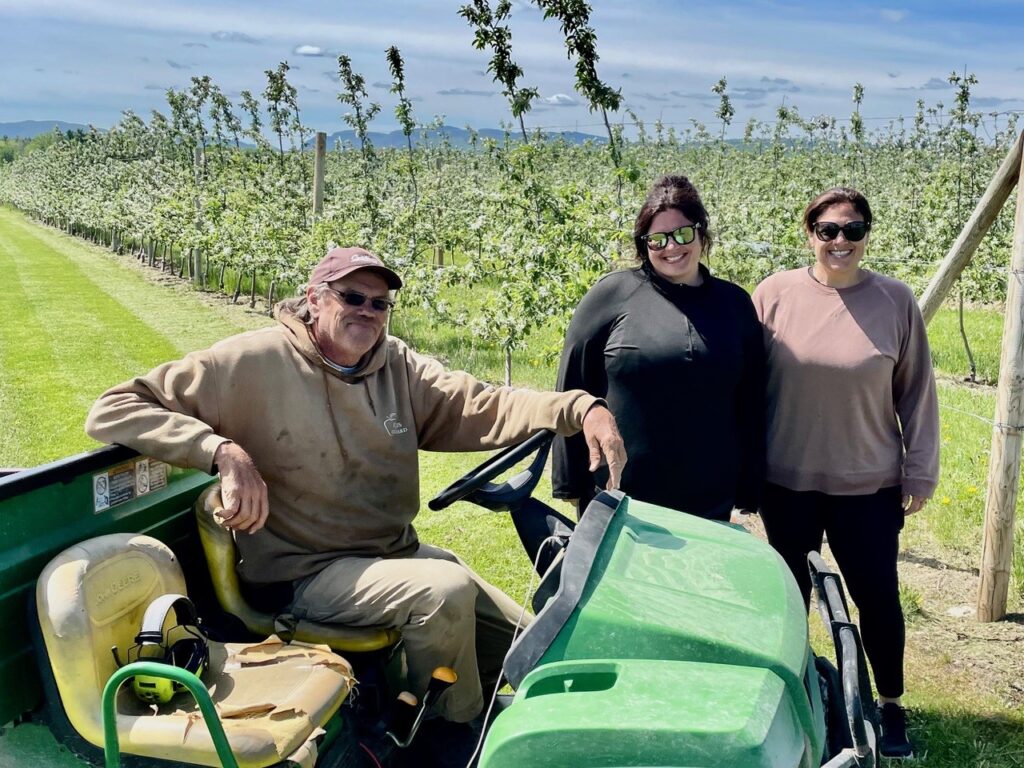
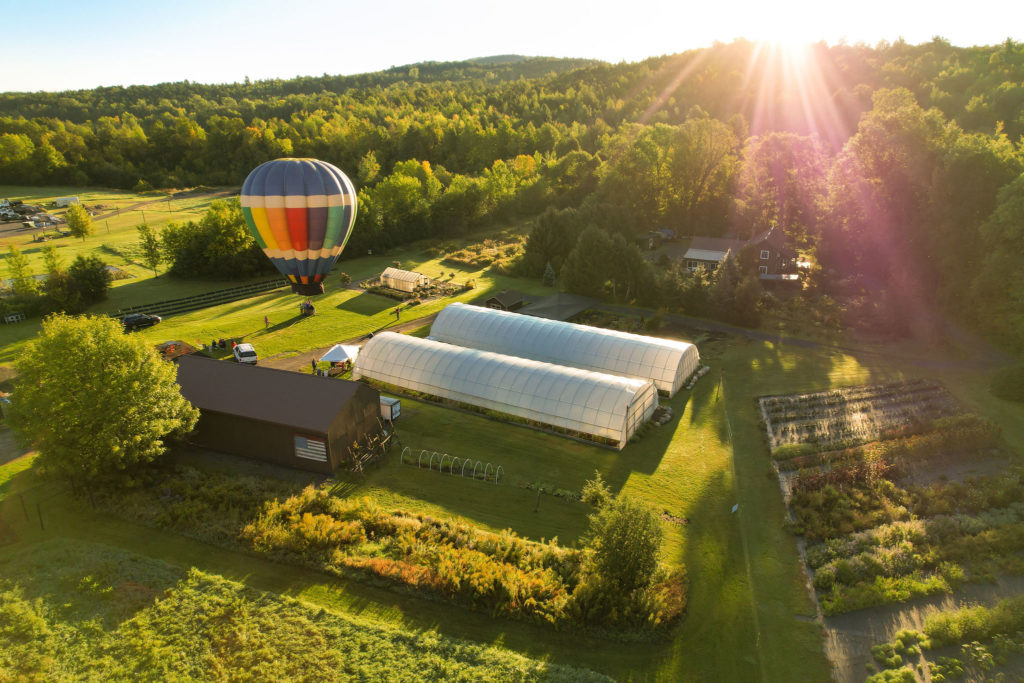
Join us for an inaugural fall tour of Washington County farms. Visit local farms at your own pace over two beautiful fall days.
WHAT TO EXPECT:
🌾 Live demonstrations at each farm
🎁 Giveaways & activities for all ages
🐄 Meet farm animals
📸 Photo opportunities
🏆 Complete the tour for a chance to win!
HOW IT WORKS:
Self-guided tour – start at any farm, visit as many as you’d like! Complete the passport at each stop and enter to win a farm product basket.
Participating Farms:
Burchdale Farm – 3155 County Route 43, Fort Ann, NY 12827
du Trieux Farm – 65 Gibbs Road, Granville, NY 12832
Grazin’ Acres – 49 Wolfe Lane, Salem, NY 12865
Holley Hill Farms – 3188 County Route 43, Fort Ann NY 12827
Lindgrove Farm – 266 Washburn Hill Road, Granville, NY 12832
Sugar Hill Ranch – 14 Russell Lane, Argyle, NY 12809
The cows of Vermont, the grapes of Sonoma and the shoofly pie of the Pennsylvania Dutch have all been parlayed into popular agritourism destinations that add value and viability to regional farms.
By contrast, vacationers flock to the Adirondacks for other reasons, such as paddling, hiking and skiing the great wilds of a six million acre park where conventional wisdom holds that too many rocks and too few days above freezing drove away most settlers who dared take a stab at farming.
The truth was otherwise, and today the eastern side of the park in particular is a robust farming region that in some ways has yet to be discovered for what it is — an attraction in and of itself.
“There’s a huge story to be told here,” said Curtiss Hemm, Chef at the AAA Four Diamond restaurant The View at Mirror Lake Inn in Lake Placid.
Local foods are not always the specific reason people come to the Adirondacks, but Hemm said a strong farm component adds value to the travelers’ overall experience. Among others, he buys beef from Asgaard Farm, lettuce from The Meadow Farmstead, cheese from Sugarhouse Creamery and sausages from Harmony Hill. He backdrops these ingredients with digital displays that let diners know that foods have been locally sourced.
“I’m very big on imagery, and we highlight our farm country,” he said. “People care about where the food comes from.” Those images have been used to great effect in other regions and nations where the farming aesthetic is enough to draw travelers and elevate the quality of local life. Britain and Switzerland actually pay farmers for maintaining an agricultural landscape, the view in their estimation having as much value as the crops.
That would certainly seem to be the case in the Adirondacks as well, where great tracts of farmland at Uihlein, Norman Ridge and Lewis Family Farm attract bicyclists, photographers and plein air artists.
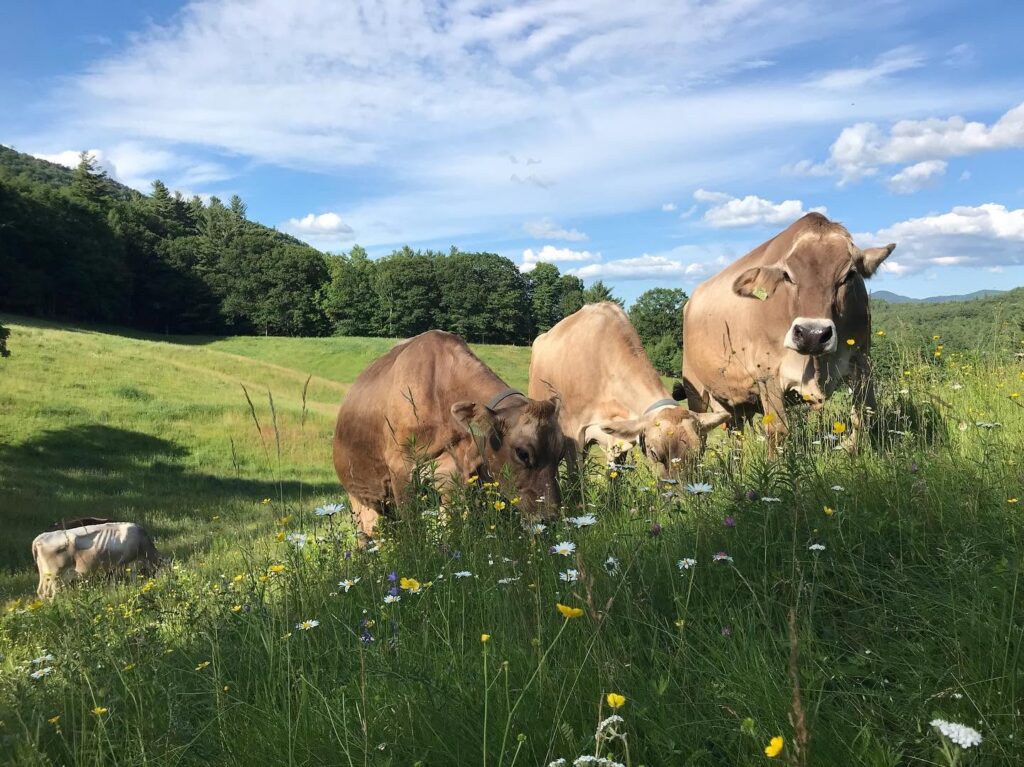
Sugar House Creamery, located in Upper Jay, is a farm of indescribable beauty, set off by the craggy Ebenezer Mountain where riverside pastures are populated with doe-eyed Brown Swiss dairy cattle.
Brown Swiss Cows at Sugar House Creamery. Photo provided by Sugar House Creamery.
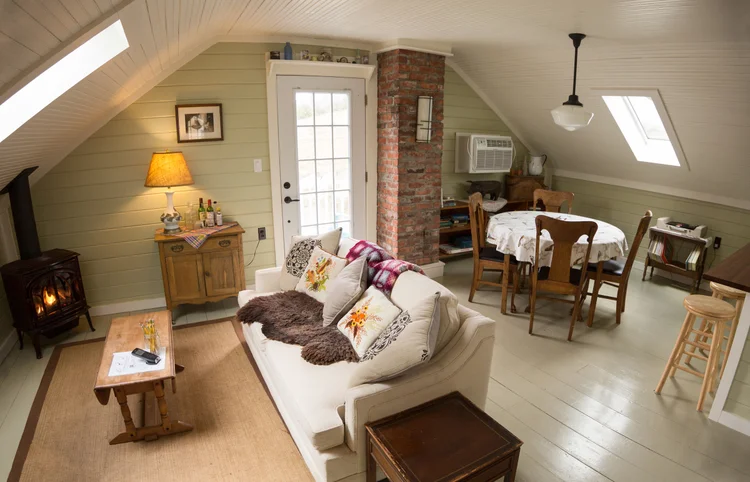
Home to a popular farm store open weekends and Wednesdays, Sugar House also features Airbnb accommodations. Although owner Alex Eaton said most people who stay there don’t come for the farm, they come to hike. That’s not particularly bad, since Eaton is more farmer than innkeeper.
Eaton runs his Airbnbs somewhat passively, hiring out cleaning services and not spending much time on social media hype. “I kind of have this sense that we’re not playing the Airbnb game as well as the moment demands, in terms of advertising and incentivizing and doing stuff like that,” he said. “If people want to come here and stay here, that’s awesome, but we’re not going to make Instagram accounts and do that whole thing, and maybe that will be our undoing.”
The Carriage Barn Airbnb at Sugar House Creamery. Photo provided by Sugar House Creamery.
At the same time, the added revenue is supportive of the farming operation, and Eaton believes farm stays can serve a higher purpose by sharing the experience of the land and the production of food.
“Dairy farms are dying, and people don’t have access to dairy farms or dairy cows, so people come here and they learn about dairy farming and hopefully walk away valuing dairy farming in a different way,” he said. “But we also honestly feel we shouldn’t be the only ones with access to this place, so we want to share it with other families.”
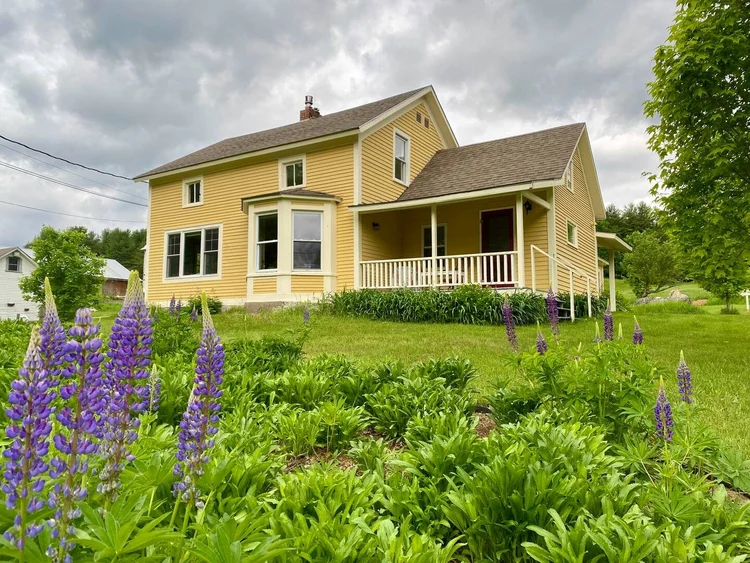
The Farmhouse AirBnb at Sugar House Creamery. Photo provided by Sugar House Creamery.
By contrast, Dave and Cynthia Johnston, owners of DaCy Meadows Farm in Westport, have leaned into the accommodations side, with housing for vacationers, nonprofit interns and people transitioning to the area and waiting for a permanent home. Cynthia recounts that they’ve counted 20 people living in Westport who once stayed at the farm.
The Johnstons see farm stays as a symbiotic relationship among farmers, vacationers and the community. This is represented by flex housing that can target the accommodations that are needed most at any particular time.
This summer, DaCy Meadow is hosting three interns for Champlain Area Trails, and it’s not much of a reach to say that without housing there would be no summer intern program. These young people learn about the farm, engage with the community and maybe one day they’ll be back, injecting much-needed young blood into an aging Adirondack demographic.
Balancing agriculture with hospitality can be tricky for the farms, but farmstays can play a key role in financial viability in a vocation with historically tight margins.
“You can sell a product directly into the marketplace, and you can turn some of it into a value-added product,” Dave said. “Then if you can also combine that with lodging, you might have a viable business now.”
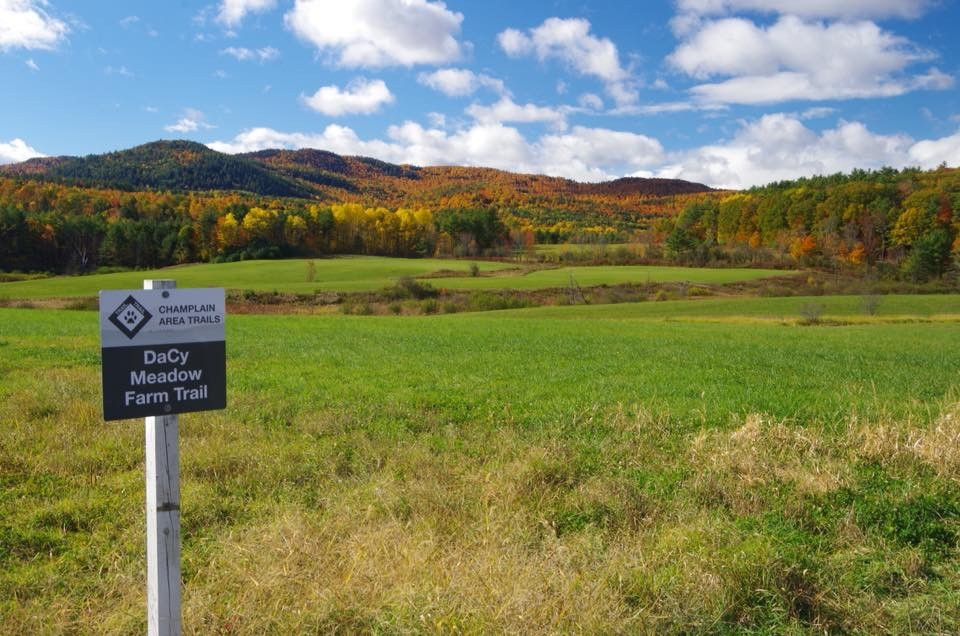
DaCy Meadows maintains enough of a working farm to be authentic, while encouraging guests — many of whom have never been on a farm before — to get some hands-on experience. They can do some trail maintenance while their kids feed the chickens and gather eggs.
CATS Trails are a year-round attraction at DaCy Meadow Farm. Photo provided by DaCy Meadow Farm.
It’s important in the listings to accurately describe the farm environment, flies and all, and be prepared to interact with guests. “People are coming for an experience, not a cot — so they need some attention,” Dave said.
For farmers considering a hospitality component, those with experience have a couple of recommendations. One, don’t oversell the experience with nothing but beautiful farm scenes. Be up-front about the manure and the flies and the noise of the machinery and suggest if that’s an issue, families might want to look elsewhere.
Second, check with liability insurers and regulatory agencies beforehand, because there are a number of potential quirks. For example, Johnston said that scratching the ears of a cow in a barn and scratching the ears of a cow in a designated petting area are two different things involving different agencies and different rules.
“The clipboard people show up a lot,” he said. But for guests who understand what they involve, farm stays mean they get to celebrate all aspects of the rural scene, whether field or forest.
Birding hike with Champlain Area Trails and farm tour at Barred Owl Brook Farm. Photo by Adirondack Harvest.
“People come to the Adirondacks to appreciate and to experience outdoor opportunities, whether they’re recreation based or not, and we see that visitors are looking for other authentic experiences. Agritourism is a great way to create a strong or durable connection to the landscape,” said Adam DeSantis, economic development director for the Regional Office of Sustainable tourism. “So in many instances, agritourism is an opportunity to create something else for the visitors to do while they’re already in our region.”
ROOST, working closely with Cornell Cooperative Extension, is active in encouraging these interactions and helping tourists understand the full range of outdoor activities.
After a hike, vacationers can visit a farm store. They can interspace a ski with a visit to a sugar shack, or take their kids on a paddle and then to a pumpkin patch. Breweries and vineyards in particular can really bridge the gap between agriculture and recreation.
“Anything that we can do to help create that durable connection to the Adirondacks, and encourage repeat visitation is a great opportunity,” DeSantis said. “I think it’s, you know, a wide variety of outdoor recreation opportunities, and agricultural offerings help reinforce that.”
Enjoy a full day celebrating agriculture, community, and the start of the fall season at Prairie’s Orchard! Meet alpacas, goats, sheep, baby calves, ponies, and other farm animals, browse local artisan vendors, participate in hands-on youth activities, enjoy delicious food from Adirondack BBQ, and listen to live music by Shawn Legacy.
Join us for a tour of the farm and some light refreshments! This event is free and open to anyone. Dan and Kimmy have some exciting plans for the future including an interesting farm cooperative project and a no spray vineyard that will be grazed and fertilized by the sheep. After the tour, we will talk a little about the role of agritourism at TGJF and share some snacks together.
Triple Green Jade Farm is a small organic, diversified farm on 80 acres bordering the Boquet River in Willsboro. Dan and Kimmy Rivera are millers, bakers, and farmers, turning local, organic wheat into fresh flour with a Vermont granite stone mill. They bake sourdough breads in a bespoke wood-fired oven and also produce fresh, bronze-die extruded whole wheat pastas. Their farm is centered around healthy soils and pastures.
Don’t let those bright spring flowers waving in the breeze fool you. Behind the lovely, carefree blooms is a serious ecological and economic engine that powers everything from tourists to tomatoes and deserves more credit than they probably get.
Meghan Kirkpatrick, manager of the Bark Eater Inn located in Keene sees it every day. She lives at the crossroads of hospitality, aesthetics and agriculture, and flowers are an essential part of all three.
“The guests that we have are traveling from more metropolitan areas that don’t have a lot of access to garden spaces, and they are just really struck by the beauty of the flowers,” she said.
Flowers attract native pollinators, and humans, too
Bark Eater Inn’s colorful gardens produce flowers for weddings and food for guests, some of whom are from urban environments in which they have not been taught, for example, that the funny spike popping up from the ground is what will show up later on their plates as asparagus.
“It’s kind of a gateway for many of our guests to learn more about local food, and what is available here, and kind of making that connection,” she said.
Pretty as they might be, flowers don’t just sit around and preen. They have an outsized role in the food system, developing relationships with pollinating insects and other plants.
Photo by Meghan Kirkpatrick.Photo by Jamie McGiver West.
Kirkpatrick intentionally selects flowers that attract pollinators, but also uses them in companion planting based on their ability to discourage pests. She chooses sunflowers that produce pollen (hybrids intended for use as cut flowers have been engineered for reduced amounts of the yellow dust so that they won’t wind up pollinating table tops) and leans toward red flowers that are better at attracting pollinators. These insects, like us, do better with a varied diet, so she chooses a wide array of flowers to act as a pollinator buffet.
This pollinator friendly policy extends to Bark Eater Inn’s meadows as well, which are mowed strategically and infrequently, accommodating both flowers and birds.
Minding the pollinators is an attitude that is now reflexive in the North Country, as their value to the ecosystem has been widely recognized for more than a decade.
Sawyer Bailey, executive director of AdkAction, said the nonprofit’s foray into pollinators began with heightened awareness over the monarch butterfly, which the U.S. Fish and Wildlife Service estimates has lost 80% of its population since the 1980s due to a loss of habitat, insecticides and climate change.
“We started by distributing milkweed seed packets exclusively with only a focus on monarchs, and then very quickly learned how integral all the pollinators that are native to this area are,” Bailey said. “And while milkweed is a keystone species for them, the interest then expanded to helping pollinators of all kinds, thinking about the types of specific habitat they would need, and the actions that we could promote to help them thrive.”
Rich Howard, Amanda Whisher and Shannon Wilkins of Rulfs Orchards. Photo by Tim Rowland.
Adirondack farms boost agritourism with help from local beekeepers
Larger farm operations, such as Rulfs Orchard in Peru, think in similar terms. Bees are the lifeblood of fruit trees, so considerable care is taken for their husbandry. The orchard contracts with local beekeepers who will move hives around in keeping with what trees are flowering.
As with Bark Eater Inn, Rulfs Orchard finds that beautiful flowers are good for business. When apples are in bloom, the North Country’s Champlain Valley is awash in a sheen of white frosting that attracts tourists and professional photographers alike.
“Everyone wants to take pictures,” said Rulfs Orchard Business Manager Shannon Wilkins. “And it’s such a short window when the trees are in bloom that photographers will be emailing, asking ‘how are the blossoms?’”
Rulfs Orchard, founded by Wilkins’ grandfather in 1952, began as a dairy. Then her grandfather began planting a few trees and basically never stopped. Today, the orchard has 35 acres of primarily apples, while also working to introduce trees to produce peaches, cherries and pears.
Although commercial apiaries do most of the heavy lifting, Farm Manager Richard Howard said the farm still depends on native pollinators as well. Due to the shape of the flower, blueberries rely on bumblebees, Howard said, and in the pumpkin patches native “ground bees” do much of the work.
“[Ground bees] actually look like a honeybee, but they’re not. When we cultivate the pumpkins we try not to disturb the ends of the field because they don’t really have hives, they live in all these little holes in the ground.”
More environmentally advanced pesticides, which Howard said “used to be pretty harsh,” have also been embraced by the orchard.
“It’s amazing, because sometimes you go down there and look at the pumpkin blossoms, and there will be 10 or 15 bees on a blossom,” he said. “So we’re very careful with our pesticides. We don’t want to hurt them, obviously, so we try to use stuff that’s bee-friendly.”
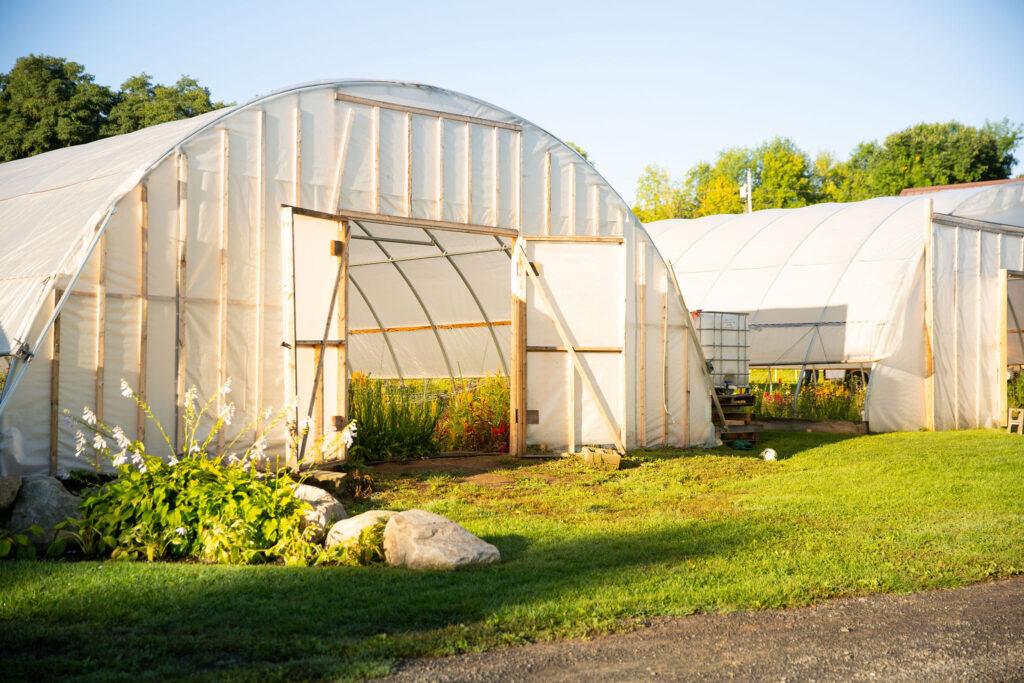
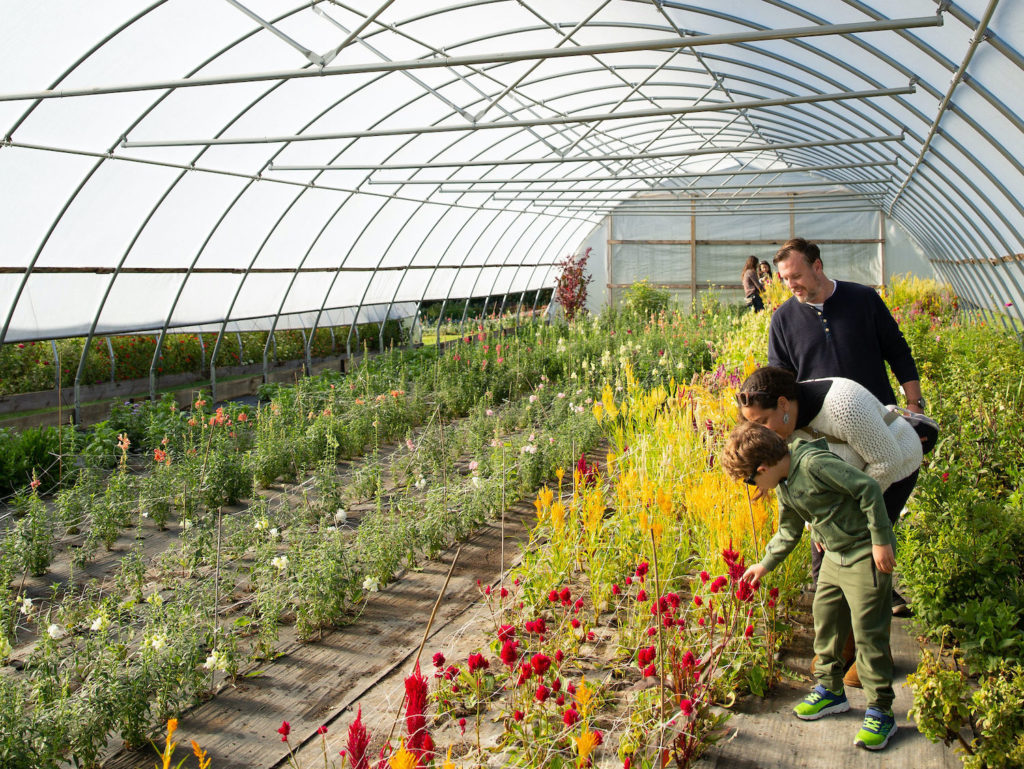
Mossbrook Roots Flower Farm’s high tunnel, an outside perspective. Photo by Katie Kearney.Inside the Mossbrook Roots Flower Farm high tunnel. Photo by Katie Kearney. Photo by Katie Kearney.
Flower growing is a budding industry for Adirondack farms
Mossbrook Roots Flower Farm and Florist evolved from something else — the landscaping company owned by Jackie and Jim Wheelin wasn’t using all the land at its Keeseville location, so something had to fill the void.
“We were like, ‘well, we have all these great farm fields, what are we going to do with them?’” Jackie Wheelin said. “And I said, ‘well, let’s grow flowers,’ so that’s kind of how that all started. It was really that simple.”
Flowers proved to be good business for them. Wheelin’s operation has expanded its reach, from fresh-cut flowers at its farm store, to CSAs, farmers’ markets, weddings, and a floral shop in Plattsburgh.
Flower farms may have a different products than vegetable farms do, but Wheelin said she deals with a lot of the same issues. Such as constantly worrying about the weather and dealing with pests. Similarly to traditional farms, crops must be rotated, fertilizers managed and soils tested. Mossbrook Roots doesn’t sell to distributors, so their customers are the end-user, whether it’s a bride or someone wanting to fill a vase on a dining room table.
Morning at a Mossbrook Roots Flower Farm event. Photo by Katie Kearney.
Flowers are also a year-round business. “We grow tulips hydroponically all winter, and we grow specialty tulips, so that is always a big hit for us,” Wheelin said. “We’re just kind of coming off the tail end of those, and then now we’re going to be switching into ranunculus. We grow those in our high tunnels because they’re pretty delicate.”
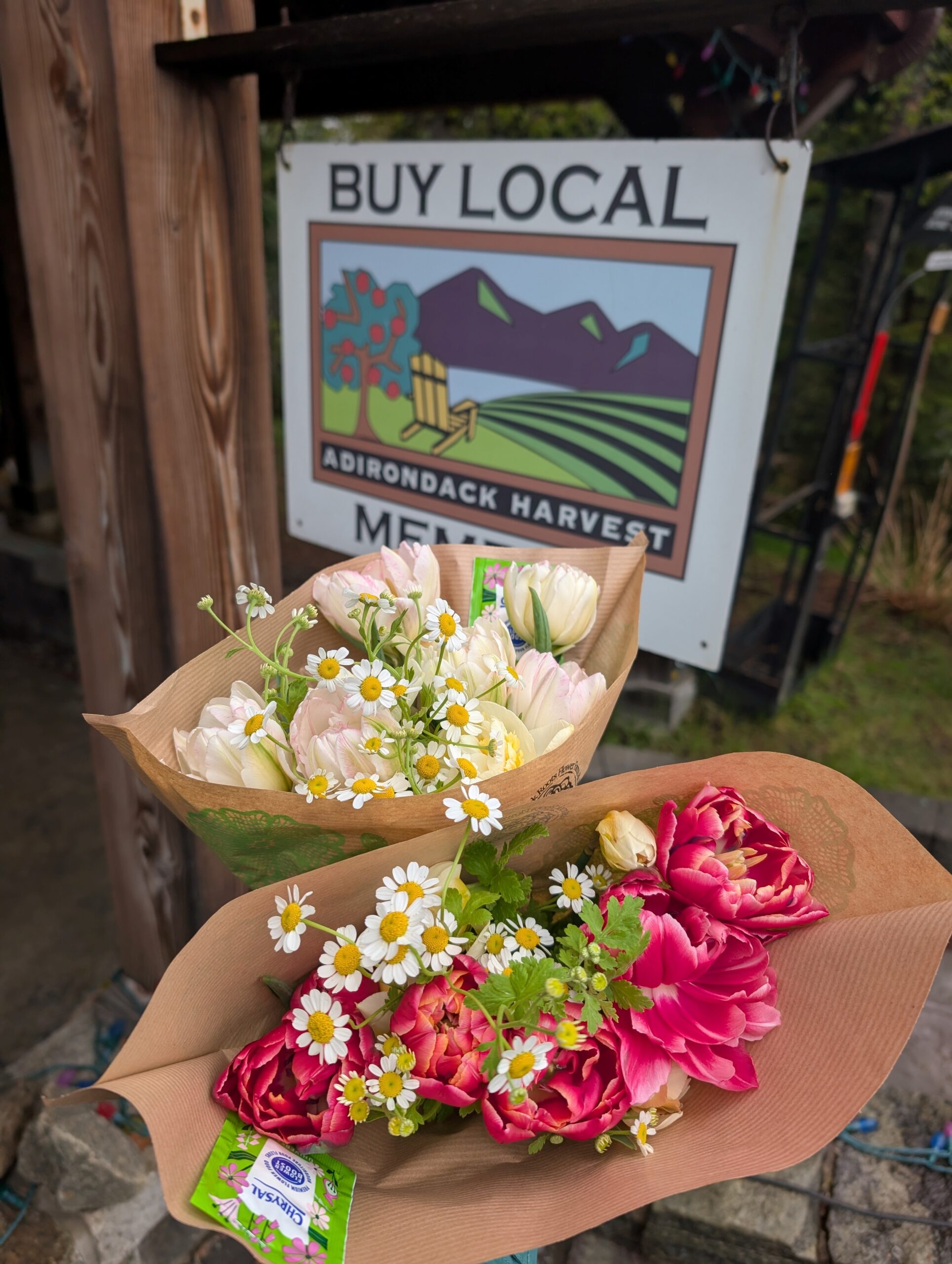
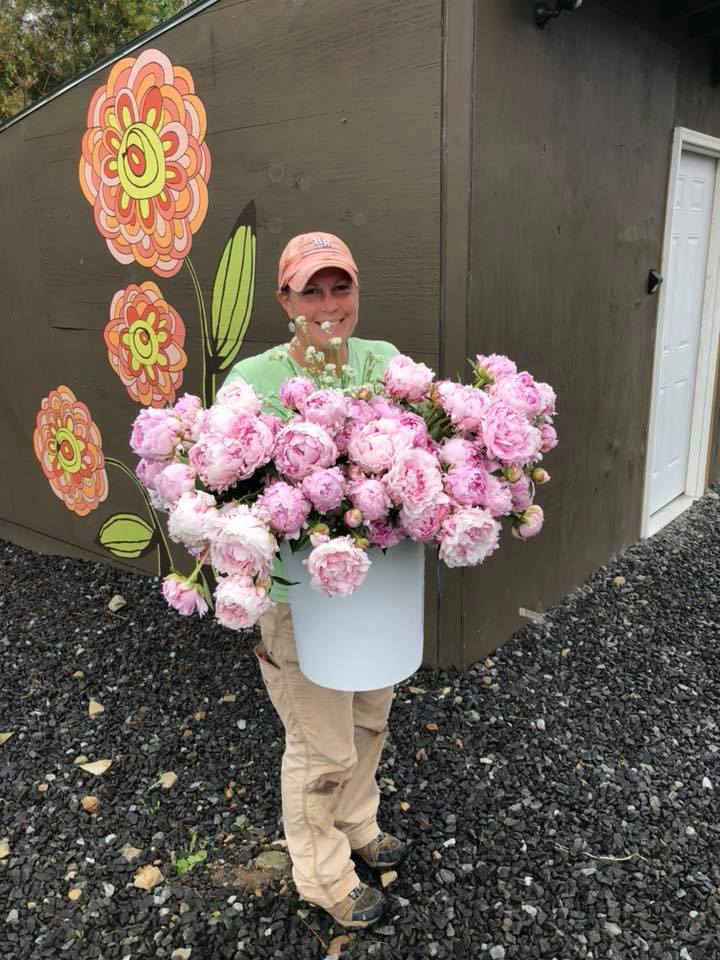
Fresh flower bouquets are dropped off by Mossbrook Roots at Green Goddess Market & Cafe in Lake Placid. Photo by Isabella Susino.Peonies are offered seasonally at Mossbrook Roots Flower Farm.
Then it will be on to peonies, lisianthus and dahlias as the season progresses. Successional plantings extend the season, and by December it will be time to plant seedlings, which means bachelor buttons and matricaria will be flowering up to six weeks earlier than with conventional planting.
In the north, local flowers are limited by the growing season, but they have distinct advantages as well. They last longer, have a more robust fragrance and do not have the environmental costs associated with being shipped in from another continent.
“They are as fresh as they possibly can be,” Wheelin said. “There are no preservatives, the smell is as true as it can get, and the colors are as true as they can get. It’s just raw natural beauty that will hopefully bring whoever you’re getting them for — or if you’re getting them for yourself — as much happiness as they can for the time that you have them.”
Of course, people aren’t the only ones invested in the blooms. A beekeeper maintains hives on the farm, and the honey has a bit of a floral taste, Wheelin said. The farm is managed for the bees’ wellbeing, too, “We leave a lot of things up for the pollinators,” she said. “We don’t cut things down right away. We have a lot of things planted specifically for them, keeping all the pollinators in mind.”
At Bark Eater Inn, introducing guests to beautiful flowers, and local food, means returning clientele and word of mouth advertising. Visitors get the benefit of a peaceful place to relax at their lodging. It’s a relationship that pays mutual dividends, Kirkpatrick said.
“I have guests that come back again and again during flower season just to simply sit out there and watch the hummingbirds and the butterflies flit from flower to flower,” she said. “And there’s a certain amount of awe and appreciation that we can experience when we slow down and sit in a place that has beauty and flowers and pollinators and food — and my garden is certainly an intersection of all of those things.”
Two hundred years ago, Merino sheep wandered the North Country like they owned it, and hundreds of small family cabin “factories” turned out warm, woolen mittens that sold for 50 cents a pair. They were worth every penny.
Sheep may not dominate the landscape like they used to, but there are echoes of the past still present. From the ancient farm stone walls that appear like ghosts in the regenerated forests, to a modern network of knitting groups where yarn skeins, coffee and laughs are shared in equal proportion.
It is, said Sue Young, owner of Young’s Studio & Gallery in Jay, a culture for cold-weather climates around the world.
“It was part of the family tradition,” she said. “My mother was an avid knitter. Both of my sisters are avid knitters. My mom would knit mittens and gloves for people every Christmas, and certain items got handed down from my oldest sister, who’s 15 years older, to me, and then to my daughter, my niece and so on.”
Young, an acclaimed North Country potter, carries a line of yarns and garments in her gallery. They’re more for the tradition and love of the craft than they are for profit. She maintains thick binders filled with sample fibers and dyes for those interested to peruse.
Despite significant financial and logistical headwinds, fiber art persists. Merino sheep are famous for having the softest wool, but to balance their books, North Country farmers need larger animals that can also produce meat more profitably.
Most textile mills have moved overseas, so after the sheep — or alpacas or even a breed of dog — are fleeced in the spring, the raw product is sent to specialty mills downstate, or to Vermont to be spun into yarn.
While synthetic or cotton yarns can cost less than $10 a skein in chain hobby stores, quality wool can top $30. A skein is only enough to make a small product, such as a pair of fingerless gloves. Of course, that’s not counting the time it takes to craft the yarn into its final form.
The advantage is that a hand-made woolen garment is practically bulletproof, and quite capable of providing loving warmth through generations of users.
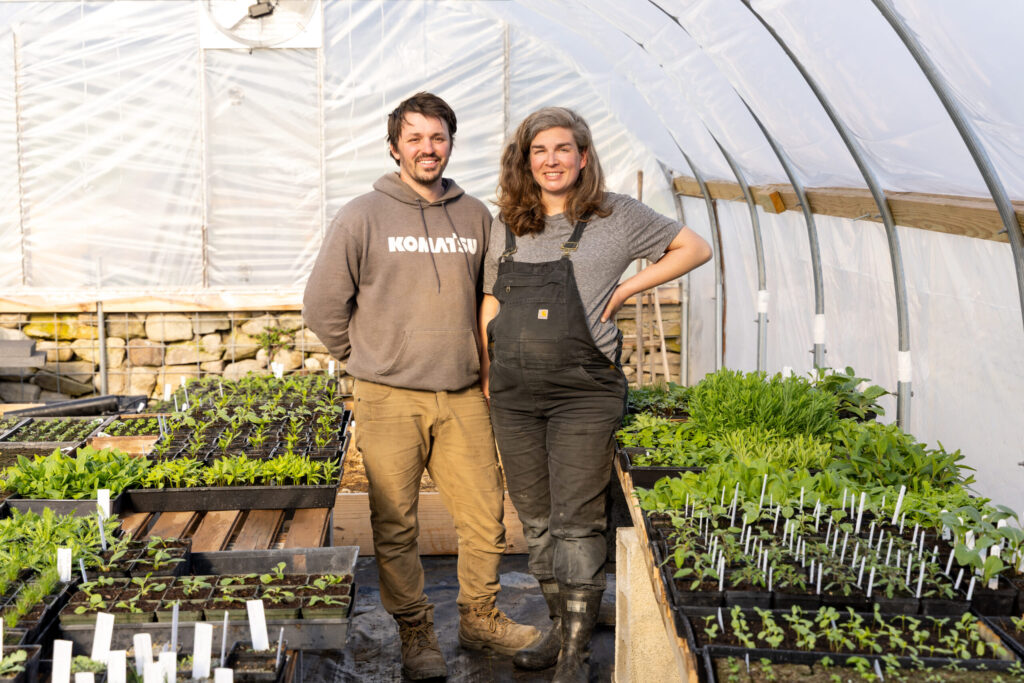
Taylor LaFleur (left) and Kirsten Liebl (right) in the greenhouse at Wollecru. Photo by Katie Kearney.
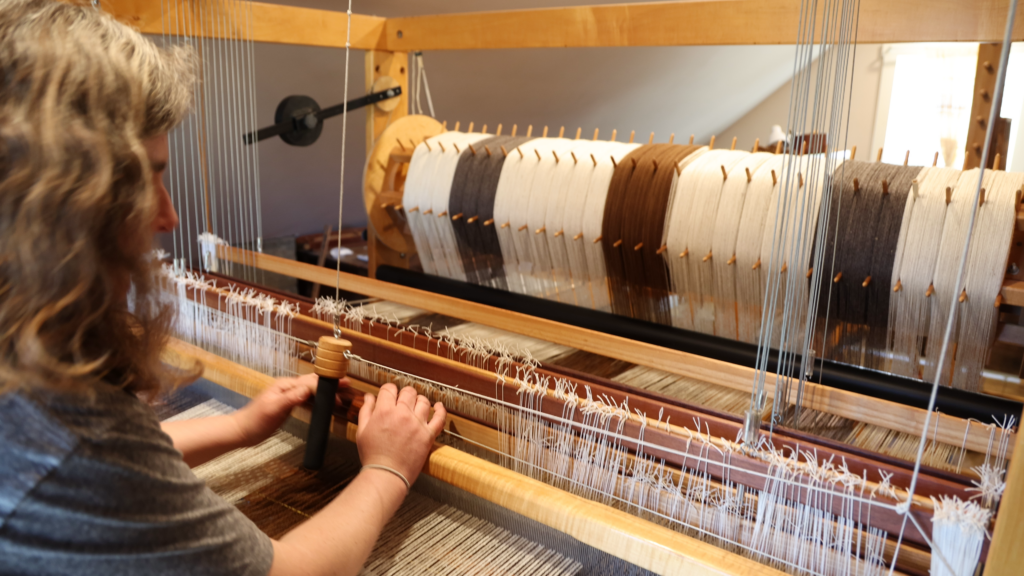
Kirsten Liebl, with her partner, Taylor LaFleur, owns Wollecru in Westport. Specializing in wool blankets, Kirsten uses her loom, made in the 1980s, to make the hand-woven heirlooms start to finish. A few weeks before lambing season in the spring, their sheep are shorn, the wool is sorted by color, processed at a nearby fiber mill, and returned to them in large cones of yarn for weaving. This yarn is either left in its natural colors or dyed by Kirsten using plants that grow on and around the farm.
Liebl first learned to weave in college, and had her first experience grazing sheep for Essex Farm. In 2016 she took the plunge into fiber, largely on faith.
“I just bought two sheep off of Craigslist,” she said. “I didn’t own property, but I was interested in producing my own fiber, and seeing what the whole process from a raw fleece to a finished woven item would be like.”
Crafting beauty one thread at a time. A person skillfully operates a traditional wooden loom.
Spinning proved to be too time-consuming, but the rest of the model worked, and the Wollecru blanket — and farm — was born. “I would say my real goal from the beginning was always to make a product that people would use, whether that’s blankets or maybe sweaters or socks — but blankets are kind of what I’ve landed on,” she said. “Customers are going to use it for the rest of their lives, or they’re going to give it as a gift for a wedding or a birth — something that’s really meaningful.”
Wollecru breeds about 30 ewes each year, and grazes up 80 to 90 animals through the summer, including the rams that will be fattened for slaughter. In the spring, the flock produces about 250 pounds of raw wool.
With a background in vegetable farming, Liebl is also adept at growing natural dyes on the farm — Japanese indigo for blue, madder root for red, and onion skins for golden yellow. “And then there’s also a ton of wild plants that I don’t have to grow, but that we can harvest to get color,” Liebl said. “There’s sheep sorrel, which is like a little weed that grows in the pastures; goldenrod and Queen Anne’s lace all make really nice natural dyes as well.”
In some ways, home-grown dyes and small-scale spinning and scouring (wool cleaning) operations are returning the world of fiber to its colonial roots. Organizations such as the Hudson Valley Textile Project and the New York Textile Lab are advocating for fiber in various ways, from helping with production to matching designers with small, Northeastern farms.
“For a long time, the story was that all these manufacturing places are shutting down, and the long arc of textiles has been declining since the 1800s, which probably overall is still pretty true,” Liebl said. “But I think there are more small-scale avenues popping up, and ways to have fiber that is produced locally available for sale.”
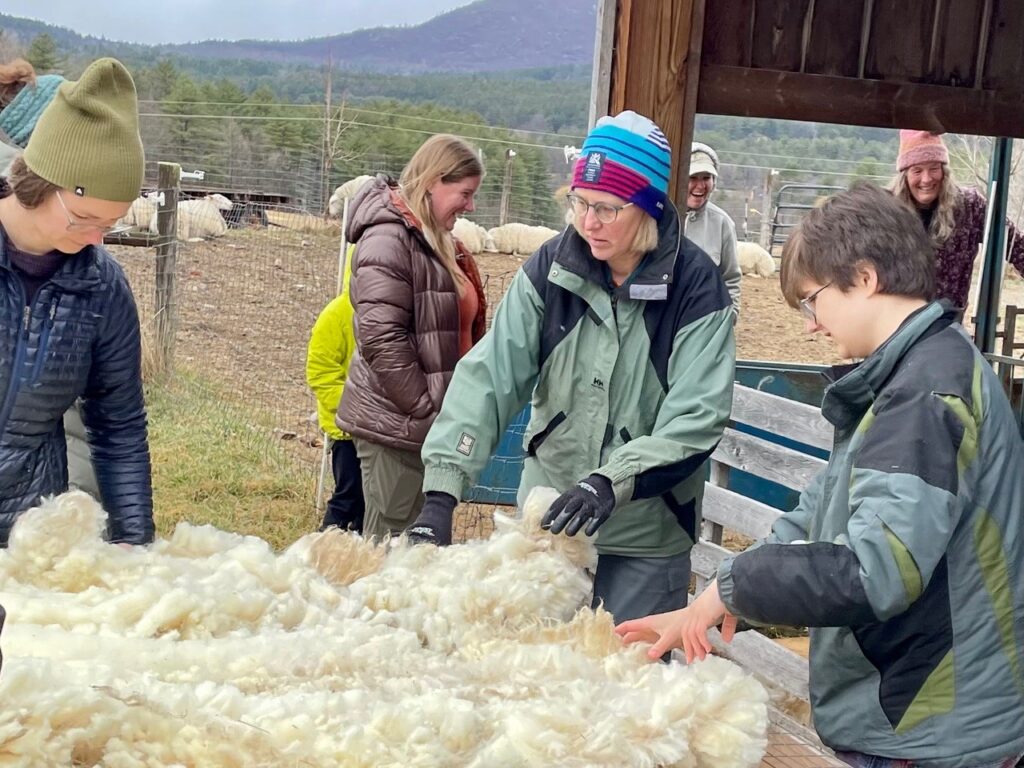
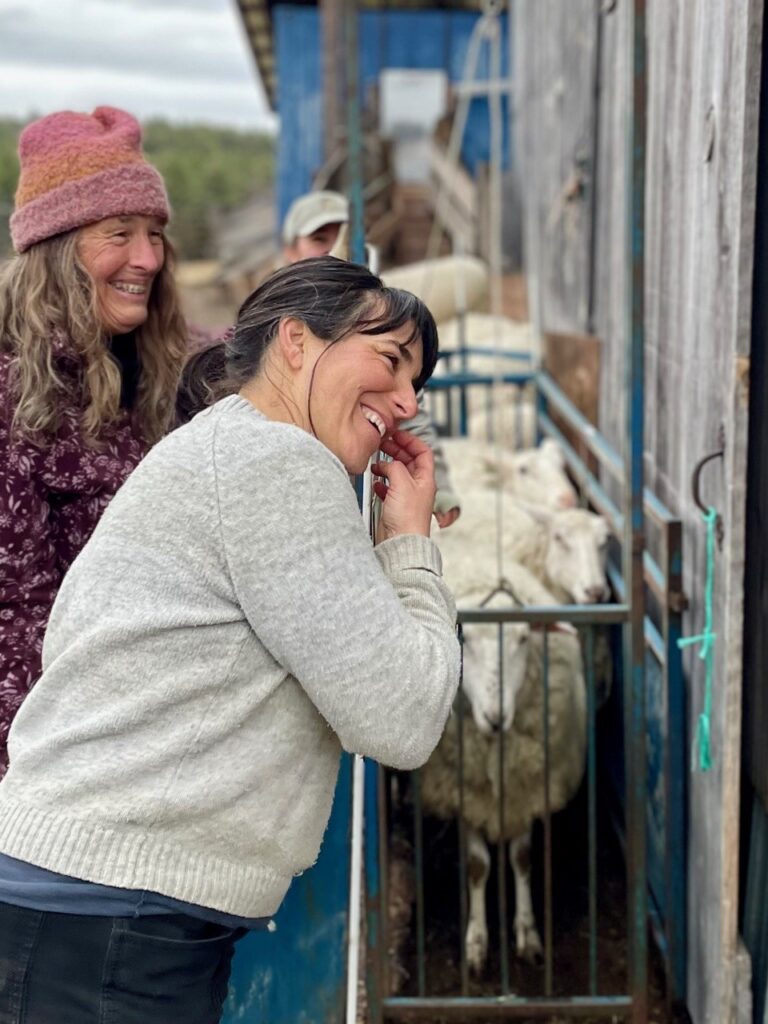
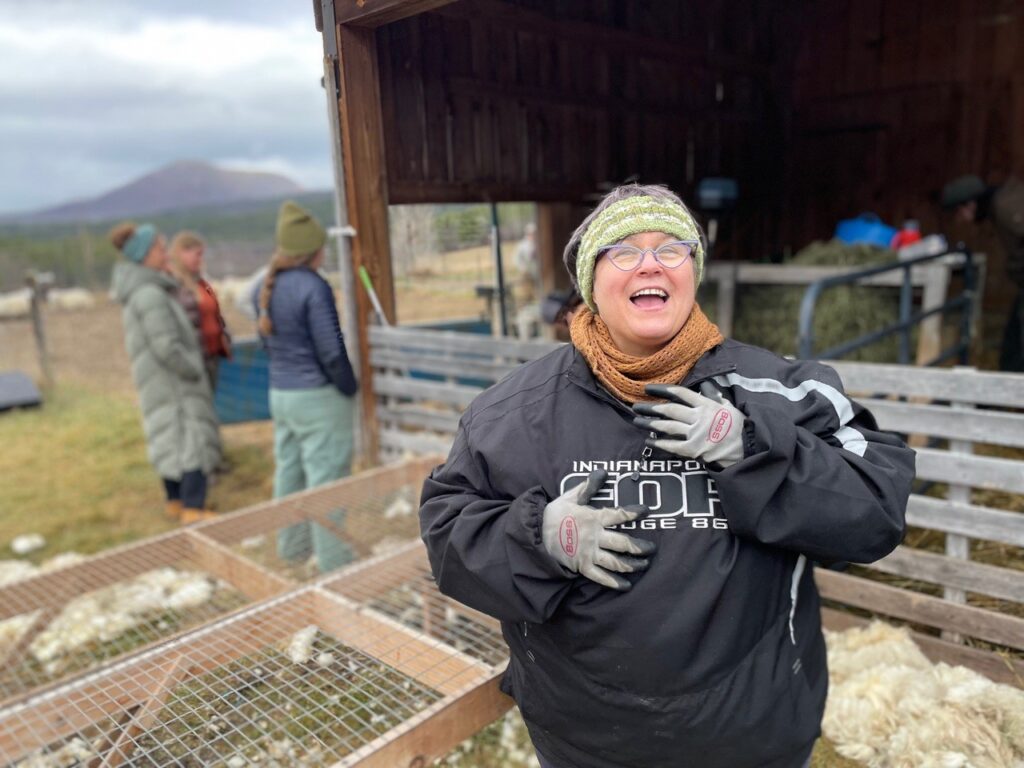
At Blue Pepper Farm, located in Jay and known for sheep’s-milk yogurt, shearing day has the qualities of events-gone-by, like corn shuckings or barn raisings. About a dozen people provide help or conversation or both, as legendary Vermont shearer Mary Lake runs electric clippers over the ewes, producing one, intact “blanket” of fleece.
As the sheep are vaccinated, the blanket is passed to a table, where dozens of human fingers comb out dirt and pasture debris. Farm owner Shannon Eaton, said she and her husband, Tyler, are sending fleece from their 50 ewes to the New York Textile Lab this year, which matches environmentally conscious fabric designers with sustainable farms like Blue Pepper.
Sheep shearing day at Blue Pepper Farm. Photo by Tim Rowland.Shannon Eaton, owner of Blue Pepper Farm. Photo by Tim RowlandSheep shearing day brings lots of joy to participants! Photo by Tim Rowland.
Lilly Marsh, founder of Lilly Marsh Studios in Glens Falls and founding member of the Hudson Valley Textile Project, is a weaver who has published scholarly papers on fiber art and culture in the United States, and works to strengthen fiber communities across the supply chain.
“We’re trying to make sure that wool that’s grown here is able to be processed here and made into finished items here,” she said.
Paradoxically, mills have been closing this century at the same time that interest in natural fibers is picking up — especially as chemicals and synthetic microfiber pollution are causing health concerns.
To answer this demand, smaller equipment, such as a line of Belfast Mini Mills and smaller mills are answering the call of small producers who would not have the minimum amount of fleece necessary for a standard-sized mill contract.
Natural fibers are showing up in more high-end designer product lines, as well as in groups that meet at local libraries to compare weaving and knitting notes.
“I’d say the first 10 to 15 years I was here, I only knew two other weavers, and I didn’t know any knitters,” said Kathy Kelley of Westport, who took up weaving after college when she became enchanted with a loom in a yarn shop. “But now we have a group we call Fiber Friends that meets in Westport, and we have close to 40 people on our contact list.”
Weavers, knitters and spinners meet once a month, sharing their work, getting feedback and solving problems.
“When we started it a couple years ago, there were just a handful of us, and we thought, okay, let’s meet — it’ll be fun,” Kelley said. “And then someone heard about it and asked if they could join. Before, you know, we have people coming from Plattsburgh, from Jay, from Crown Point. So [now] we have them from all over, and we meet at Camp Dudley.”
Weaving is magical, Kelley said. “I really love the texture, the feel of it, and the colors. And even with a simple, plain weave, there are so many different color combinations you can get.”
So, of course, she said yes when a neighbor asked if he could put some sheep up in her barn for the winter.
“His sheep have been hanging out outside my barn,” she said. “They don’t really like to go in much for the winter. And we’ve traded: rather than him paying me rent, I’m trading for yarn.”
Knitting & Fiber Art Groups and Resources
Information valid as of April, 2026.
Charity Knit and Crochet at Wells Memorial Library Upper Jay.
Wednesdays 5:30-7 PM. Call the Upper Jay Library for more information at 518-946-2644, or visit their website.
High Peaks Handcrafters
The third Sunday of the month from 12-3 PM at the Black Brook General Store from April through December 21. For winter location information, please contact: Sue Young, sue young@hotmail.com or Karen Keasler, keasler5@charter.net.
Knitting Upstairs at Keene Valley Library
Please contact the Keene Valley Library for more information: kvla@library.com, 518-576-4335, or visit their website.
The Knitting and Crocheting with Linda
The group meets in the Keeseville Library on Wednesdays at 10 AM. For more information, please call 518-834-9054 or visit their website.
Knitterondackers
The Knitterrondackers meet at the Saranac Lake Library, downstairs in the Crandall room, on Thursdays from 1:30-4:30 PM. For more information, please call 518-891-4190 or visit their website.
Spinners at the VIC
Paul Smith’s College Visitor Interpretive Center (VIC), typically meets on Tuesdays from 1-4 PM. For more information, please contact Carol Jones, knitnspin@outlook.com.
Fiber Collective
The Strand, Plattsburgh, Fiber Collective, 2nd Wednesdays of each month from 25 PM. For more information, please call 518-563-1604 or visit their website.
This self-guided summer tour centered around yarn and fiber is a yarn lover’s dream. Explore shops, visit working fiber farms, and find your new favorite fiber spaces across New York State from May 1 until October 31. For more information and to find stops on the trail, visit their website.
Adirondack Watershed Institute
Join a unique project showcasing scientific data and local fiber arts with the Paul Smith’s College Adirondack Watershed Institute. The Wool and Water project is a data art project in which we are using knitting, crochet, weaving and other fiber arts to illustrate concepts and trends related to our waterways. This effort blends fiber art with scientific data to create visual representations of changing water quality conditions in the Adirondacks and Lake Champlain Basin. Find out more at their website.