Two hundred years ago, Merino sheep wandered the North Country like they owned it, and hundreds of small family cabin “factories” turned out warm, woolen mittens that sold for 50 cents a pair. They were worth every penny.
Sheep may not dominate the landscape like they used to, but there are echoes of the past still present. From the ancient farm stone walls that appear like ghosts in the regenerated forests, to a modern network of knitting groups where yarn skeins, coffee and laughs are shared in equal proportion.
It is, said Sue Young, owner of Young’s Studio & Gallery in Jay, a culture for cold-weather climates around the world.
“It was part of the family tradition,” she said. “My mother was an avid knitter. Both of my sisters are avid knitters. My mom would knit mittens and gloves for people every Christmas, and certain items got handed down from my oldest sister, who’s 15 years older, to me, and then to my daughter, my niece and so on.”
Young, an acclaimed North Country potter, carries a line of yarns and garments in her gallery. They’re more for the tradition and love of the craft than they are for profit. She maintains thick binders filled with sample fibers and dyes for those interested to peruse.
Despite significant financial and logistical headwinds, fiber art persists. Merino sheep are famous for having the softest wool, but to balance their books, North Country farmers need larger animals that can also produce meat more profitably.
Most textile mills have moved overseas, so after the sheep — or alpacas or even a breed of dog — are fleeced in the spring, the raw product is sent to specialty mills downstate, or to Vermont to be spun into yarn.
While synthetic or cotton yarns can cost less than $10 a skein in chain hobby stores, quality wool can top $30. A skein is only enough to make a small product, such as a pair of fingerless gloves. Of course, that’s not counting the time it takes to craft the yarn into its final form.
The advantage is that a hand-made woolen garment is practically bulletproof, and quite capable of providing loving warmth through generations of users.
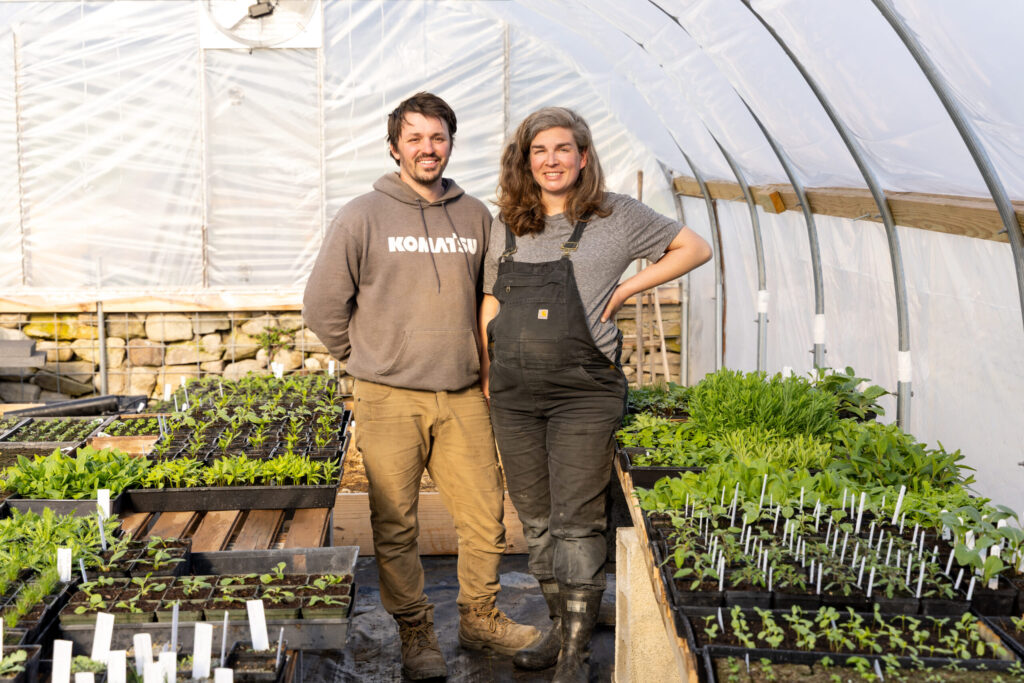
Taylor LaFleur (left) and Kirsten Liebl (right) in the greenhouse at Wollecru. Photo by Katie Kearney.
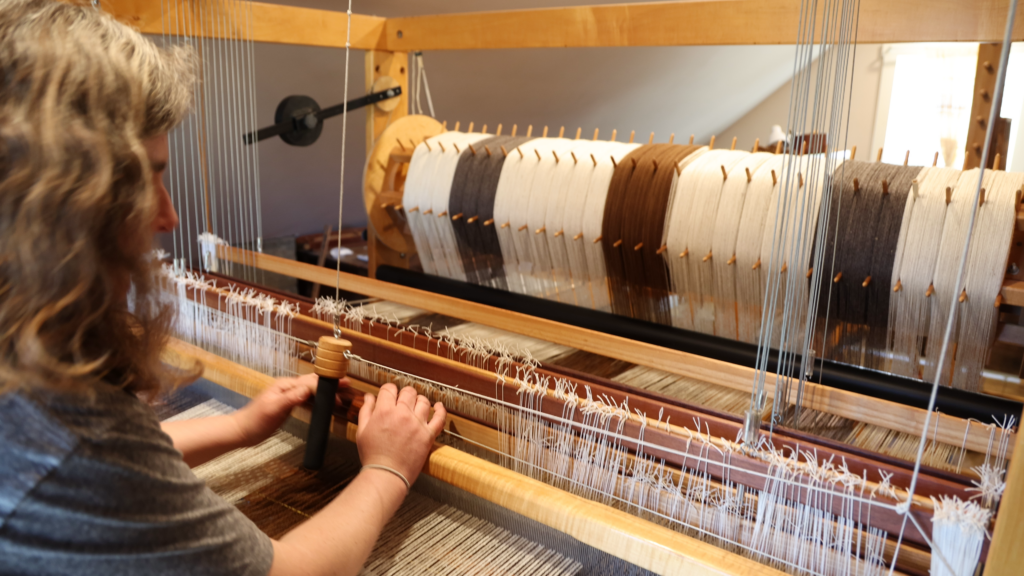
Kirsten Liebl, with her partner, Taylor LaFleur, owns Wollecru in Westport. Specializing in wool blankets, Kirsten uses her loom, made in the 1980s, to make the hand-woven heirlooms start to finish. A few weeks before lambing season in the spring, their sheep are shorn, the wool is sorted by color, processed at a nearby fiber mill, and returned to them in large cones of yarn for weaving. This yarn is either left in its natural colors or dyed by Kirsten using plants that grow on and around the farm.
Liebl first learned to weave in college, and had her first experience grazing sheep for Essex Farm. In 2016 she took the plunge into fiber, largely on faith.
“I just bought two sheep off of Craigslist,” she said. “I didn’t own property, but I was interested in producing my own fiber, and seeing what the whole process from a raw fleece to a finished woven item would be like.”
Crafting beauty one thread at a time. A person skillfully operates a traditional wooden loom.
Spinning proved to be too time-consuming, but the rest of the model worked, and the Wollecru blanket — and farm — was born. “I would say my real goal from the beginning was always to make a product that people would use, whether that’s blankets or maybe sweaters or socks — but blankets are kind of what I’ve landed on,” she said. “Customers are going to use it for the rest of their lives, or they’re going to give it as a gift for a wedding or a birth — something that’s really meaningful.”
Wollecru breeds about 30 ewes each year, and grazes up 80 to 90 animals through the summer, including the rams that will be fattened for slaughter. In the spring, the flock produces about 250 pounds of raw wool.
With a background in vegetable farming, Liebl is also adept at growing natural dyes on the farm — Japanese indigo for blue, madder root for red, and onion skins for golden yellow. “And then there’s also a ton of wild plants that I don’t have to grow, but that we can harvest to get color,” Liebl said. “There’s sheep sorrel, which is like a little weed that grows in the pastures; goldenrod and Queen Anne’s lace all make really nice natural dyes as well.”
In some ways, home-grown dyes and small-scale spinning and scouring (wool cleaning) operations are returning the world of fiber to its colonial roots. Organizations such as the Hudson Valley Textile Project and the New York Textile Lab are advocating for fiber in various ways, from helping with production to matching designers with small, Northeastern farms.
“For a long time, the story was that all these manufacturing places are shutting down, and the long arc of textiles has been declining since the 1800s, which probably overall is still pretty true,” Liebl said. “But I think there are more small-scale avenues popping up, and ways to have fiber that is produced locally available for sale.”
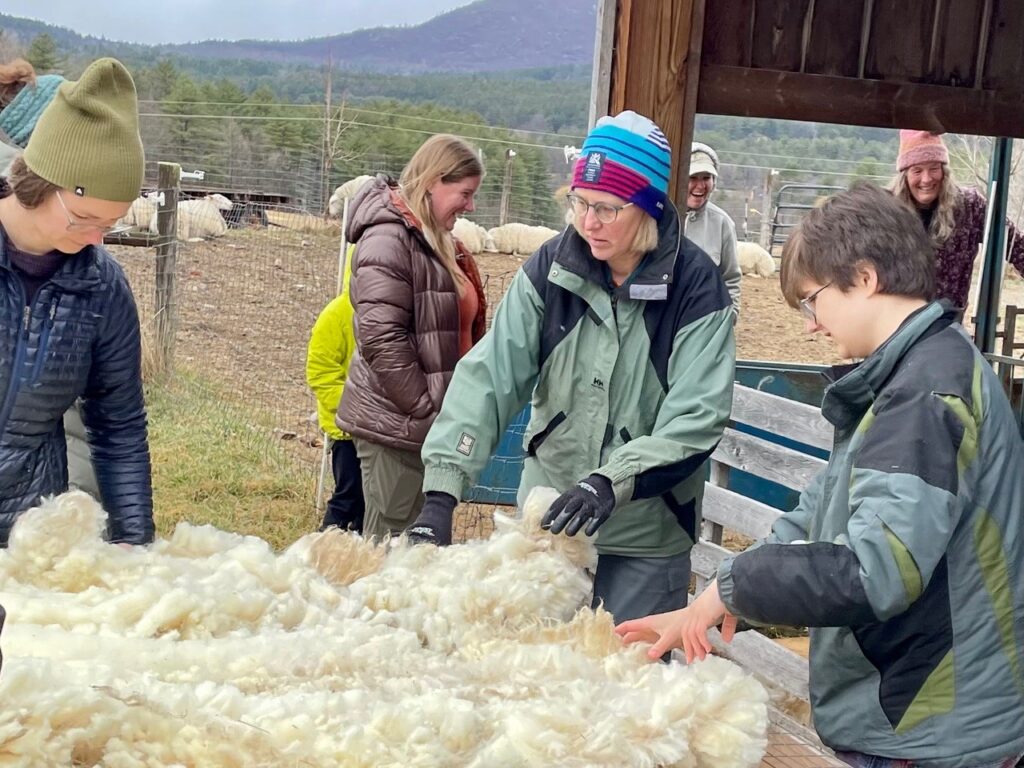
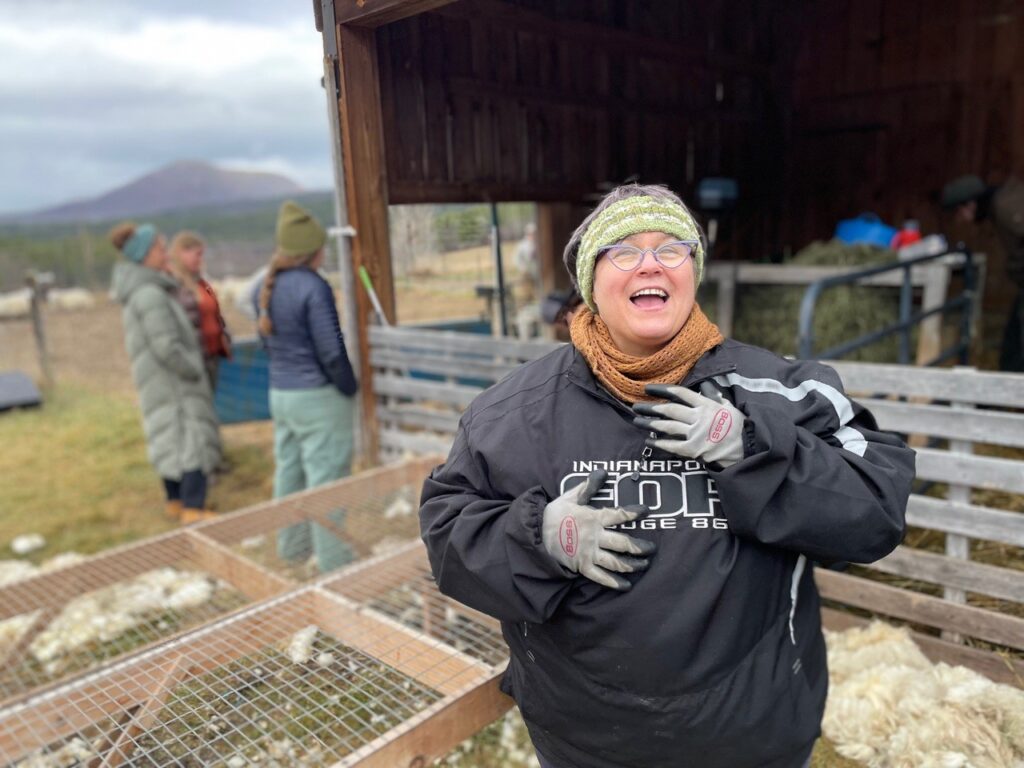
At Blue Pepper Farm, located in Jay and known for sheep’s-milk yogurt, shearing day has the qualities of events-gone-by, like corn shuckings or barn raisings. About a dozen people provide help or conversation or both, as legendary Vermont shearer Mary Lake runs electric clippers over the ewes, producing one, intact “blanket” of fleece.
As the sheep are vaccinated, the blanket is passed to a table, where dozens of human fingers comb out dirt and pasture debris. Farm owner Shannon Eaton, said she and her husband, Tyler, are sending fleece from their 50 ewes to the New York Textile Lab this year, which matches environmentally conscious fabric designers with sustainable farms like Blue Pepper.
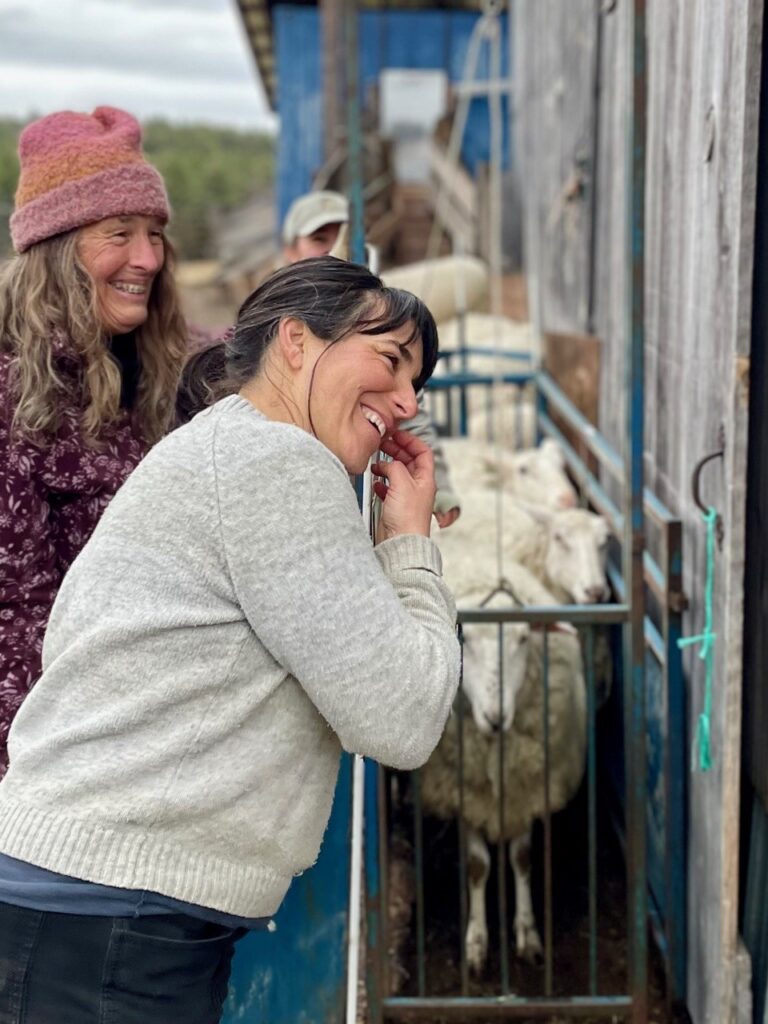
Sheep shearing day at Blue Pepper Farm. Photo by Tim Rowland.Shannon Eaton, owner of Blue Pepper Farm. Photo by Tim RowlandSheep shearing day brings lots of joy to participants! Photo by Tim Rowland.
Lilly Marsh, founder of Lilly Marsh Studios in Glens Falls and founding member of the Hudson Valley Textile Project, is a weaver who has published scholarly papers on fiber art and culture in the United States, and works to strengthen fiber communities across the supply chain.
“We’re trying to make sure that wool that’s grown here is able to be processed here and made into finished items here,” she said.
Paradoxically, mills have been closing this century at the same time that interest in natural fibers is picking up — especially as chemicals and synthetic microfiber pollution are causing health concerns.
To answer this demand, smaller equipment, such as a line of Belfast Mini Mills and smaller mills are answering the call of small producers who would not have the minimum amount of fleece necessary for a standard-sized mill contract.
Natural fibers are showing up in more high-end designer product lines, as well as in groups that meet at local libraries to compare weaving and knitting notes.
“I’d say the first 10 to 15 years I was here, I only knew two other weavers, and I didn’t know any knitters,” said Kathy Kelley of Westport, who took up weaving after college when she became enchanted with a loom in a yarn shop. “But now we have a group we call Fiber Friends that meets in Westport, and we have close to 40 people on our contact list.”
Weavers, knitters and spinners meet once a month, sharing their work, getting feedback and solving problems.
“When we started it a couple years ago, there were just a handful of us, and we thought, okay, let’s meet — it’ll be fun,” Kelley said. “And then someone heard about it and asked if they could join. Before, you know, we have people coming from Plattsburgh, from Jay, from Crown Point. So [now] we have them from all over, and we meet at Camp Dudley.”
Weaving is magical, Kelley said. “I really love the texture, the feel of it, and the colors. And even with a simple, plain weave, there are so many different color combinations you can get.”
So, of course, she said yes when a neighbor asked if he could put some sheep up in her barn for the winter.
“His sheep have been hanging out outside my barn,” she said. “They don’t really like to go in much for the winter. And we’ve traded: rather than him paying me rent, I’m trading for yarn.”
Knitting & Fiber Art Groups and Resources
Information valid as of April, 2026.
Charity Knit and Crochet at Wells Memorial Library Upper Jay.
Wednesdays 5:30-7 PM. Call the Upper Jay Library for more information at 518-946-2644, or visit their website.
High Peaks Handcrafters
The third Sunday of the month from 12-3 PM at the Black Brook General Store from April through December 21. For winter location information, please contact: Sue Young, sue young@hotmail.com or Karen Keasler, keasler5@charter.net.
Knitting Upstairs at Keene Valley Library
Please contact the Keene Valley Library for more information: kvla@library.com, 518-576-4335, or visit their website.
The Knitting and Crocheting with Linda
The group meets in the Keeseville Library on Wednesdays at 10 AM. For more information, please call 518-834-9054 or visit their website.
Knitterondackers
The Knitterrondackers meet at the Saranac Lake Library, downstairs in the Crandall room, on Thursdays from 1:30-4:30 PM. For more information, please call 518-891-4190 or visit their website.
Spinners at the VIC
Paul Smith’s College Visitor Interpretive Center (VIC), typically meets on Tuesdays from 1-4 PM. For more information, please contact Carol Jones, knitnspin@outlook.com.
Fiber Collective
The Strand, Plattsburgh, Fiber Collective, 2nd Wednesdays of each month from 25 PM. For more information, please call 518-563-1604 or visit their website.
This self-guided summer tour centered around yarn and fiber is a yarn lover’s dream. Explore shops, visit working fiber farms, and find your new favorite fiber spaces across New York State from May 1 until October 31. For more information and to find stops on the trail, visit their website.
Adirondack Watershed Institute
Join a unique project showcasing scientific data and local fiber arts with the Paul Smith’s College Adirondack Watershed Institute. The Wool and Water project is a data art project in which we are using knitting, crochet, weaving and other fiber arts to illustrate concepts and trends related to our waterways. This effort blends fiber art with scientific data to create visual representations of changing water quality conditions in the Adirondacks and Lake Champlain Basin. Find out more at their website.
Gardening programs have been a staple of the WPBS schedule, with shows like From a Country Garden and The Gardener with Ed Lawrence. With almost 25 years since WPBS aired a show produced in-house, the station is very excited to debut the new program, The Home-Scale Forest Garden.
“It’s really been a labor of love,” said Tracy DuFlo, Director of Production and Executive Producer at WPBS. “We filmed eight episodes over the four seasons, and it was very fascinating to see Dani’s garden on Wellesley Island transform with each season. One thing I found really interesting is that there is something to harvest in a home-scale forest garden almost year-round.”
Based on Wellesley Island, NY, in the beautiful Thousand Islands Region, Baker and her partner, David Belding, own Cross Island Farms, where the Enchanted Edible Forest is located. Baker is the author of The Home-Scale Forest Garden, a practical guide to creating a low-maintenance, sustainable, perennial, food-producing garden, and is the original blueprint of the show. On the farm, they grow certified organic fruit and vegetables, and raise chickens, grass-fed beef. Agritourism opportunities for visitors include U-pick fruit, farm and garden tours, rustic camping and volunteer opportunities to gain hands-on experience in sustainable agriculture.
Baker hopes to inspire viewers to create their own beautiful, bountiful, edible landscape at any scale—from a few dozen square feet to an acre or more. “I am very excited and grateful to have had the opportunity to work with WPBS on a TV series about forest gardening,” said Baker. “My lifetime ambition is to inspire as many people as possible to establish this kind of planting, where we work with nature to create abundant healthful harvests, while reducing our labor and helping the environment. A gardening show that is nationally distributed through PBS is the perfect vehicle to inform and inspire a receptive audience.”
Following the premiere of the The Home-Scale Forest Garden series on WPBS, the show will be released for broadcast and streaming on PBS stations nationwide later this spring.
The award, given annually, recognizes outstanding stewardship practices and conservation achievements of Beef Producers across New York. The hope is to recognize operations with a desire to leave the land better than they found it for the next generation.
Ben Wever Farm is a diversified Angus Beef cow-calf operation owned by the Gilliland family and is located within the Adirondack Park — a destination that sees over 12.5 million visitors every year. The 495-acre farm produces beef, lamb, pork, poultry, compost, eggs, mushrooms and honey, all carrying the character of their farmland. Ben Wever Farm believes that truly local food carries the “terroir” (a French winemaking term that essentially conveys character and taste) of the place and the stewards who raised it.
“We’ve been practicing rotational adaptive grazing since 2005. Based upon a belief that trying to develop a farm that’s regenerative means actually working with natural cycles of the environment. We want to be a full-cycle farm, that’s why we concentrate so much on soil health,” said Gilliland.
Gilliland said Ben Wever Farm always looks to the soil as the basis of their management decisions, which translates to more vibrant grasslands and thriving livestock.
“Through regenerative grazing, composting materials, and then using a manure and compost mix to place back on the land helps to regenerate after taking things off of it,” said Gilliland. “We’re giving things back to the land after taking from it. Keeping to the water and carbon cycles in the environment is in the vision of what we want to do on the farm.”
Ben Wever’s ancestors had worked the farm since its establishment in 1829, creating a diversified ecosystem throughout each generation and putting their own management style into the craft. The Gilliland family started with the farm under Ben’s instruction. He taught them about the farm, the work, the animals and the love of the vocation. While Ben slowly transitioned out, the Gilliland family took on more and more tasks until they took the reins fully.
Gilliland was honored to receive the award, but said he was stunned.
“It was very much a surprise to me,” said Gilliland. “I was invited to be on the board of directors of the NY Beef Council, and this was my first meeting. The event was in conjunction with the [New York] Beef Producers Association. We were all having dinner, and they suddenly were announcing that Ben Wever Farm had won the award.”
“These [awards] have been really, really just humbling, you know, that people recognize this. We don’t feel that we’re doing anything special. We’re just trying to do the right thing. To be quite truthful, the whole community of farmers in Essex County are all in the same mind and pursuing the same goals. It’s great being in this farming community.”
Being in community with like-minded people is essential for small-scale farms. Gilliland said relationship-building and collaborative efforts with agriculture service providers are key to improving the climate resiliency of farms in the North Country region.
Gilliland said that Essex County SWCD and NRCS have been fantastic partners on projects and initiatives, and have just finished programs on climate resiliency, composting facilities and grazing management.
Ben Wever Farm is increasing its agroforestry initiatives on the farmland. Gilliland said they’re already doing forest regeneration cuttings to encourage new growth. They’re starting to develop silvopastures, the practice of mixing forestry with grazing pastures. NRCS has been assisting them in identifying and eradicating invasive plants, such as barberry, to be able to implement these forested pastures.
The next step for Ben Wever Farm is giving veterans a second career in farming. Gilliland plans to call the initiative the Corporal Harry Weaver Project in honor of the late World War I veteran who once owned the farm. Their goal is to renovate the original 1800s-era farmhouse on the property to provide housing for participants of the initiative, getting them hands-on farming experience within the region.