• Skip to main content
  • Skip to footer

Adirondack Harvest

Farm Fresh Foods, Local Producers and Adirondack Farmers' Markets

  • Browse
  • Farmers’ Markets
  • Wholesale
    • Buy Wholesale
    • Local Food Wholesale Database
    • Sell Wholesale
    • Join the Wholesale Database
  • Learn More
    • Explore the Adirondack Cuisine Trails
      • About the Adirondack Cuisine Trails
    • Benefits of Buying Local Food
    • What’s in Season When
    • Farming in the Adirondacks
    • Meet the Makers
    • Decoding Food Labels
    • Food Assistance Benefits & Local Food
    • Food Assistance Benefit FAQ
    • Blog
  • Events
    • About the Adirondack Harvest Festival
    • 2025 Adirondack Harvest Festival
    • Event Calendar
  • Email Sign-Up

Agritourism

Knitting Communities Together: Adirondack Fiber Arts

04/20/2026

Two hundred years ago, Merino sheep wandered the North Country like they owned it, and hundreds of small family cabin “factories” turned out warm, woolen mittens that sold for 50 cents a pair. They were worth every penny.

Sheep may not dominate the landscape like they used to, but there are echoes of the past still present. From the ancient farm stone walls that appear like ghosts in the regenerated forests, to a modern network of knitting groups where yarn skeins, coffee and laughs are shared in equal proportion.

It is, said Sue Young, owner of Young’s Studio & Gallery in Jay, a culture for cold-weather climates around the world.

“It was part of the family tradition,” she said. “My mother was an avid knitter. Both of my sisters are avid knitters. My mom would knit mittens and gloves for people every Christmas, and certain items got handed down from my oldest sister, who’s 15 years older, to me, and then to my daughter, my niece and so on.”

Young, an acclaimed North Country potter, carries a line of yarns and garments in her gallery. They’re more for the tradition and love of the craft than they are for profit. She maintains thick binders filled with sample fibers and dyes for those interested to peruse. 

Despite significant financial and logistical headwinds, fiber art persists. Merino sheep are famous for having the softest wool, but to balance their books, North Country farmers need larger animals that can also produce meat more profitably.

Most textile mills have moved overseas, so after the sheep — or alpacas or even a breed of dog — are fleeced in the spring, the raw product is sent to specialty mills downstate, or to Vermont to be spun into yarn.

While synthetic or cotton yarns can cost less than $10 a skein in chain hobby stores, quality wool can top $30. A skein is only enough to make a small product, such as a pair of fingerless gloves. Of course, that’s not counting the time it takes to craft the yarn into its final form.

The advantage is that a hand-made woolen garment is practically bulletproof, and quite capable of providing loving warmth through generations of users.

Taylor LaFleur (left) and Kirsten Liebl (right) in the greenhouse at Wollecru. Photo by Katie Kearney.

Kirsten Liebl, with her partner, Taylor LaFleur, owns Wollecru in Westport. Specializing in wool blankets, Kirsten uses her loom, made in the 1980s, to make the hand-woven heirlooms start to finish. A few weeks before lambing season in the spring, their sheep are shorn, the wool is sorted by color, processed at a nearby fiber mill, and returned to them in large cones of yarn for weaving. This yarn is either left in its natural colors or dyed by Kirsten using plants that grow on and around the farm. 

Liebl first learned to weave in college, and had her first experience grazing sheep for Essex Farm. In 2016 she took the plunge into fiber, largely on faith.

“I just bought two sheep off of Craigslist,” she said. “I didn’t own property, but I was interested in producing my own fiber, and seeing what the whole process from a raw fleece to a finished woven item would be like.”

Kirsten Liebl weaving a blanket using her loom. Photo by Katie Kearney.

Spinning proved to be too time-consuming, but the rest of the model worked, and the Wollecru blanket — and farm — was born. “I would say my real goal from the beginning was always to make a product that people would use, whether that’s blankets or maybe sweaters or socks — but blankets are kind of what I’ve landed on,” she said. “Customers are going to use it for the rest of their lives, or they’re going to give it as a gift for a wedding or a birth — something that’s really meaningful.”

Wollecru breeds about 30 ewes each year, and grazes up 80 to 90 animals through the summer, including the rams that will be fattened for slaughter. In the spring, the flock produces about 250 pounds of raw wool.

With a background in vegetable farming, Liebl is also adept at growing natural dyes on the farm — Japanese indigo for blue, madder root for red, and onion skins for golden yellow. “And then there’s also a ton of wild plants that I don’t have to grow, but that we can harvest to get color,” Liebl said. “There’s sheep sorrel, which is like a little weed that grows in the pastures;  goldenrod and Queen Anne’s lace all make really nice natural dyes as well.”

In some ways, home-grown dyes and small-scale spinning and scouring (wool cleaning) operations are returning the world of fiber to its colonial roots. Organizations such as the Hudson Valley Textile Project and the New York Textile Lab are advocating for fiber in various ways, from helping with production to matching designers with small, Northeastern farms.

“For a long time, the story was that all these manufacturing places are shutting down, and the long arc of textiles has been declining since the 1800s, which probably overall is still pretty true,” Liebl said. “But I think there are more small-scale avenues popping up, and ways to have fiber that is produced locally available for sale.”

At Blue Pepper Farm, located in Jay and known for sheep’s-milk yogurt, shearing day has the qualities of events-gone-by, like corn shuckings or barn raisings. About a dozen people provide help or conversation or both, as legendary Vermont shearer Mary Lake runs electric clippers over the ewes, producing one, intact “blanket” of fleece.

As the sheep are vaccinated, the blanket is passed to a table, where dozens of human fingers comb out dirt and pasture debris. Farm owner Shannon Eaton, said she and her husband, Tyler, are sending fleece from their 50 ewes to the New York Textile Lab this year, which matches environmentally conscious fabric designers with sustainable farms like Blue Pepper.

Sheep shearing day at Blue Pepper Farm. Photo by Tim Rowland.
Shannon Eaton, owner of Blue Pepper Farm. Photo by Tim Rowland
Sheep shearing day at Blue Pepper Farm. Photo by Tim Rowland

Lilly Marsh, founder of Lilly Marsh Studios in Glens Falls and founding member of the Hudson Valley Textile Project, is a weaver who has published scholarly papers on fiber art and culture in the United States, and works to strengthen fiber communities across the supply chain.

“We’re trying to make sure that wool that’s grown here is able to be processed here and made into finished items here,” she said. 

Paradoxically, mills have been closing this century at the same time that interest in natural fibers is picking up — especially as chemicals and synthetic microfiber pollution are causing health concerns.

To answer this demand, smaller equipment, such as a line of Belfast Mini Mills and smaller mills are answering the call of small producers who would not have the minimum amount of fleece necessary for a standard-sized mill contract.

Natural fibers are showing up in more high-end designer product lines, as well as in groups that meet at local libraries to compare weaving and knitting notes.

“I’d say the first 10 to 15 years I was here, I only knew two other weavers, and I didn’t know any knitters,” said Kathy Kelley of Westport, who took up weaving after college when she became enchanted with a loom in a yarn shop. “But now we have a group we call Fiber Friends that meets in Westport, and we have close to 40 people on our contact list.”

Weavers, knitters and spinners meet once a month, sharing their work, getting feedback and solving problems.

“When we started it a couple years ago, there were just a handful of us, and we thought, okay, let’s meet — it’ll be fun,” Kelley said. “And then someone heard about it and asked if they could join. Before, you know, we have people coming from Plattsburgh, from Jay, from Crown Point. So [now] we have them from all over, and we meet at Camp Dudley.”

Weaving is magical, Kelley said. “I really love the texture, the feel of it, and the colors. And even with a simple, plain weave, there are so many different color combinations you can get.”

So, of course, she said yes when a neighbor asked if he could put some sheep up in her barn for the winter.

“His sheep have been hanging out outside my barn,” she said. “They don’t really like to go in much for the winter. And we’ve traded: rather than him paying me rent, I’m trading for yarn.”


Knitting & Fiber Art Groups and Resources

Information valid as of April, 2026.

Charity Knit and Crochet at Wells Memorial Library Upper Jay. 

Wednesdays 5:30-7 PM. Call the Upper Jay Library for more information at 518-946-2644, or visit their website.

High Peaks Handcrafters 

The third Sunday of the month from 12-3 PM at the Black Brook General Store from April through December 21. For winter location information, please contact: Sue Young, sue young@hotmail.com or Karen Keasler, keasler5@charter.net. 

Knitting Upstairs at Keene Valley Library

Please contact the Keene Valley Library for more information: kvla@library.com, 518-576-4335, or visit their website.

The Knitting and Crocheting with Linda

The group meets in the Keeseville Library on Wednesdays at 10 AM. For more information, please call 518-834-9054 or visit their website.

Knitterondackers

The Knitterrondackers meet at the Saranac Lake Library, downstairs in the Crandall room, on Thursdays from 1:30-4:30 PM. For more information, please call 518-891-4190 or visit their website.

Spinners at the VIC

Paul Smith’s College Visitor Interpretive Center (VIC), typically meets on Tuesdays from 1-4 PM. For more information, please contact Carol Jones, knitnspin@outlook.com.

Fiber Collective

The Strand, Plattsburgh, Fiber Collective, 2nd Wednesdays of each month from 25 PM. For more information, please call 518-563-1604 or visit their website.

Lake Placid Center for the Arts

Cheryl Maid, cmmaid@gmail.com, Gail Huston, adirondackdogss@gmail.com, have taught weaving at the arts center. Find events and more information on the Lake Placid Center for the Arts website.

Fiber Arts Trail

This self-guided summer tour centered around yarn and fiber is a yarn lover’s dream. Explore shops, visit working fiber farms, and find your new favorite fiber spaces across New York State from May 1 until October 31. For more information and to find stops on the trail, visit their website.

Adirondack Watershed Institute

Join a unique project showcasing scientific data and local fiber arts with the Paul Smith’s College Adirondack Watershed Institute. The Wool and Water project is a data art project in which we are using knitting, crochet, weaving and other fiber arts to illustrate concepts and trends related to our waterways. This effort blends fiber art with scientific data to create visual representations of changing water quality conditions in the Adirondacks and Lake Champlain Basin. Find out more at their website.

Cornell Cooperative Extension of Essex County Receives 2026 Generous Acts Grant from Adirondack Community Foundation

04/05/2026

For Immediate Release

April 2, 2026
Elizabeth Lee, Executive Director
Cornell Cooperative Extension of Essex County
el677@cornell.edu | (518) 962-4810

LEWIS – Cornell Cooperative Extension of Essex County is excited to announce that we have received funding for the Adirondack Cuisine Trails and the International Tasting Trail from Adirondack Community Foundation’s Generous Acts program.

The Boquet Valley Cuisine Trail map with a bouquet of flowers.
The Boquet Valley Cuisine Trail map. Photo by Katie Kearney.

This project will support our Adirondack Harvest program as we work with the Regional Office of Sustainable Tourism to migrate the Adirondack Cuisine Trails to a new platform called Bandwango. The new platform will allow us to create a more robust user experience for the trails and this funding will help us bridge the Adirondack Cuisine Trails with the International Tasting Trail, a collaborative endeavor featuring regional partners in Vermont, Quebec, and Ontario. This partnership will direct more visitor traffic to our farms and cultivate more consumer awareness around sustainable agritourism.

“The agricultural community that we have here is profoundly unique and I can’t overstate how special it is to be surrounded by such an abundance of high-quality, clean food. This funding will help us showcase the incredible work our farmers are doing and also serve to elevate agriculture in the overall Adirondack visitor experience.” said Cole Trager, Agriculture & Local Food Team Leader at Cornell Cooperative Extension of Essex County.

A woman is buying flowers from a flower cart at the Adirondack Harvest Festival.
Mossbrook Roots Flower Farm Mobile Bloom Bar at the Adirondack Harvest Festival. Photo by Katie Kearney.

The mission of Adirondack Harvest is to increase opportunities for profitable, sustainable production and sale of high-quality food and agricultural products and expand consumer choices for locally produced nutritious food. Adirondack Harvest’s work covers the greater Adirondacks and North Country region. In 2022, Cornell Cooperative Extension of Essex County approved a Farmland Protection and Food System Plan that directly outlined sustainable agritourism as a key impact area for our local farms. It is our privilege to continue this work through digital marketing, promotions, educational and agritourism events, resources for consumers – residents and tourists alike – through the Adirondack Harvest program. 

The Generous Acts Grant from Adirondack Community Foundation allows us to continue these initiatives by supporting our work with the Adirondack Cuisine Trails and the International Tasting Trail. Adirondack Community Foundation is a force for good that pools gifts from generous donors who love the Adirondack region and care about our communities. The Foundation connects people, ideas, and resources to improve lives and expand opportunities throughout the Adirondack region. To learn more about the Generous Acts grant, please visit adkcommunityfoundation.org/GenerousActs.

##

Questions can be directed to:
Elizabeth Lee, Executive Director
Cornell Cooperative Extension of Essex County
el677@cornell.edu | (518) 962-4810

10th Annual Adirondack Harvest Festival Returns September 19, 2026

04/01/2026

By Isabella Susino | Adirondack Harvest Program Lead

FOR IMMEDIATE RELEASE
Date: April 1, 2026
Contact: Isabella Susino, Adirondack Harvest Program Lead, ihs27@cornell.edu

WESTPORT, NY – Celebrate the 10th anniversary of the Adirondack Harvest Festival at the Essex County Fairgrounds in Westport, NY. Enjoy the harvest season and learn about Adirondack agriculture on Saturday, September 19th from 12 PM to 5 PM. 

This family-friendly event is free to enter, features a large farmers’ market, live music, demonstrations, lectures, local food trucks, “Local Libations” tent, hands-on workshops, kids’ activities, farm animal petting zoo, draft horse wagon rides and much more. 

The theme of the 10th annual Adirondack Harvest Festival is “Bees and Honey,” showcasing the robust community of beekeepers in our region and the agricultural importance of these pollinators for many farms in the area. Free demonstrations and kids’ activities will offer insights into the myriad ways that attendees can use honey or other honeybee related byproducts in their everyday lives. For an additional charge, attendees can participate in hands-on workshops such as making salves and balms, beeswax wraps and candles, and more.

The Adirondack Harvest Festival is unique in that it specifically highlights locally grown food and products from the region. The festival farmers’ market will feature 30+ vendors, all members of Adirondack Harvest who are committed to the mission of protecting agriculture and increasing market opportunity. Local food and drink will be available for purchase from food trucks, and the Local Libations’ Tent will feature alcoholic beverages for sale to those age 21 or older. Champlain Area Trails (CATS) will be hosting a guided pre-festival hike. Adirondack Community Action Programs, Inc. will be hosting a food drive during the festival, visitors are encouraged to bring dry and canned goods to donate.

Three bands will provide visitors live music all-day. The Big Takeover is returning as a smash hit from the 2024 festival. Annie in the Water is a locals’ favorite, with performances throughout the High Peaks region. To see us through the end of the festivities is Ploughman’s Lunch, another local crowd favorite and farmer-based band. Visitors are encouraged to bring lawn chairs or blankets, dance, or settle on the grass, and enjoy the music all afternoon. 

This event will be hosted rain or shine! Participants are encouraged to bring cash to buy goods and fresh food from the farmers’ market; and to pay for the hands-on workshop drop-in registration. For more information on what you can bring, frequently asked questions, activity and workshop information, band lineup and more, please visit adirondackharvest.com/festival. Pets are not permitted at the fairgrounds due to farm animal presence.

The Adirondack Harvest Festival is organized by Cornell Cooperative Extension of Essex County and is free to attend thanks to our generous sponsors. If you would like to become a sponsor and support our festival, please contact Laurie Davis at lsd22@cornell.edu. Find our sponsor list on our 2026 festival page.

If you would like to volunteer at the Adirondack Harvest Festival, please contact ihs27@cornell.edu. 

Drone aerial shot of the Essex County Fairgrounds during the 2025 Adirondack Harvest Festival.
Ploughman's Lunch band on stage at the 2025 Adirondack Harvest Festival
Ploughman’s Lunch at the 2025 festival. Photo by Katie Kearney.
The Local Libations' tents at the 2025 Adirondack Harvest Festival. Photo by Katie Kearney.
The Local Libations’ tents at the 2025 Adirondack Harvest Festival. Photo by Katie Kearney.
Antique Tractors on display at the 2025 Adirondack Harvest Festival. Photo by Katie Kearney.
Chef Robert Dumas, Paul Smith's College, talking with workshop attendees at the 2025 festival. Photo by Katie Kearney.
Chef Robert Dumas, Paul Smith’s College, talking with workshop attendees at the 2025 festival. Photo by Katie Kearney.
Rachael Trossman and Ryan Beattie making seed paper at the workshop during the 2025 festival. Photo by Katie Kearney.
Lucky Clover Sleigh Rides giving draft horse carriage rides at the 2025 Adirondack Harvest Festival. Photo by Katie Kearney.
Workshop attendees at the 2025 Adirondack Harvest Festival. Photo by Katie Kearney.
Laurie Davis, CCE Essex Senior Office Administrator, holds her granddaughter surrounded by family. Photo by Katie Kearney.

 ###

Graphic for the 2026 festival theme to come.

About Adirondack Harvest

Adirondack Harvest is a program of Cornell Cooperative Extension of Essex County and works to increase opportunities for profitable, sustainable production and sale of high-quality food and agricultural products and expand consumer choices for locally produced nutritious food. Adirondack Harvest’s work covers the greater Adirondacks and North Country region. Learn more about the work that we do at adirondackharvest.com. 

Maple Season Marks the First Harvest of the Year for North Country Sugar Shacks

03/20/2026

By Tim Rowland | Contributing Writer

In northeastern agriculture, maple is the first harvest of the year. And even if some mushy snow is still hanging onto the hillsides, maple syrup revelers know in their sweet, sticky souls that if the sap’s on its way in, winter is on its way out.

This time of year can be celebrated during New York’s Maple Weekends, which are scheduled for March 21–22 and March 28–29, 2026. During these weekends, hundreds of maple producers across the state open their sugarhouses from 10 am to 4 pm for public tours, demonstrations, and pancake breakfasts. Find Adirondack Harvest member events here.

Image shows Brandy Brook Maple and Olde Thyme Winery's sugar house in winter. There's snow all around and a dog looking longingly at its owner, who is taking the photo.
Image by Brandy Brook Maple and Olde Thyme Winery.

For those who do not hail from these parts, they may be introduced to maple goodness for the first time. “I get so many people who have never tried maple syrup before in their life,” said Joy Herfurth, owner of Olde Tyme Winery at Brandy Brook Maple Farm in Ellenburg Center. “All they’ve had is corn syrup or something, and it’s amazing to see their faces when they try the pure product, because this is so good.”

But syrup as a pancake appliqué is not the only way it can be enjoyed, nor are maples the only trees that can be tapped.

“The forest has all these resources for us; we just have to take advantage of it,” Herfurth said. “We are innovative in that we’re making our wine using maple syrup as a fermenting sugar. So not only are we growing the fruit and the grapes, but we’re producing our own sugar, fermenting with it, start to finish. So basically, everything is made right here on site.”

Uihlein Sugarhouse with steam rising from their maple flume.
Uihlein Sugarhouse 2025. Photo by Adam Wild.

Producers are also tapping other trees besides maple, including birch, aspen, beech and walnut. This adds interest and new flavors for the consumer, and helps producers diversify, said Adam Wild, director of Cornell University’s Uihlein Maple Research Forest in Lake Placid.

A birch tree with a sap tap inserted into the cambium through the outside bark.
Birch tap and sap line. Photo by Cornell University Uihlein Maple Research Forest.

Maple became the gold standard not just for its high sugar content, but it’s also its strong flow of sap. Sap will flow out of a maple, but has to be suctioned out of a birch, Wild said. And it takes about three times the sap to make a gallon of birch syrup as it does maple.

“The traditional method of drilling a hole and putting a bucket on those trees doesn’t give you any sap,” Wild said. “You actually have to put a vacuum on and suck the sap from those trees.”

Despite it being harder to get the sap and needing more of it, advances in sap reduction using reverse osmosis have made the process efficient enough to be productive.

From a forestry aspect, a diverse sugarbush with multiple species is better than a monoculture represented only by maple. Birch sap doesn’t start running until the tail end of the maple season, extending this early spring harvest season for producers.

“Why bother tapping these trees? One thing is that the flavors are different and unique,” Wild said. “Birch flavor can vary quite a bit. Early in the season you can get birch syrup that is fairly close to maple syrup, and is pretty sweet and not too far off from maple syrup — but most birch syrup tends to be what I like to compare as a balsamic vinegar reduction.”

Which can be an unwelcome surprise for someone putting it on their waffles.

“If you think about balsamic vinegar, you probably don’t want to put it in your yogurt or on your pancakes like you would with maple syrup,” Wild said. “But it’s great pairing it with salmon or roasted vegetables, or drizzling over fresh tomato, fresh mozzarella, goat cheese, or one of my favorites, using it with a white pizza.”

Thin, tall bottles of dark syrup. The bottle is labeled as Birch Syrup.
Birch Syrup bottles for sale at Uihlein Maple Research Forest.

To help people understand the difference, Uihlein’s sugarbush bottles birch syrup in tall, slim bottles that resemble vinegar and olive oil vessels rather than the typical maple casks and jugs.

For producers, it can be interesting to experiment with other trees because of the variety. “Each is different,” Wild said. “Aspen and beech, I find, are kind of between the birch and the maple in that the beech flavors are closer to maple than the birch, so they’re not as strong. They’re more on the sweeter side, and have notes like raisin, dried pear or plums.”

Birch sap has also found its way into beverages, marketed as a health drink, and spirits. 

“People are willing to give it a try, and it’s actually been selling fairly well,” Wild said. “We certainly don’t sell as much as we do maple syrup, or produce as much, but the last couple of years, we’ve actually been selling out of what we’ve made.”

Chef Robert Dumas stands in one of the culinary labs at Paul Smith's College.
Chef Robert Dumas. Photo by Isabella Susino.

Chef Robert Dumas, Director of the Institute of Adventure Hospitality and Food at Paul Smith’s College, said he appreciates maple as an ingredient, but also as an anchor to the North Country that is thousands of years old, according to American Indian Magazine.

“I think that the tradition of tapping and reducing sap to make a sweetener predates any kind of cooking that we would recognize as modern, which is largely a European influence,” he said. “As an Adirondack chef, or as a modern Adirondack chef, I think that maple syrup is a wonderful opportunity to give your food a sense of terroir — a French cooking term that refers to a sense of place.”

And unlike other sugars, the sweetener derived from trees does not disturb the soil or ecosystem, nor does it require fertilizers or pesticides. It’s minimally invasive to the land that the grove stands on.

Using maple in cooking is very approachable, from a quick sauce for a chicken breast – to salad dressing – to a glaze for grilling or chicken wings. “Alternatively, you could do a soft cheese, like brie or camembert, drizzle maple syrup over that and have that sweet and salty kind of combination, along with some crackers or bread,” Dumas said. “It’s a really lovely way to highlight maple syrup in a way that’s kind of unique.”

Maple, of course, has also found its way into creams and candies, seltzers, bacon and hot dogs and even peanut butter — giving producers plenty of ideas for product diversity.

An outdoor sign that is green reads Paul Smith's Sugarbush, Established 1946.
Paul Smith’s Sugarbush sign on White Pine Road. Photo by Isabella Susino.
The outside of Paul Smith's College Sugarbush.
The outside of Paul Smith’s College Sugarbush. Photo by Isabella Susino.
Mike Richelin speaking to people outside of the photo frame. He's pointing to the grove of maple trees that surrounds the sugar bush.
Mike Rechlin at Paul Smith’s College Sugarbush. Photo by Isabella Susino.

While maples and a handful of other trees can be tapped, that’s not true of all tree species. Maples, birch and the like are “diffuse porous,” with uniform pores throughout the growth period that facilitate tapping, said Michael “Maple Mike” Rechlin, a lecturer and syrup producer at Paul Smith’s College, Research Professor at the Future Generations University Appalachian Program, and expert on tree physiology. “Ring-porous” trees like oak ash and hickory, on the other hand, have pores that decrease in size during the growing season, cutting off the flow of sap.

This tidbit of tree physiology can lead to some curious discoveries.

“Sycamore is a diffuse-porous hardwood, so in theory, it will give sap, and in the spring you can boil it down and make syrup,” Rechlin said. “So I’m giving a talk down in West-by-God Virginia, the folk art capital of the east, and I said, you know, sycamore is a tree that should also make a syrup, but I’ve never heard of anybody doing it. Two ladies in that audience independently raise their hands and say, ‘we grew up on sycamore syrup.’” The flavor is like butterscotch.

Rechlin spent 15 years in West Virginia, where walnut makes a popular syrup, one with a rich flavor that draws admiration even in the north. Sycamore and walnut are not prevalent in the north, but as the climate changes walnut is a particularly attractive possibility, considering its syrup sells for $360 a gallon, five or six times that of maple.

Of course maple season in itself is pretty hectic as producers greet the public and process the sap from tens of thousands of trees. Instead of tapping more trees, Herfurth said, “sometimes you just want to take a nap.”

An icon that is a green outlined circle with a purple maple leaf in the center.

Adirondack Harvest members with Maple Weekend events

Bechard’s Sugarhouse pancake breakfasts on March 21 & 22, March 28 & 29.

Brandy Brook Maple Farm offers open house weekends, March 21 and 22 and March 28-29, where they’ll offer Adirondack maple syrup tours.

Uilhein Maple Research Farm open houses on March 21 & 22, March 28 & 29 will include maple syrup tasting, tours of the Adirondack maple research forest, waffles for purchase, educational conversations on the maple sugaring process and how local producers can start their Adirondack sugarbush. Be sure to stop by to say hello to Adirondack Harvest!

Parker Family Maple Farm‘s Maple Celebration with Fireworks in on March 21; their Maple Open Houses on the designated Maple Weekends, March 21 & 22, March 28 & 29; and Pancake Breakfasts both weekends March 21 & 22, March 28 & 29.

Paul Smith’s Sugarbush will have a pancake breakfast on April 18th from 9-11am, please register and grab your ticket here. The Forestry and Culinary students work together to put on this event at the college’s sugarbush.


Other Adirondack Harvest members that produce maple

  • Black Rooster Maple
  • Hunter French’s Liquid Gold
  • Mousseau Family Maple
  • Reber Rock Farm
  • Saratoga Maple
  • Souza’s Farmstand & Maple House
  • Whitney’s Maple Spring Farm

To find stores or retail locations near you that carry maple syrup and other products, please click the button below.

Find Local Food and Products

For more information on maple weekend events, please visit New York State Maple Association.


Related reading

Parker Family Maple Farm Recipient of 2026 New York State Agricultural Society Business of the Year Award

The Home-Scale Forest Garden: New WPBS Original Show With Adirondack Harvest Member, Dani Baker

03/05/2026

A picture of a woman smiling. Her name is Dani Baker.
Dani Baker, owner of Cross Island Farms and The Enchanted Edible Forest. Photo provided by WPBS.

Since 2023, WPBS has been working in collaboration with Adirondack Harvest member, Dani Baker, to produce a weeknight show based on her book, The Home-Scale Forest Garden. The show will be on Mondays at 7:30 PM, beginning on March 9th. Community members can watch the show on WPBS-TV and can stream it for free on the PBS app.

Gardening programs have been a staple of the WPBS schedule, with shows like From a Country Garden and The Gardener with Ed Lawrence. With almost 25 years since WPBS aired a show produced in-house, the station is very excited to debut the new program, The Home-Scale Forest Garden.

“It’s really been a labor of love,” said Tracy DuFlo, Director of Production and Executive Producer at WPBS. “We filmed eight episodes over the four seasons, and it was very fascinating to see Dani’s garden on Wellesley Island transform with each season. One thing I found really interesting is that there is something to harvest in a home-scale forest garden almost year-round.”

Based on Wellesley Island, NY, in the beautiful Thousand Islands Region, Baker and her partner, David Belding, own Cross Island Farms, where the Enchanted Edible Forest is located. Baker is the author of The Home-Scale Forest Garden, a practical guide to creating a low-maintenance, sustainable, perennial, food-producing garden, and is the original blueprint of the show. On the farm, they grow certified organic fruit and vegetables, and raise chickens, grass-fed beef. Agritourism opportunities for visitors include U-pick fruit, farm and garden tours, rustic camping and volunteer opportunities to gain hands-on experience in sustainable agriculture.

Baker hopes to inspire viewers to create their own beautiful, bountiful, edible landscape at any scale—from a few dozen square feet to an acre or more. “I am very excited and grateful to have had the opportunity to work with WPBS on a TV series about forest gardening,” said Baker. “My lifetime ambition is to inspire as many people as possible to establish this kind of planting, where we work with nature to create abundant healthful harvests, while reducing our labor and helping the environment. A gardening show that is nationally distributed through PBS is the perfect vehicle to inform and inspire a receptive audience.”

Following the premiere of the The Home-Scale Forest Garden series on WPBS, the show will be released for broadcast and streaming on PBS stations nationwide later this spring.


You’re invited!

The Home-Scale Forest Garden – Private Screening

Join us for an exclusive screening event featuring a special episode of WPBS’s newest original series: The Home-Scale Forest Garden on Sunday, April 19 at 4:00 pm at the stunning Sally Port View, recently opened in Three Mile Bay. Hosted by author and forest gardening expert, Dani Baker, viewers are invited to explore how to cultivate beautiful, productive edible landscapes at any scale. Dani and others involved in the show will be able to answer questions after the presentation.

Enjoy light refreshments, coffee, and water during the screening. Guests are also welcome to purchase additional food and beverages from the bar.

Register today and come connect with fellow members, get inspired for the growing season, and celebrate this locally produced series in a beautiful setting! 🌿

Event Registration

Farewell to summer: Thank you for supporting Adirondack farmers’ markets

10/08/2025

By Isabella Susino | Adirondack Harvest Program Lead

Taken by Isabella Susino.

As autumn colors are painted across the Adirondack Park, we say goodbye to another amazing season of the summer farmers’ markets. Each week, our markets have been more than a place to buy food – they’ve been community hubs where neighbors connect, farmers share their stories on the growing season, and visitors discover the freshest local foods.

This summer, dozens of local farms and small businesses filled market tables with seasonal produce, farm-fresh meats, artisan cheeses, maple products, baked goods, and other local products. So many hamlets and townships gather together for outdoor market season: Lake Placid, Old Forge, Bloomingdale, Saranac Lake, Ticonderoga, Plattsburgh, Glens Falls, Schroon Lake, and more. We’re sure the farmers markets near you were alive with energy and local pride for their farmers, and we are so thankful for your support.

Now, as the summer market season ends, we want to let you know that some markets transfer inside for the wintertime. Every purchase you made supported farms in Upstate New York, helping preserve the region’s agricultural traditions and strengthen our local food system. Let’s keep the ball rolling and ensure we’re giving back to our local producers through holiday season and into the colder months.

Find winter markets and producers near you

The local food system in the winter continues through farm stands, winter markets, and CSA programs. Be sure to find year-round opportunities to shop local and to stay connected to the Adirondack food community.

Thank you for making this season special by supporting your local farms, celebrating the locally produced foods, and keeping the Adirondack Harvest mission in mind while shopping. We can’t wait to see you at the markets next summer!

Find winter markets near you

Agritourism, Buzzword or Bust? 

01/02/2025

By Mary Godnick, Adirondack Harvest Program Leader |

Agritourism can be considered a dirty word to farmers who really just want to care for their animals, grow their crops, make their products, and make a living. Most farmers are farmers because they love farming- the day-to-day operations of growing and selling products, managing a business, and working with a team to bring food, fiber, and flowers to life to share with their community. 

In some instances, agritourism has been viewed as merely a marketing strategy by enterprises that don’t genuinely engage in agricultural practices. For example, there are many “farms” being built and purchased to be used as full-time wedding venues with a certain aestheticbut without any real farming activities. Some working farmers see this as diluting the value of genuine agricultural practices and creating a false narrative that farmers are simply entertainment providers rather than skilled caretakers of the land and animals.

The concept of “Agritourism” has been a part of the Adirondack Harvest program since its beginning in 2001, but we have reinvested in learning more about the opportunities it can offer our members in 2020 when we took on the administration of the Adirondack Cuisine Trails, joined an international effort to build an agritourism network connecting the Adirondacks to Quebec, Ontario and Vermont, and began making more meaningful partnerships with regional and statewide tourism organizations. 

Through interactions with farmers and various partners, it became clear that supporting growth in agritourism could support local working farms and bring the Adirondacks closer to a more equitable food system. However, we heard a healthy amount of skepticism about the idea that local farms should shift their focus toward visitor management, marketing, and concierge services.

The feedback we gathered clearly showed that if we were to invest more time, resources and effort into supporting growth in agritourism in the Adirondack region, the primary goal should be to sustain and support working farms in their core operations, farming, rather than diverting their efforts into the tourism sector. We found that the emphasis should remain on agricultural practices that ensure the production of locally grown and harvested food and products rather than on creating off-brand tourist experiences.

The USDA defines agritourism as: “a form of commercial enterprise that links agricultural production and/or processing with tourism to attract visitors onto a farm, ranch, or other agricultural business for the purposes of entertaining or educating the visitors while generating income for the farm, ranch, or business owner.”

While not legally considered agritourism, off-farm activities, like farm-to-table dining and farmers’ markets can also be considered agritourism. 

Local, small farms diversify their income in many ways to remain agile and resilient in the face of economic and environmental challenges. Givenshrinking year-round populations, seasonal tourism is a major sector in the Adirondacks. With roughly 7-10 million visitors each year, tourism offers local farms a larger customer base to sell to.

Some agritourism offerings can support local working farms by extending their season and providing cash flow during times of the year that are usually quite slow. For example, farms near popular ski destinations may choose to offer special experiences, farm tours, and dinners to take advantage of the out-of-town traffic.

Agritourism also increases awareness and appreciation of local agriculture. People seeing how things are grown, raised, and processed offers a deeper appreciation of local farms and their products, and of the Adirondacks themselves. People travel from all over the world to experience the natural landscape of the Adirondacks, and the food that grows from itssoil, waters, and climate.  The Adirondacks has its own terroir that is ripe for appreciation along with High Peak’s views. 

So, how do we collectively tap into this?

Because the tourism part of agri-tourism can be lucrative, there is a chance that businesses with a farm aesthetic can co-opt the concept and dilute opportunities for working farms to offer authentic agritourism experiences. Is a lake house rented on Airbnb with three horses in a meadow a farm stay? Does it matter what they call themselves?

Some farmers and small business owners LOVE agritourism. They love to host on-farm events, tours, and welcome visitors to the Adirondacks to get a taste of the landscape and their life. Agritourism can be a solid retirement plan, a resource to turn to during hard financial times, and a way for farms to market their products to a larger audience.

Our view is that we will continue to support our local farms in ways that help keep them farming. And, more people having exposure to small, sustainable, working farms supports the long-term goal of rebuilding a global food system that prioritizes local producers.

If having an Airbnb rental on their property supports farmers’ income, allowing them to afford to keep farming, that is a good thing. We want to keep farms in the Adirondack region farming and cultivating food, fiber, flowers and wood products for their communities.

Agritourism in the Adirondacks Looks Like:

Farm-Focused Markets and Festivals 

Farmers’ markets and events that emphasize locally grown products are primary retail outlets for many small farms and producers. Tourists and seasonal second-home owners are the primary customers for many small farms, and farmers’ markets help remote farms connect with these higher-income customers in a centralized location. Efforts to keep the farmers in farmers’ markets are becoming increasingly important in maintaining them as an important part of the local food system, as well as an authentic and high-quality experience for visitors to buy locally grown food and products.

Wholesale Sales

Some farms indirectly participate in agritourism by selling their products wholesale to businesses that directly serve tourists such as restaurants, co-ops, and resorts. By sourcing locally, businesses can attract conscious customers looking to enjoy local and seasonal cuisine. Large regular orders from repeat wholesale customers also help the farmers’ bottom line so they can invest in things like sustainable farming practices and improving conditions and wages for employees.

On-Farm Lodging, Farm Stores & Experiences

Research shows that most tourists want to travel “like a local”. They seek authentic experiences that give them a connection to the landscape and culture of the people who live here. Farms are uniquely positioned to offer such experiences to tourists through on-farm lodging, tours, and special events. These experiences also offer education about sustainable agriculture and eating local. 

3 Ways the Adirondack Harvest Program at CCE Essex is Currently Supporting Sustainable Agritourism:

  1. Boosting awareness of agriculture and sustainable agritourism across the Adirondack region, fostering stronger support for sustainable farming and forest practices.
  2. Working with collaborators to increase the visibility of agritourism and agricultural producers in existing tourism promotions. Working with the Regional Office of Sustainable Tourism, many local chambers of commerce, I Love NY, and other partners encourage friendly partnerships that enhance resource sharing and collaborative marketing efforts.
  3. Using events, communications and outreach we bolster agricultural literacy among youth and adults alike, nurturing an appreciation for the region’s natural resources.

If you’d like to stay connected to our work on this topic, check out the Adirondack Cuisine Trails, and sign up for the Adirondack Harvest Weekly email newsletter here. 

Funding for this project came from a 2024 Special Programs Grant from the Champlain Valley National Heritage Partnership

Yoga in the Orchard

09/01/2023

Flying Lotus Yoga and Ayurveda
will be holding their regular Saturday morning Community Yoga in a special
location- our orchard! Kelly from Flying Lotus will teach an all-levels class,
beginner and advanced yogis welcome. Kelly will also provide fresh-squeezed
apple juice samples for a post-yoga refresher. Community Yoga begins at 9am,
and will run for about an hour. Please bring your own mat and water bottle.
Start your weekend on the right foot, connecting with nature!

Blue Pepper Farm Offers a Glimpse into Adirondack Farm Life at Farmstay

07/31/2023

When signing the mortgage paperwork a decade ago for land in the Town of Jay that would become Blue Pepper Farm, Tyler Eaton had a thought. He and his wife Shannon could vacate to a family cabin over the Fourth of July and Ironman weekends and make the farmhouse available to the copious tourist population that swarmed into the region in search of accommodations.

They put the farmhouse up on an app few had ever heard of at the time, Airbnb, and sure enough, there were takers. This wasn’t agri-tourism in the traditional sense; Blue Pepper (named after two family dogs) began raising broiler chickens and the Eatons didn’t figure that the slaughter would be anything summer vacationers would want to see. Even though some did, as part of an authentic experience that was growing in the conscience of travelers.

The Eaton Family, Blue Pepper Farm in Jay, NY (Photo by Lisa Godfrey)

“We would warn people when we were killing chickens — we told them they could come see it or avoid it,” Shannon said.

But the farm experience was clearly a selling point, Tyler said, and “some people were really into it, some would just glance at a distance and say, ‘OK, that’s cute.’”

Playing up the local agricultural scene, the Eatons would stock the fridge with products from their own farm as well as neighboring producers at Asgaard Farm and Sugarhouse Creamery.

Through the years, both the farm and the rental business grew. Blue Pepper transitioned into laying hens and East Friesian sheep (one customer at a farmers market asked if the sheep laid the eggs, but those who stay at the farm tend to be a bit more savvy), today producing legendary sheep-milk yogurt, grass-fed lamb, wool, tanned sheepskins, yarn and eggs.

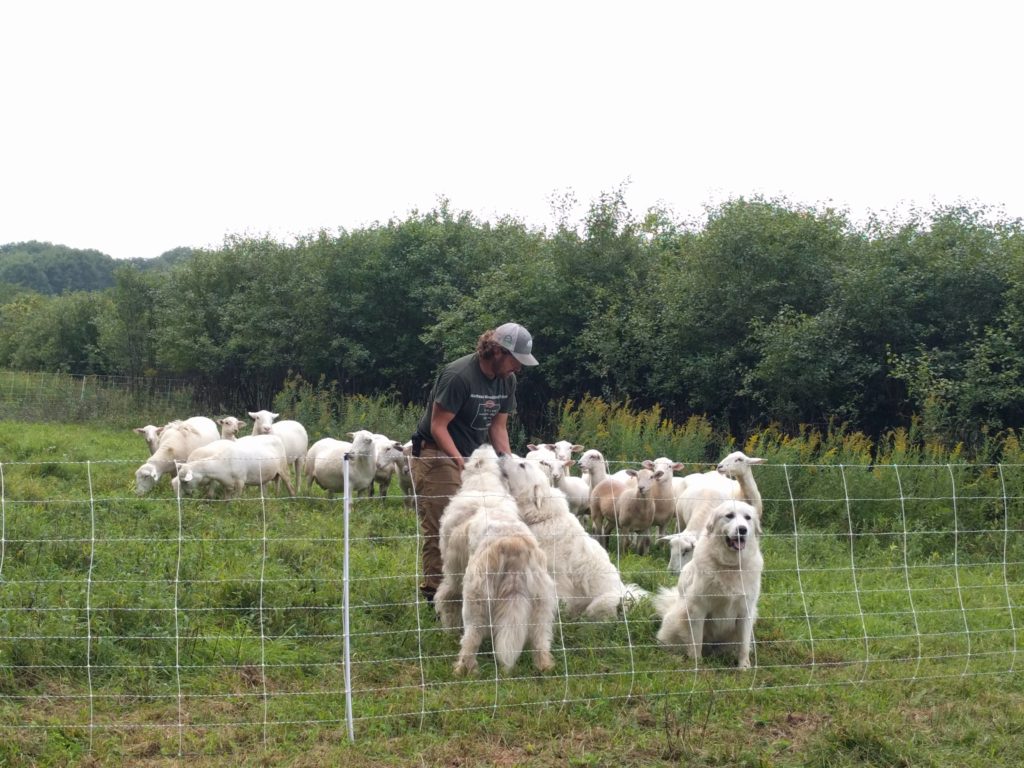
Sheep at Blue Pepper Farm (Photo by Lisa Godfrey)

Rentals were becoming more frequent, but repeatedly moving in and out of the farmhouse throughout the summer was wearing thin, so the Eatons were considering building a cabin on the property when Shannon saw that a neighbor was selling a yurt.

For a few years the yurt became their summer home — a development applauded by their young boys Wyatt and Shep who viewed it as one big campout. For adults though, the rustic pleasures of no running water and no electricity were not as enticing.

The Yurt Available for Rental at Blue Pepper Farm (Photo from Airbnb.com)

The Eatons improved the yurt until moving into a house across the road from the farm, as the rental business basically became an all-summer affair.

The farm and rental are treated as two separate businesses, but still require a precise  choreography — making yogurt, cleaning the rental, staffing farmers markets. Both are a lot of work, but there are some built-in advantages.

The pastoral setting (it is hard to out-quaint a herd of sheep) and grand mountain views are obvious assets, but so is living across the road. Shannon said guests are particularly appreciative of having the hosts nearby in case something is in need of attention.

“People like that we’re available,” Shannon said. “We try to read the room, to see if they’re more social or if they want their space.”

The Farmhouse Available for Rental at Blue Pepper Farm (Photo from Airbnb.com)

Some become genuine farm groupies, showing up in Blue Pepper t-shirts and eager for farm tours. Others take more adjustment. “One told us they had seen twelve flies,” Tyler said. “They said ‘we know we’re staying at a farm, but — twelve.’”

The large farmhouse rents for $522 a night during the summer season (somewhat less at other times of the year), a cost that can easily be shared among two families. Impeccably decorated, it also features a pool, large deck, woodstove and of course the proximity to Whiteface Mountain and grand views accented with herds of sheep and lambs.

The Farmhouse Available for Rental at Blue Pepper Farm (Photo from Airbnb.com)

As short-term rentals have proliferated, Tyler said he hasn’t noticed an oversaturation of the market. Still, just to be sure, he lowered the price a bit to ensure that it stayed booked. “It’s more valuable to have it booked all 12 weeks (of summer) and take a little less,” he said.

Tyler said a side benefit is that it forces neat-and-tidy farming, to the degree possible. The farmhouse is close to the barn, but he has fashioned a “farm pit” where machinery, supplies and other tools of the farming wars are stored, more or less out of sight of vacationers.

The Shepherd’s Crook Tiny House Available for Rental at Blue Pepper Farm (Photo from Airbnb.com)

“It’s been massively successful, but a lot of it is location, and the compatibility,” Tyler said. “We’ve been able to manage the farm in a way that makes it presentable.”

The results are evident on Airbnb, where virtually everyone gives the experience five stars and the Eatons are listed as “superhosts.” As a June guest commented, “This is our new favorite place  to stay in the Adirondacks.”

You can find out more about the farmstays at Blue Pepper Farm here.

Raw Adirondack Wildflower Honey Tasting and Beeswax Candle Giveaway at the Adirondacks Welcome Center

06/18/2023

Queensbury, NY — As part of the I LOVE NY Summer Tour, the Adirondacks Welcome Center will be hosting a Raw Adirondack Wildflower Honey tasting and beeswax candle giveaway sponsored by the Mohawk Valley Trading Company on June 24th & 25th from 9am-5pm.
Honey has been used by humans for thousands of years for its health benefits and as a sweetener and flavoring for many foods and beverages. However, if it is to be used for its health-benefits, it must be raw honey since heating honey (pasteurization) destroys the all of the pollen, enzymes, propolis, vitamins, amino acids, antioxidants and aromatics.

According to the Scientific American: “Organic honey isn’t impossible. It’s just beyond of the ability of most beekeepers. Bee yards situated in isolated spots deep in the Adirondacks, or mountain valleys in sparsely-populated New Mexico, can probably pull off honey free of agrochemicals. Most beekeepers operate within a bee’s flight of pesticides, however, making “organic” honey an illusory proposition.”
Mohawk Valley Trading Company Raw Adirondack Wildflower Honey is in the same condition as it was in the hive, and although it is not labeled organic honey, it is as organic as you can get from honey produced in the United States.

100% Pure Beeswax Candles

Unfortunately, most people who burn candles are unaware of the dangers of burning petroleum-based paraffin (a sludge and waste product from the refining of petroleum) and scented candles which produce highly toxic fumes and soot when burned. The soot and highly toxic fumes released into the air by burning paraffin wax are the same as those found in burning diesel fuel.
Beeswax candles have been used by humans since prehistoric times and are one of the oldest sources of artificial light. Unlike paraffin candles, they do not contain any additives, synthetic chemicals or produce highly toxic fumes and soot when burned. Beeswax candles are made from the melted and filtered caps that seal the honeycomb and have their own natural honey/floral scent even when not burning.

About The Adirondacks Welcome Center

The Adirondacks Welcome Center serves as a comfortable, modern gateway to the Adirondacks region.
Food and beverages sourced from the region and other locations in New York are showcased in nine state-of-the-art Taste NY vending machines. In general, visitors can find craft sodas, locally sourced water, maple syrup and maple novelties, honey, jams, sauces, artisan cheese, fresh milk, ice cream, nuts, snack, and candy. Prepared foods like sandwiches and salads, plus non-food items like pottery, will also be available.
About The Mohawk Valley Trading Company

The Mohawk Valley Trading Company offers the highest quality organic and natural products they can produce including, but not limited to: raw honey, maple syrup, maple sugar, beeswax candles, buckwheat pillows, natural soap and natural skin care products.

For more information, contact:

Jennifer Hill Kraft
Taste NY Market Manager at the Adirondacks Welcome Center
I-87 Northbound (Between Exits 17 & 18)
Queensbury, NY 12804
(518) 487-0045
jennifer@lakegeorgechamber.com

Donna Jones
Mohawk Valley Trading Company
901 Broad St
Utica, NY 13501
(315) 519-2640
info@tenonanatche.com

  • Page 1
  • Page 2
  • Page 3
  • Go to Next Page »

Footer

  • Facebook
  • Instagram
  • Twitter
  • YouTube
alt-text

8487 U.S.Route 9, Lewis, NY 12950

Phone: (518) 962-4810

cornell-cooperative-logo

If you have a disability and are having trouble accessing information on this website or need materials in an alternate format, please contact the Cornell Cooperative Extension of Essex County office for assistance (518) 962-4810 or email essex@cornell.edu.

  • Browse
  • Markets
  • Events
  • Festival
  • Blog
  • Trails
  • Login | Join
  • Home
  • About Us
  • Harvest News
  • Local Food Guides
  • Contact Us
  • Get Listed or Renew
  • Make a Donation
  • Friends

Copyright© 2026 · Adirondack Harvest. All images to their original owners. adk-chair