
The Quest for Food Justice in the Adirondacks
by Tim Rowland |
On their way to the dollar store to buy cheap, easily consumed and ultra processed foods such as instant noodles, hot dogs, sweet rolls, and mac and cheese, financially challenged North Country people might just pass gardens, farm fields and orchards teeming with vegetables, fruits and berries, along with sun-splashed fields grazed by sheep, cattle and goats. Hoop houses shelter pastured chickens pecking at leaves and bugs outside, while inside, producers are making cheese and yogurt, baking bread and growing mushrooms.
Yet, among this bounty, people are going hungry, said Cameron Burke, Cornell Cooperative Extension in Herkimer County. The New York State food insecurity rate is currently hovering around 11.5% with rates of 15% or higher in much of the North Country. “Food insecurity is roughly defined as the inability to regularly access food that is able to support your health,” said Burke at the 2025 Food Justice Summit in Tupper Lake. Matching healthy local food with at-risk communities is the goal of multiple North Country agencies, and it’s being done in ways that might be expected and ways that might not.
Governments and nonprofits are administering financial aid programming while also packing food boxes and teaching people — some who have never used a paring knife — how to cook.
The Keeseville Public Library has plans to lend out canners for putting up vegetables and meat grinders for processing deer. In Herkimer, Burke said CCE delivers produce to underserved neighborhoods where busy moms might not have the time to shop at farm stores and markets. “The Veggie Van is a way for us to drive into food deserts and create dynamic points of access within tiny communities,” she said.
Photo credit: Cornell Cooperative Extension Herkimer County
The nonprofit Keeseville-based ADK Action is among the organizations working to match fresh and healthy farm products with people in need, while also advocating for local producers.
Kim Trombly, project manager for ADK Action, said it’s not just those living below the poverty line who risk being shut out of the local food scene, where prices are higher and food takes more time to prepare.
Food injustice also affects what are known as ALICE, or “Asset Limited, Income Constrained, Employed” households — calculated by United Way as making up 30% to 40% of the North Country population. These are people who work and are technically not impoverished, but have no assets, little savings and live paycheck to paycheck. “In that ALICE threshold where you’re making too much money to access public funding for food security, I think that’s where a lot of our community members are falling through the cracks,” Trombly said.
To help, ADK Action has a Fair Share program offering free Community Supported Agriculture baskets to lower income people, and a Fair Food program, which provides targeted debit-style cards to low income individuals that can be used at local farm stands, local farm stores and farmers’ markets.
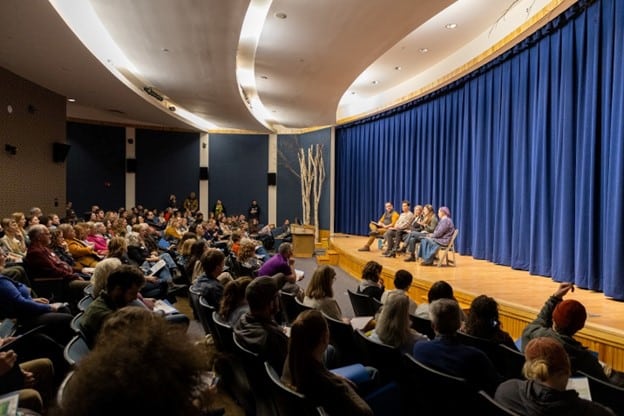
Photo credit: Jack Moulton and the Adirondack Food System Network
Those programs will put healthy food on the table for about 2,000 people this year, while benefiting local producers at the same time. “Not only are they meeting basic needs, but they also are infusing about $200,000 back into our local food system through direct payments to our local farms and the CSA shares and other local food retail outlets,” Trombly said.
The CSA shares are particularly valuable to local farmers from a cash-flow standpoint, because they’re paid up-front in the spring, when farms are ramping up with extra farmhands, but funds from the previous year’s sales are running low.
Cherie Whitten, owner of Whitten Family Farm in St. Lawrence County and the ADK Food Hub in Tupper Lake, also helps farmers and consumers by making affordable, grab-and-go meals from surplus crops — this year it was butternut squash — that might otherwise go to waste. “I’m very focused on health, so I like to provide healthy, local food that is affordable,” Whitten said. “And I have found that convenience is very important to customers.”
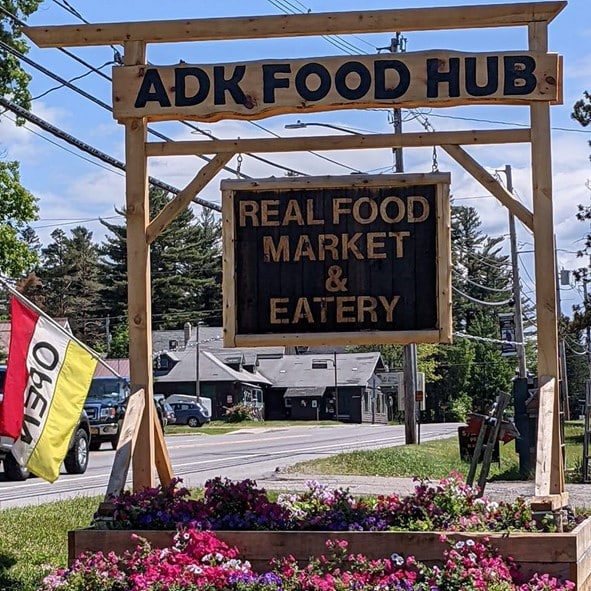
Photo credit: Adirondack Food Hub
Whitten said the co-op is “barely profitable,” but for her, the value is in the mission. “In the summer, you can come in and have food as fast as you can at McDonald’s, and not for a lot different price,” she said. “We’re like a farm-to-table restaurant, but we don’t provide service, and it doesn’t cost $100 to eat there. You can get a decent meal for $12 that’s organic, local, and fresh. I want to make this model work, and I want people to have affordable food that’s good for them.”
Local governments too have a role in putting good food on the table of lower-income families, said Jessica Darney Buehler, director of health planning and promotion for the Essex County Health Department. “The Well Fed Essex County Collaborative serves as the networking space for food system agencies in Essex County to identify gaps and work through mutually reinforcing initiatives to increase access to healthy, nutritious foods in Essex County,” she said.
Because of its work in underserved communities, the health department directly knows what’s needed and can quickly react to emerging problems as they arise, distributing nutritious food during natural disasters or after house fires.
The health department works with 600 eligible WIC (Special Supplemental Nutrition Program for Women, Infants, and Children) participants in Essex County. Along with providing supplemental nutrition, county employees have unique insight to the barriers that prevent families from eating healthy foods, Buehler said. Those barriers include “a lack of transportation, knowing what to do with raw foods, and even having the tools needed to prepare foods,” she said.
Along with the Essex Food Hub, the health department wrote a Mother Cabrini Health Foundation grant that pays for food boxes, food-preparation demonstrations at local food banks and allows WIC families to choose an appliance to support their home-cooking needs such as a microwave, instant pot or air fryer, along with mixing bowls, measuring cups/spoons, knives and cutting boards.
As federal cuts begin to impact food delivery networks and programs, food advocates believe it is worth asking whether the North can ultimately sustain itself and its at-risk people without outside help. “We are so fortunate in the Champlain Valley, where we have a rich agricultural history, and also a very large diversification of farms,” Trombly said. “We have everything we need. I think one of the really strong benefits of our program is we are really investing directly into our local food system. The more we can sustainably invest into our local farms, the greater the food resiliency across our region would be. So can we feed ourselves? We should sure try.”
Related Reading





Please take our survey: Local Food and COVID-19, Learning Through Experience
Franklin County Farm Tour
Snapshots from the 2019 Adirondack Harvest Festival!
Highlights from the 2019 Power of Produce Club!
Power of Produce Club
It’s a Wrap!


