
Spring is an Egg-cellent Time to Buy Local
By Mary Godnick, Adirondack Harvest Program Leader |
Eggs are an integral part of traditions, celebratory dishes, and the everyday diet around the globe. Historians estimate that humans have been eating eggs for roughly 6 million years. Originally, people foraged eggs from wild bird nests until they were domesticated around 1500 BCE in Ancient Egypt. Throughout history, eggs have been a symbol of life, rebirth, renewal, and fertility for many cultures.
Today, humans eat about 88 million tons of eggs each year worldwide. China is the top producer of eggs (roughly 34 million tons), then the United States (roughly 6.9 million tons), and then Mexico (roughly 4 million tons). While we may think of them as a staple of the American diet, countries like Japan, Paraguay, China, and Mexico consume more eggs per person each year.
You may have noticed the association between eggs and the warmer weather of spring.. If chickens lay eggs year-round, why are eggs associated with spring?

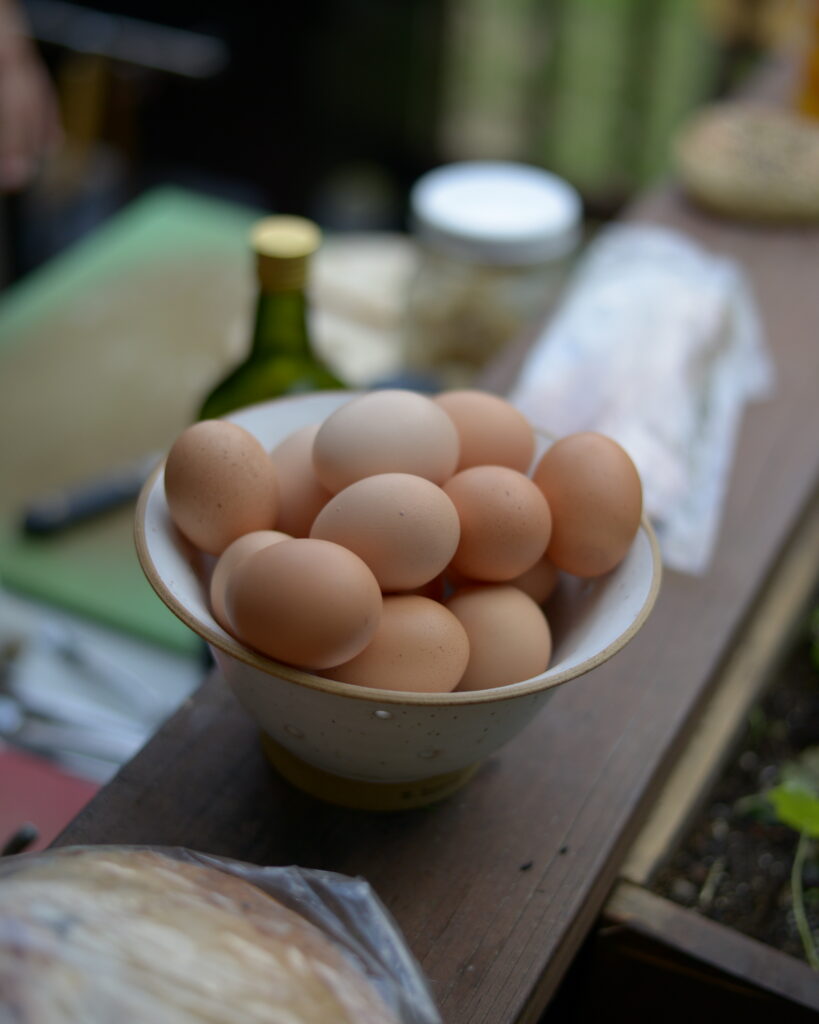
On average, each female chicken (hen) lays one egg every 24 hours. This frequency fluctuates based on factors like weather, age, health, and daylight. To produce an egg a day, chickens require about 14 hours of daylight. Farmers can use artificial lights to keep chickens producing eggs, this is what the big commercial operations do. But for many small farms, egg production simply slows down during the dark winter months. As daylight starts to lengthen in the spring, hens are put into high drive and begin producing an abundance of eggs again throughout the spring and summer.
Chickens have been a backyard fixture in the Adirondacks since the earliest European colonists and settlers moved in. Chickens were historically raised on subsistence farms for both eggs and meat. An interest in keeping backyard chickens exploded during the early days of the COVID-19 pandemic. In the Adirondacks, you can find many farmstands (from co-ops to coolers on the side of the road) with eggs for sale.
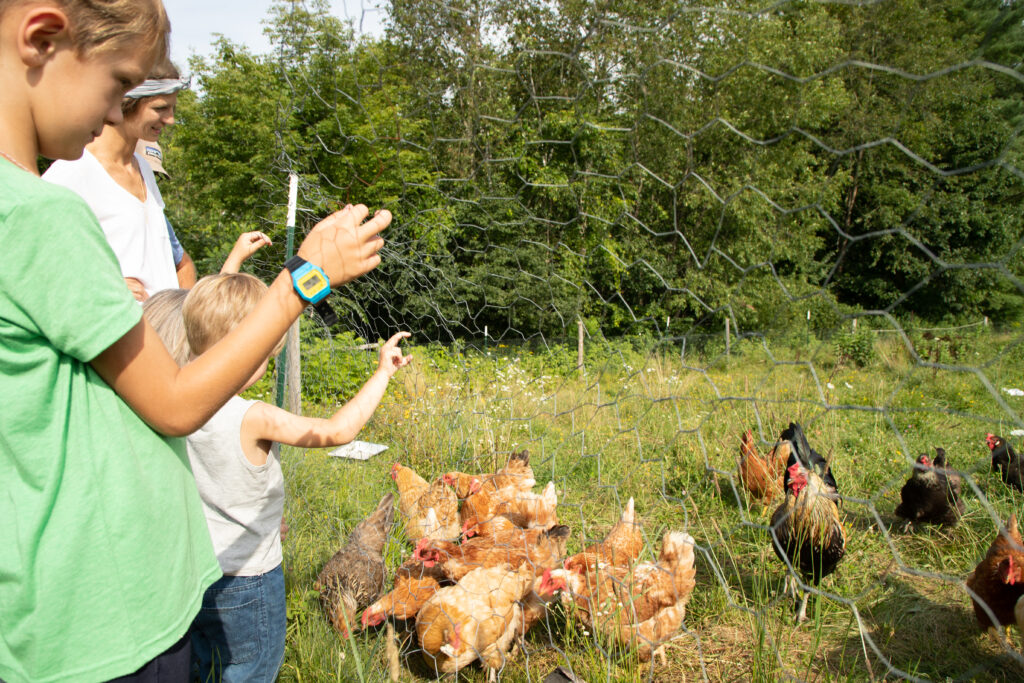
Some of the large egg operations in the area produce their eggs in facilities similar to what you’d see in a commercial operation- indoor spaces, lots of birds. Many smaller farms in the Adirondacks keep their egg layers outdoors, in a coop with access to pasture usually in a fenced-in area.
So why buy locally-raised eggs? How a chicken is raised and what it is fed are the biggest determinants in the flavor and nutrition of the eggs they make. According to a 2010 study from Penn State’s College of Agricultural Sciences, eggs from pastured chickens had up to twice the amount of Omega 3 Fatty Acids and Vitamin E than eggs from conventionally raised chickens. Chickens that have the opportunity to forage in grassy open spaces will also create eggs with deeper yellow yolks and more flavor.
The majority of eggs sold at grocery stores and commercially are made in large-scale egg operations, where chickens are confined, crowded, and live in generally miserable conditions. They are not a healthy place for animals or workers to be. They are notorious for causing dangerous levels of pollution in surrounding communities. If you’re curious about how eggs are produced on a local farm, just ask! Most farmers will be happy to tell you how their animals are raised, and may even offer to give you a tour so you can see for yourself.
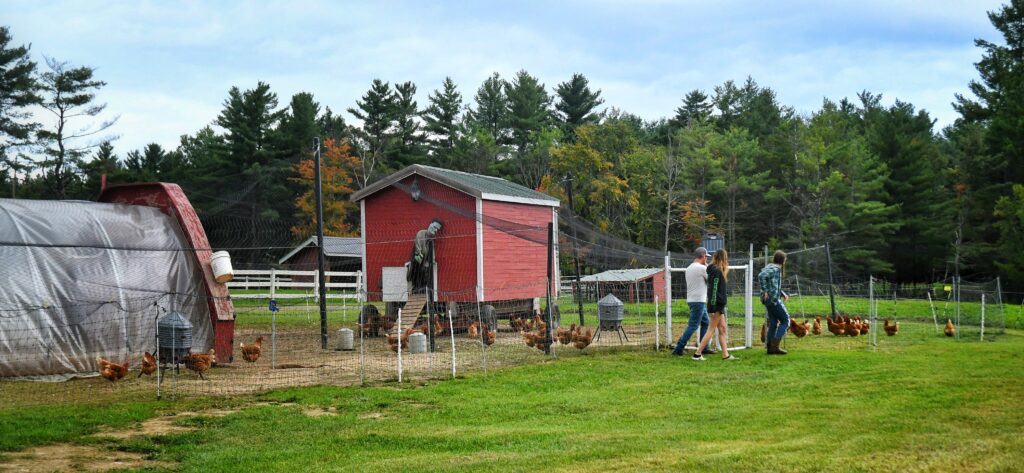
Because consumers are becoming more aware of the importance of healthier living and growing conditions for farms, and are becoming more discerning about the products they purchase, large companies have used this as a way to charge a premium for their products. There has been a large increase in the sale of “pastured” eggs in the United States in the past three years.
However, “pasture-raised” or “pastured” eggs just means that birds have access to the outdoors for 120 days of the year. This definition does not specify how big, or what kind of space the birds have access to. Additionally, “Cage Free” only means that a bird isn’t kept in a cage, usually, this means they are still kept indoors in cramped conditions, just not in a wire cage.
So how do you know that the qualities that are most important to you are more than just a label slapped on a package?
The only way to truly know how a bird is raised, fed, and treated before you buy her eggs is to talk to the farmer, and better yet, visit their farm and see how they are raised yourself! Our small farms in the Adirondacks are stewarded by dedicated farmers who deliberate tough decisions about what their animals eat, how they’re housed, and how they’re cared for. They know that the health and well-being of their animals is directly linked to the quality of their products.
Many locally raised eggs also come in fun a rainbow of colors and sizes. From pure white, deep brown and shades of blue and green. The color of an eggshell is determined by the breed of chicken that lays it. As an egg travels through the chicken’s oviduct, the shell starts forming and becomes white. This takes approximately 26 hours. Different breed chickens will release different pigments in their oviduct during this phase, which are absorbed by the forming eggshell, thus creating different colored eggshells.
The color diversity of local eggs is beautiful, but there is no difference in nutrition or flavor between different colored shell eggs. The biggest determinant of egg quality, nutrition and flavor is how the hens were raised and how fresh the eggs are.

Many local farms are starting to offer not only chicken eggs, but duck eggs. Duck eggs are larger and richer than chicken eggs, their whites are less watery, and they have bigger yolks. Some people also find duck eggs to be creamier and more flavorful than chicken eggs, and are especially good for baking. When baking, simply use 2oz of duck eggs for every egg called for.
You may be thinking, this all sounds well and good but I just can’t justify spending $7 a dozen on eggs when I can buy them at the grocery store for $4 a dozen. While this is true, it’s not a comparison of apples to apples. The cost difference is actually pretty minimal- Market 32 sells their brand of large free-range organic eggs for $7.58 a dozen, and most local farms sell their eggs for about $4-7 a dozen, and they are generally higher quality, give their hens better living conditions, and utilize more sustainable farming practices.
Where you choose to buy your groceries from also has a bigger picture ripple effect than just the money saved in your pocket. Reducing the number of miles your food travels from field to the shelf directly shrinks your grocery carbon footprint. It’s been estimated that locally grown food creates 5 to 17 times less CO2 than nationally wholesale distributed food. It also is an investment in the farms that provide jobs, feed your neighbors and steward the land in your community. The more local food we add to our plate, the more we can realize many economic, environmental, and social benefits.
From the Saratoga Farmers’ Market
INGREDIENTS
*Ingredients currently in season locally
- 4 large eggs*
- 4 egg whites*
- 2 TBSP milk*
- ½ tsp salt, divided
- ¼ tsp pepper, divided
- 1 cup mushrooms of choice, sliced
- 1 cup kale*, chopped
- 1 cup bacon*, cooked and chopped
- ½ tsp chopped fresh thyme leaves
- 1 TBSP chopped parsley leaves* (reserve some for garnish)
- ½ cup chevre* (or another soft cheese*), crumbled into tiny pieces
INSTRUCTIONS
- Preheat the broiler and place the top rack 4-5” from the element. Whisk together the eggs, egg whites, milk, ¼ tsp salt, and a pinch of pepper and set aside.
- On the stovetop, melt butter over medium-high heat in an iron skillet. Add vegetables and saute until they begin to soften for about 3-4 minutes. Add in the bacon, thyme, half of the parsley, 1/4 tsp salt, and a pinch of pepper. Cook stirring for 1 more minute.
- Pour the egg mixture over the veggies and stir to evenly spread the veggies around. Let it cook, for about 3-4 minutes. Remove the skillet from heat and sprinkle cheese over the top.
- Place skillet under the broiler until eggs are slightly puffed and cheese begins to bubble and brown, 3-4 minutes. Watch carefully. Remove from the oven, and slide frittata onto a serving platter. Garnish with remaining parsley. Slice and serve.
Almost every farmstore, co-op, and farmers’ market will have local eggs for sale. Many local bakeries and restaurants also use local eggs in their dishes. Visit adirondackharvest.com/browse to find local eggs near you.
Spring is also a great time to travel along the Adirondack Cuisine Trails and get a taste of the Adirondacks. This time of year, the blackflies and mosquitoes are out in full force deep in the forests and on the lakes of the Adirondacks, so you may want to opt to spend a day visiting some farmstores, markets, wineries, breweries, and restaurants along the Adirondack Cuisine Trails instead of hiking and paddling. Find out more about the Adirondack Cuisine Trails at adirondackharvest.com/adirondack-cuisine-trails.
Mary Godnick is the program coordinator for the Adirondack Harvest program at Cornell Cooperative Extension of Essex County. This article was written with grant funding through CVNHP and NEIWPCC.
This article originally appeared in the June issue of Northern HGL Magazine.



Related Reading





Please take our survey: Local Food and COVID-19, Learning Through Experience
Franklin County Farm Tour
Snapshots from the 2019 Adirondack Harvest Festival!
Highlights from the 2019 Power of Produce Club!
Power of Produce Club
It’s a Wrap!


