
Grafting Heritage Fruit Trees at Mace Chasm Farm
By Tim Rowland
Armed with pruners and a clipboard, Courtney Grimes-Sutton surveys row upon row of young apple trees, none of which are named Red Delicious or McIntosh. The varieties in her nursery at Mace Chasm Farm have names average consumers have never heard of, and rich, complex flavors they have never tasted. Once they get a bite, Grimes-Sutton believes, they might never go back.
These are antique apples (she also grafts other fruit trees, including cherries, quince, plums and Asian pears) that hail to the pre-monoculture days when farm catalogs brimmed with hundreds of varieties, some tart, some sweet, some specifically for cider and some admittedly weird by today’s standards — shaped like an egg, for example.
Many of these trees were almost lost to time, saved only by a small but dedicated band of antique apple sleuths and propagators. “In some cases, there was only one tree left,” Courtney said.
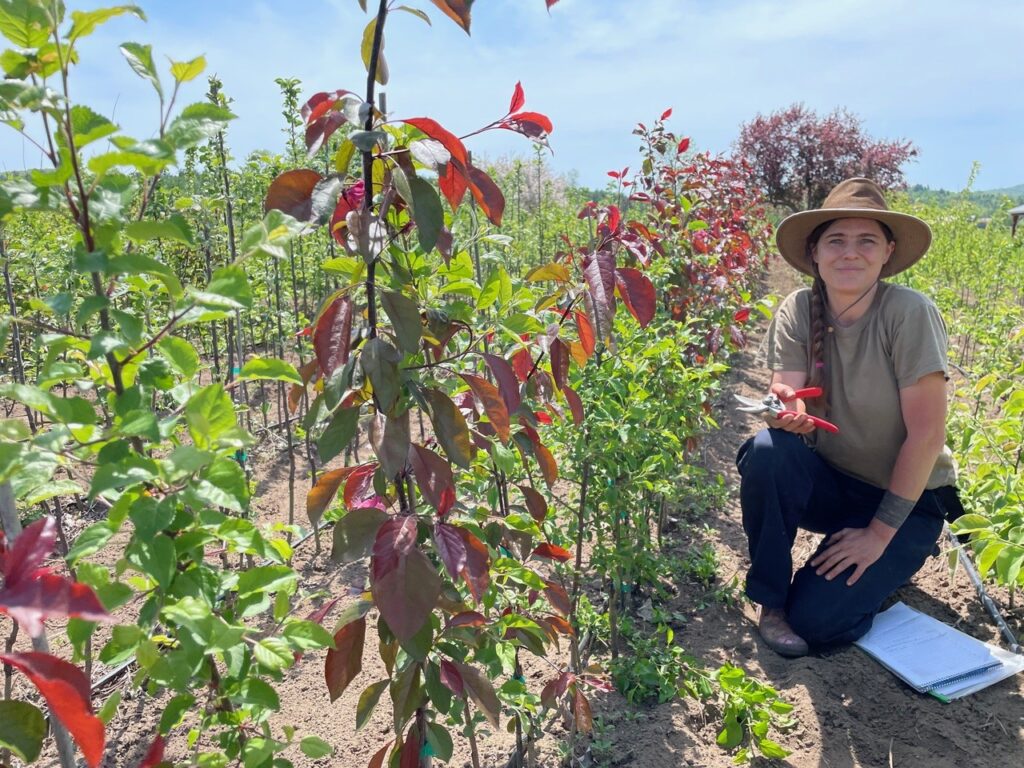
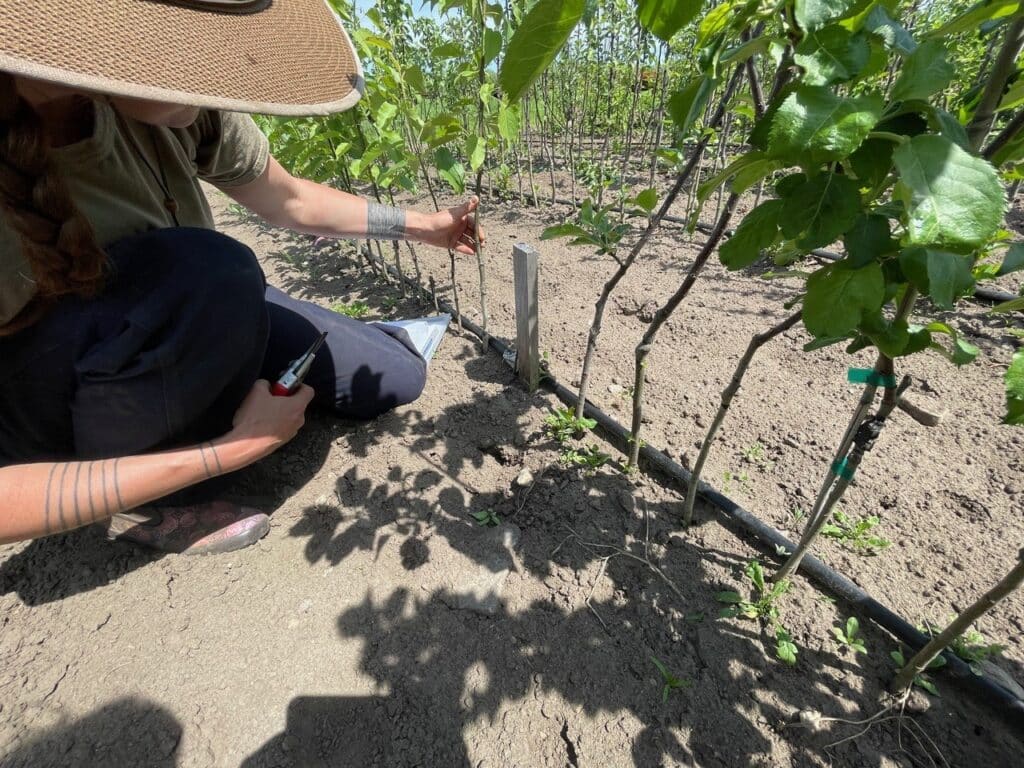
But bringing these fruit trees back from the brink is not as simple as gathering fruit and saving seeds. Because of cross-pollination, apple seeds do not produce true copies of their varieties. So varieties are replicated by taking scions or buds and splicing them onto a suitable rootstock, in this case the Antonovka stock from Russia that’s suitable to the North Country. The grafted scion will determine the variety, while the rootstock will dictate the tree’s mature size and hardiness.
Grimes-Sutton grafts the trees and grows them for 18 months before they are dug and shipped to the national retailer Fedco Seeds of Maine. From there, Fedco sells the trees through their website and catalog and sends them by mail to customers across the US. At certain times during the year, Mace Chasm also offers these antique fruit trees for sale locally.
Mace Chasm, which Courtney owns with her husband Asa Thomas-Train, is best known for high-quality meats, including its signature sausages that Grimes-Sutton creates based on seasonal herbs and flavorings.
Without the ability to greatly expand capacity, however, small farms often concentrate on diverse or value-added sidelines. But in taking on heritage fruit trees, Courtney had another goal in mind as well.
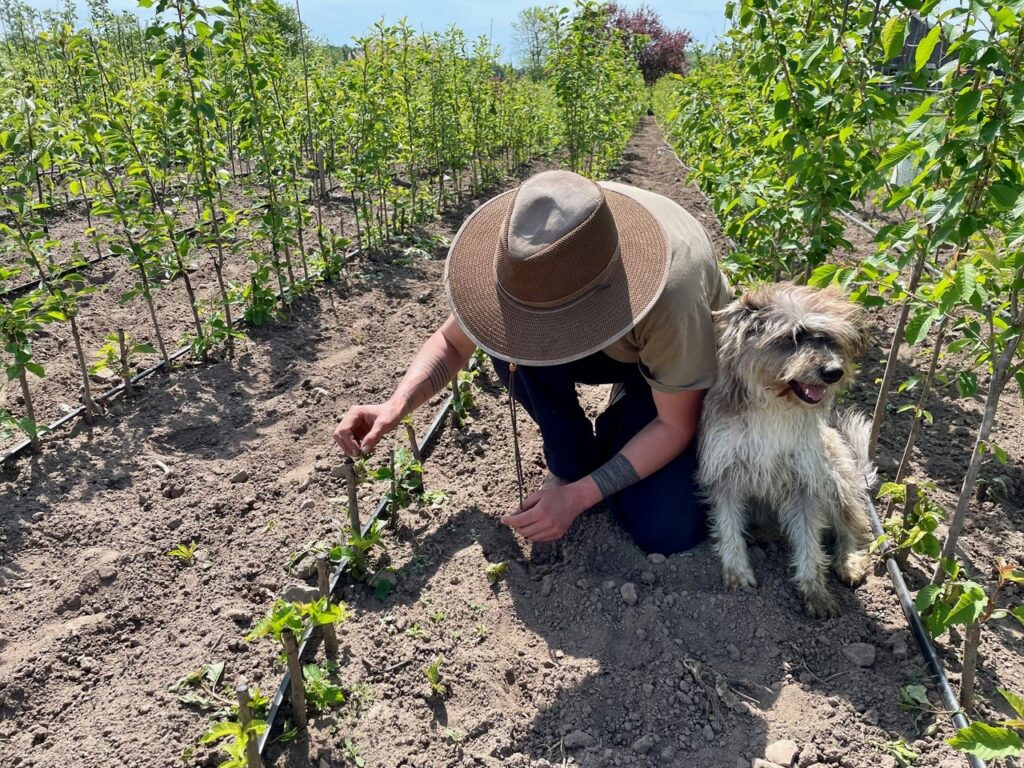
“The butchery work is interesting and satisfying to me, but I needed to be out in the fields as well in the elements for balance,” she said. Her farm work occupies her time six days a week, but her off-day is now spent in the nursery caring for 3,000 trees.
Jacob Mentlik, Scionwood Coordinator for Fedco, said these apples have a broad set of characteristics (not just for eating) and have piqued the curiosity of people who are hungry to learn more.
“There is a growing interest in heirloom cider apples for bittersweet and sharp flavors, storage apples that can be kept through the winter, and cooking apples that hold their shapes for pies and tarts,” Jacob said. “We like to offer a balance of varieties, both modern and heirloom as well as notable wild apple discoveries that our network of fruit explorers and cider makers have found to be well adapted to our local conditions.”
Antique apples aren’t the most attractive of fruits, sometimes mottled or misshapen, which explains how they fell out of favor. “In general, heirloom apple varieties have a much larger range of flavors and uses than modern apples, which are mostly bred for disease resistance and commercial production, uniformity and such,” Jacob said.
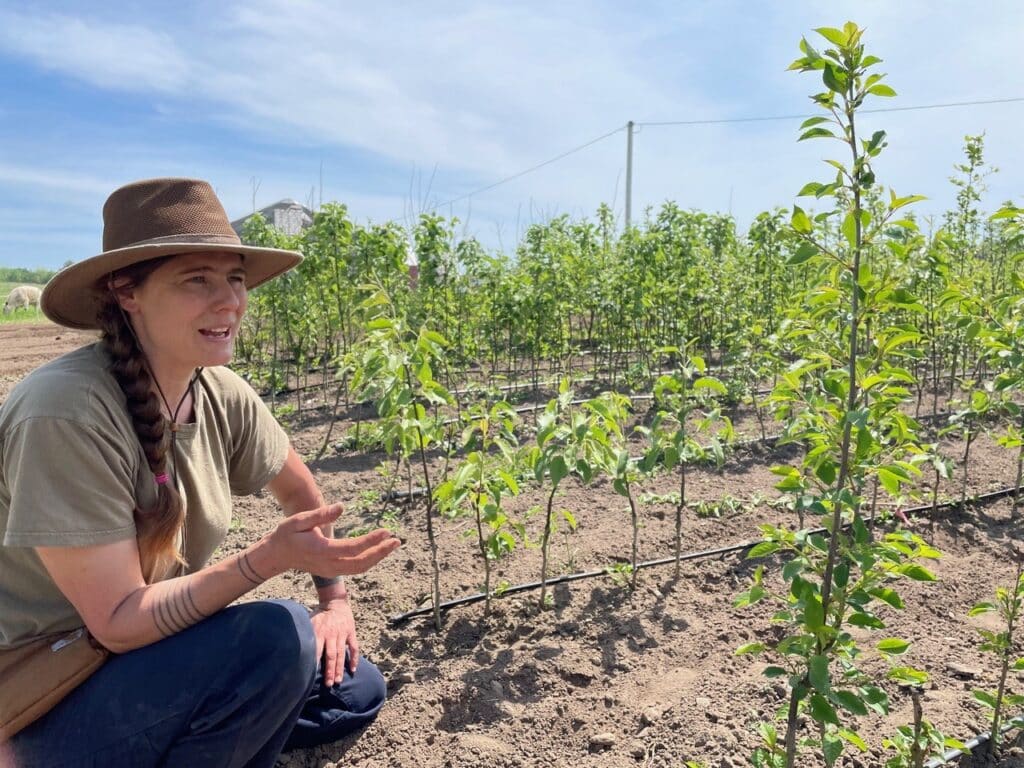
At Mace Chasm, the nursery work fills an important time slot. In the North Country, the high season for sales lasts 20 weeks through the summer, before dropping off precipitously in October. That’s about the time the saplings are dug and placed in cold storage in anticipation of spring sales. Those sales come at just the right time — when farm employment begins to ramp up, but income is typically at its lowest point.
“We have had challenging seasons in recent years when it felt like we needed to diversify the farm income or change our model,” Courtney said, “mostly due to inflation and rising costs that we don’t feel can be fully reflected in the prices of our goods; so small margins shrink further.”
Fedco pays $14 a tree, and trees that are sold locally bring double that price. It’s a land-efficient crop — an eighth of an acre is sufficient for a nursery. There are periods of intense labor, but unlike a squash that can rot if not attended to, the trees are more forgiving.
Skill is needed to graft, but for Courtney — a talented welder, among other things — the process of fusing two pieces of wood comes naturally. By herself she can graft 250 trees a day, although it should go without saying that for most people it’s not that easy.
Courtney also does custom grafting. If there’s a “wild” or unidentifiable apple you love, she can replicate it. Just down the road from her farm was a tree along the road whose fruit was enjoyed by the whole community as being out of the ordinary. No one can quite identify the fruit, but whatever it is, the variety has now been revitalized thanks to Courtney’s grafts.
Antique fruit trees, Courtney said, represent more than cider and pies. They also stand as an allegory for small farms that themselves are in danger of being lost. “Small-town America died when small agriculture died,” she said. Monocultures and megafarms have damaged the flavor not just of crops, but communities.
And these unique communities are perhaps like the apples themselves, of which Courtney said, “They’re like nothing you’ve ever tasted.”
You can buy Mace Chasm’s fruit trees along with their pasture-raised meats and other local food items at their self-serve farmstore in Keeseville. Learn more about Mace Chasm and other local producers, farmers markets and local food retailers at adirondackharvest.com/browse.
Funding for this blog post was made possible by a grant/cooperative agreement from the U.S. Department of Agriculture (USDA) Agricultural Marketing Service. Its contents are solely the responsibility of the authors and do not necessarily represent the official views of the USDA.


