
Agrivoltaics Continues to Emerge as Promising Opportunity for North Country Farmers
In a striking overlay of past and future, a flock of sheep can be found northwest of Plattsburgh grazing a lush pasture of alfalfa and orchard grass beneath dark, glossy solar panels, a scene that has elements of both our pastoral ancestral roots and science fiction.
What are agrivoltaics?
Agrivoltaics, pronounced as [ag-riv-ol-TAY-iks], is the simultaneous use of an area of land for farming and for electricity generation using photovoltaic solar panels; a system or technology that enables this (Oxford English Dictionary).
Essentially, the sheep are hired lawnmowers really, that keep the vegetation down cheaply and with less fossil fuel consumption than their four-wheeled competition. Meanwhile, the farmers actually get paid to manage the site instead of shelling out money for a traditional lease. For the property owners, solar arrays are a way to subsidize existing farming operations or generate a retirement income without selling their beloved fields for housing developments.
None of this is to mention the clean energy that’s being produced, which, after all, is the central point.
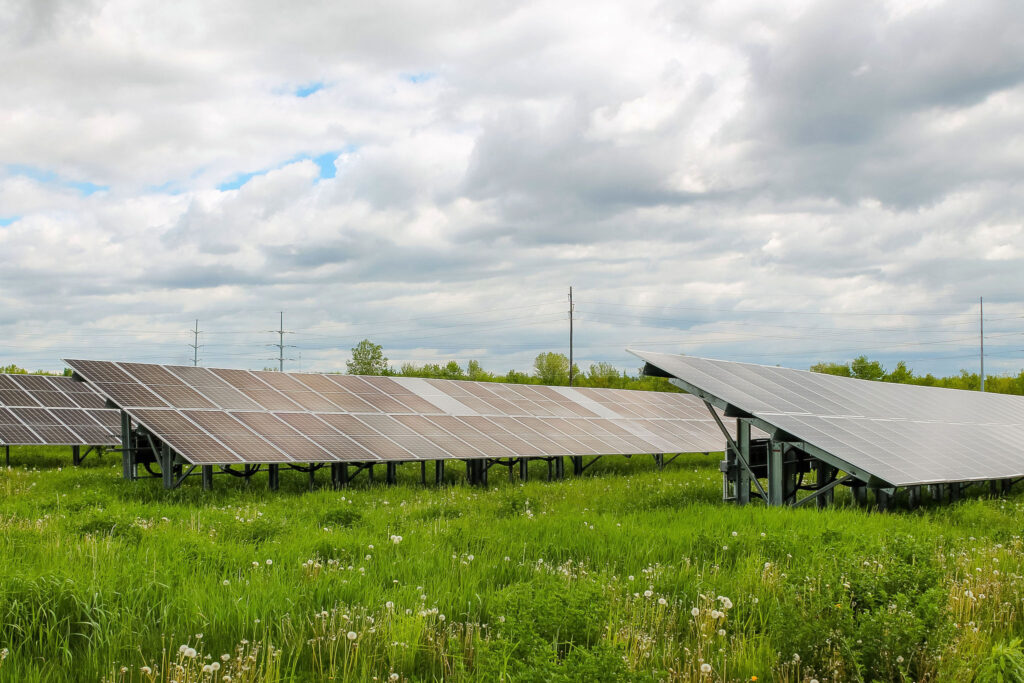
A North Country sheep grazier working with solar arrays
The sheep on this solar array belong to Rebekah and Josh Pierce, owners of J&R Pierce Family Farm. The Pierces were early adopters of agrivoltaics in the North Country, a surprisingly efficient way to fatten sheep on land that is also producing power.
At ten North Country solar sites totalling 200 acres, they graze 300 sheep, deftly moving thin electric lines that allow them to efficiently rotate their livestock throughout the space. Permanent and high-cost perimeter fencing is not an issue because solar arrays already have one enclosing the panels, as required by law.
Both the grass and animals do better because of the intermittent shade the panels provide. The sheep are, well, sheep. They are not naughty like goats, nor are they damaging, half-ton behemoths like cows that like to scratch their backs on whatever hardware might present itself.
For J&R Pierce Family Farm, the arrangement is not just a business model, it’s a revelation into the future of farming.
The Pierces were not looking to become farmers when they bought 22 acres of land in West Chazy in 2015; they just wanted plenty of space to walk their dog. But they got a coop of chickens, and that’s how it starts.
They soon added other animals to become hobby farmers, who enjoyed working the land so much that they liked the idea of farming full-time.
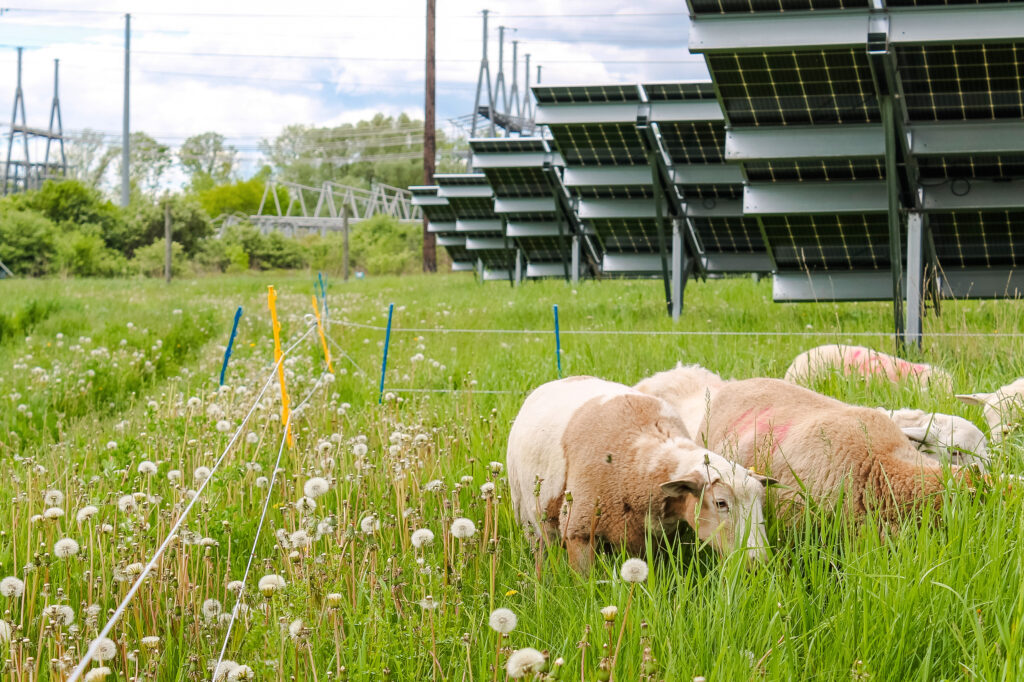
Getting started with solar grazing
With the price of land, buying or leasing enough to scale-up was out of the question. Then came a conversation with the farmer from whom they bought their hay. He was in his 70s and was financing a well-deserved retirement with the income from a solar lease.
The Pierces were inspired with his idea, but the decision would ultimately rest with the solar company. When solar development really started to ramp up across the state, companies would try to negate concerns about farmland loss at town board meetings, by assuring a skeptical public that animals could graze beneath the panels. But they didn’t always mean it.
“This site was not designed for grazing,” Rebekah said. “We had to lobby pretty hard. They were worried about the risk, and we kept saying there’s no risk. Sheep aren’t goats. They’re not jumping on things or chewing on equipment. The [sheep] just want to eat [grass].”
It worked, and in the North Country, what had once been a PR talking point was now becoming an industry standard. “This is helping to keep farmers on the land,” Rebekah Pierce said. “As more people talk about it, developers are starting to realize that if they want community buy-in, they need to incorporate these kinds of agricultural uses into more sites.”
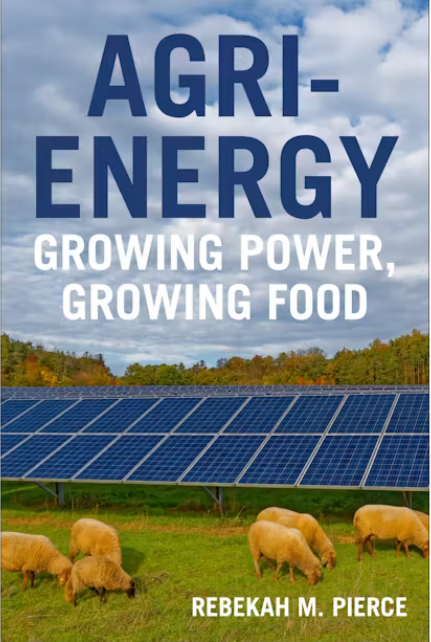
Rebekah said she started seeing the relationship between agriculture and energy in increasingly symbiotic ways and was inspired to write the book Agri-Energy: Growing Power, Growing Food.
In a technical sense, it was still true that small-scale farming didn’t pay. But combined with renewable energy, it would.
“We wouldn’t be farming full-time without it,” she said. “Even if you take away the payment we get for vegetation management, we wouldn’t have access to enough land to graze the number of animals we’re doing now.”
Debates over farmland protection have largely shifted as solar grazing continues to become more established, said Cole Trager, Agriculture & Local Food Team Leader for Cornell Cooperative Extension of Essex County. While there still may be concern that the land is unavailable for tillage or hay production for 30 years, the economic realities for graziers are hard to argue with.
Land is often considered a farmers’ retirement account, and while ideally they might want to sell to a young person interested in carrying on the agricultural tradition, few young farmers have the kind of money it takes today to buy large tracts of land.
Solar provides a steady retirement income without having to sell the land at all. For younger farmers who still want to farm, a solar array can at minimum pay taxes on the land and make the operation more viable. Either way, “it can be a dream opportunity for farmers,” Trager said.
Solar developers seek sheep for grazing
Solar arrays have experienced a growth spurt in this decade. According to the Adirondack Park Agency, since 2020, the APA has received 51 solar project pre-applications and applications. Of those, 17 projects have been approved already — 16 by the APA and one 40 megawatts through the state Office of Renewable Energy Siting. Of the 16 APA-approved projects, three were between 10-20 megawatts, while the remaining 13 were 5 megawatts or smaller.
Commercial arrays are not automatically subject to APA permitting, but it’s generally required for commercial solar projects that generate power for off-site sale. An APA spokeswoman added that not all applications come to fruition.
Today, the Pierces say many developers actively seek grazing partners, but they also spend time poring over town planning board minutes searching for projects that may be progressing under the radar.
Nationwide, solar grazing is growing fast. According to its most recent census in October 2024, the American Solar Grazing Association reports there were more than 113,000 sheep grazing 129,000 acres across over 500 solar sites.
Solar grazing logistics for happy herds
The work involves much more than simply turning sheep loose in a field. Animals are moved frequently through rotational grazing systems that improve forage quality and protect soil health. The sheep may only spend a short time in one section before moving on.
“We like to wait about 45 days before putting animals back on the same area,” Josh said. “That’s good for the forage, but it’s also important for animal health.”
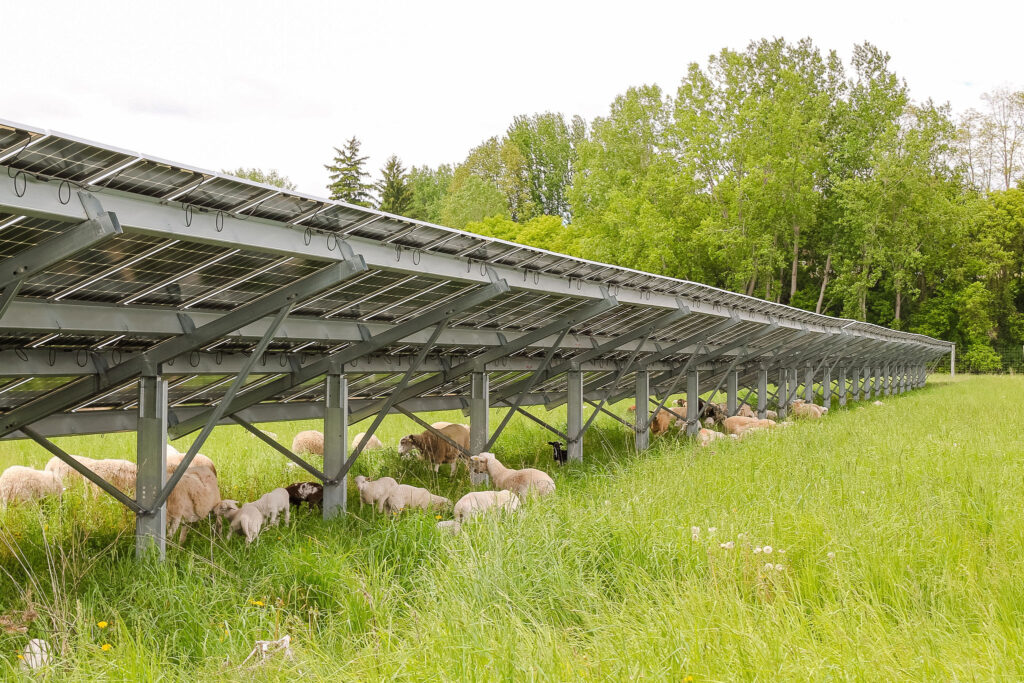
The system offers unexpected benefits. Sheep often prefer forage growing beneath the panels, where shade keeps plants tender and moisture levels higher. During last year’s drought, the difference was striking.
“Everything between the rows burned up,” Josh said. “But underneath the panels we still had green growth. We were still able to graze because that shade protected the forage.”
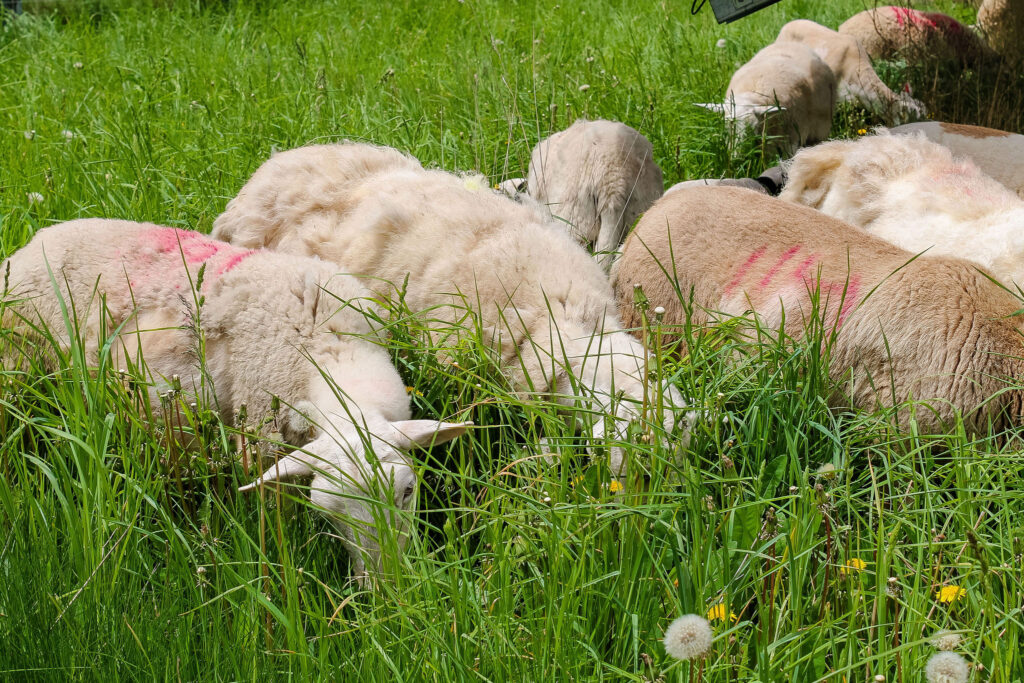
Back among the sheep, lambs rest in the shade beneath the panels while their mothers graze nearby. The animals gain weight, vegetation stays under control, and electricity flows into the local grid.
For the Pierces, that combination is not a contradiction; it is the future of working farmland.
“We need to stop thinking of it as energy versus agriculture,” Pierce said. “The question should be how we can make them work together.”


