• Skip to main content
  • Skip to footer

Adirondack Harvest

Farm Fresh Foods, Local Producers and Adirondack Farmers' Markets

  • Browse
  • Farmers’ Markets
  • Wholesale
    • Buy Wholesale
    • Local Food Wholesale Database
    • Sell Wholesale
    • Join the Wholesale Database
  • Learn More
    • Explore the Adirondack Cuisine Trails
      • About the Adirondack Cuisine Trails
    • Benefits of Buying Local Food
    • What’s in Season When
    • Farming in the Adirondacks
    • Meet the Makers
    • Decoding Food Labels
    • Food Assistance Benefits & Local Food
    • Food Assistance Benefit FAQ
    • Blog
  • Events
    • About the Adirondack Harvest Festival
    • 2025 Adirondack Harvest Festival
    • Event Calendar
  • Email Sign-Up

Ag in the Classroom

AuSable Forks Elementary Students Get A Sweet Introduction At The Uihlein Maple Research Forest

04/15/2026

By Tim Rowland | Contributing Writer

Freed of the walled confines of AuSable Forks Elementary School, 19 second graders sprinted up a snowy hill to explore the sugarbush where 6,500 maple trees are tapped each year by Cornell University’s Uihlein Maple Research Forest in Lake Placid.
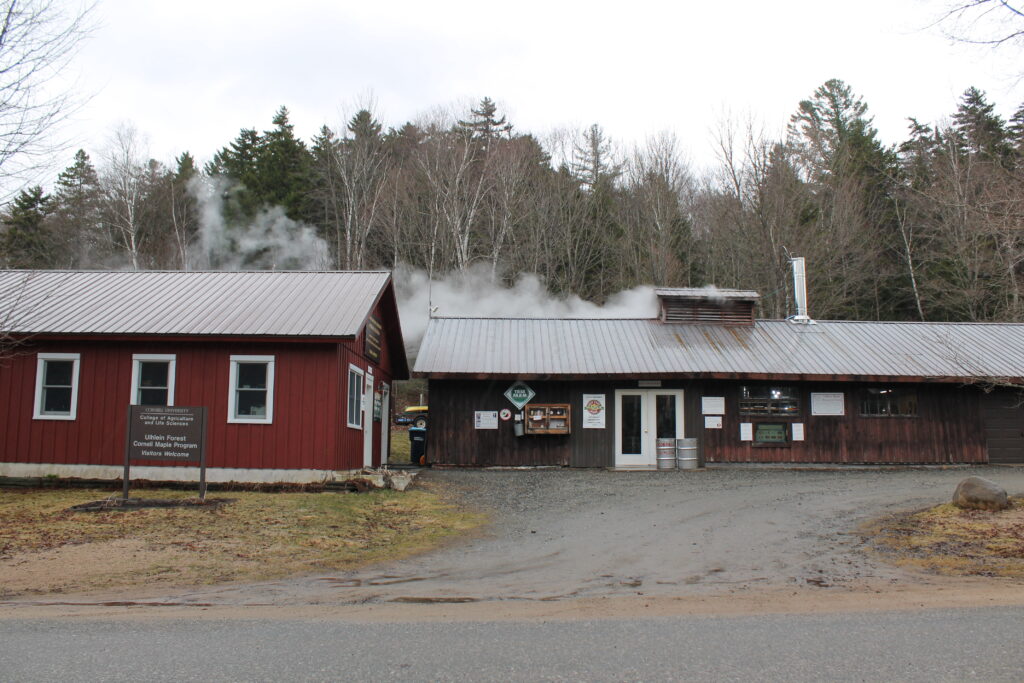
Cornell University Uihlein Maple Research Forest. Photo by Isabella Susino.

The class was there as part of Cornell Cooperative Extension of Essex County’s (CCE Essex) Rooted in Learning program, which explores local farms and foods, increasing students’ awareness of where their food comes from, and how positive food choices will help them lead healthy lives.

Second-grade teacher Liz Donahue said exploration of Adirondack forests also expands the children’s connection to the land and culture.

Thanks to a previous maple tree-tapping demonstration by CCE Essex Community Vitality Resource Educator Ellie Hoffman, the second graders understood the fundamentals of sugaring already. At the Uihlein Forest, they learned that it can be a long way from tree to pancake, with a lot of pipelines and big machinery in between.

“Farm field trips are where Farm to School programs come full circle,” Hoffman said. “Students might learn about agriculture in the classroom through hands-on activities and taste the products of that agriculture in their school cafeterias, but the farm or forest is where they discover how those products got to the cafeteria, and why knowing that matters.”
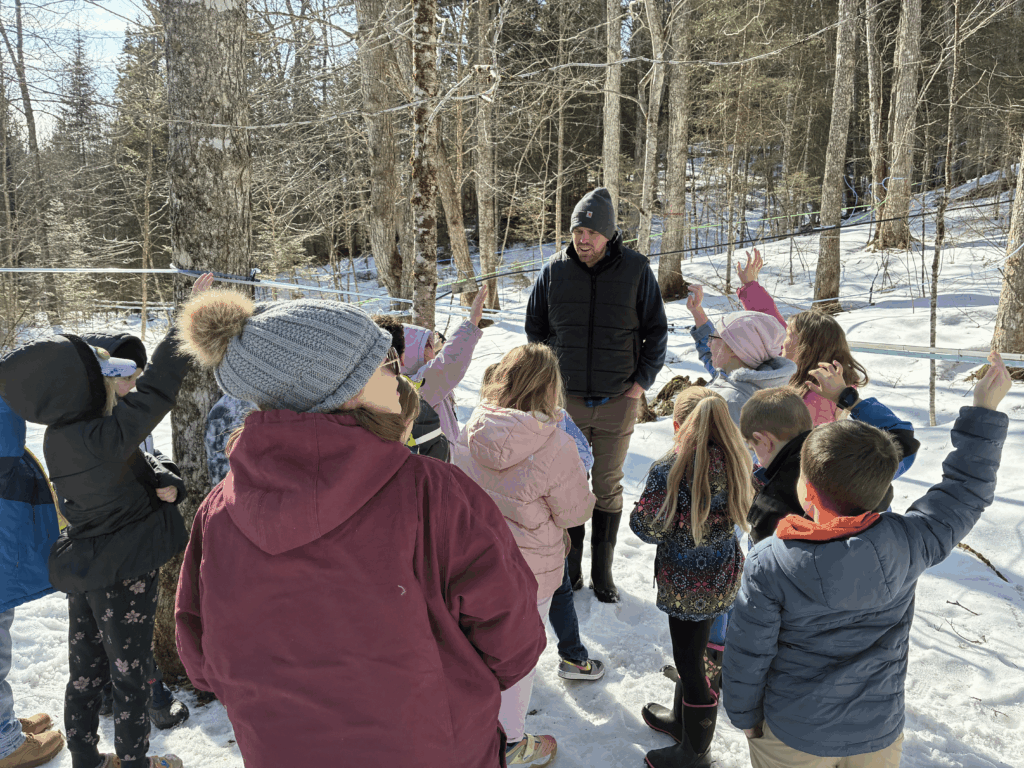
Adam Wild with AuSable Forks second grade students in the sugarbush. Photo by Liz Donahue.
Director Adam Wild with AuSable Forks second grade students in the sugarbush. Photo by Liz Donahue.

Adam Wild, Director of the Uihlein Maple Research Forest, began by explaining how maple trees are identified in the forest by the color and texture of the bark. Maples were also identifiable by the blue piping affixed to their trunks, but that was cheating.

“These are natural, native forests,” Wild said. “These trees weren’t planted, so maple’s kind of cool in that we’re working in these natural forests in our Adirondack Mountains, and that’s where we get the sap from.”

These maples grow alongside other trees, such as fir and birch, and this diversity is good, he said, because it protects the forest as a whole against attacks from pests or disease that affects one particular species.
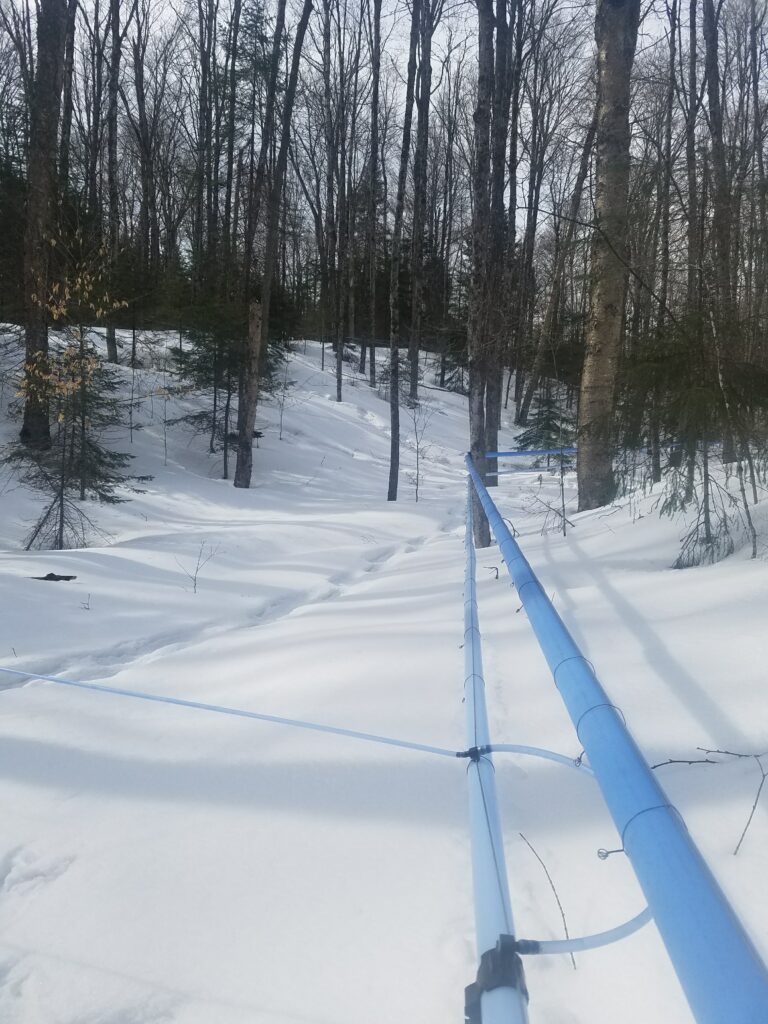
Uihlein Research Forest sap tubing. Photo by Adam Wild.
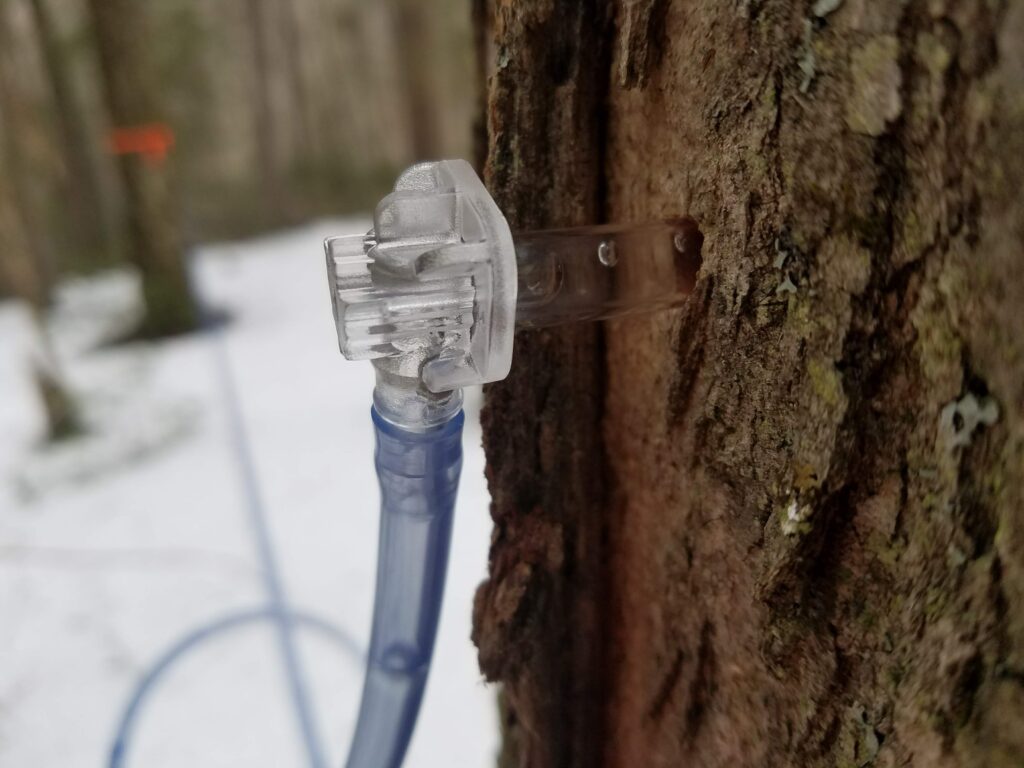
A tap in the maple tree filled with sap. Photo by Adam Wild.

Thirsting for action, the kids cheered when the sap was clearly visible flowing from the tree through the tubing — 100 miles of it in the Uihlein forest — that would send it to the sugar shack below.

If this tubing looks fragile, though, it’s because it is, and leaks can develop by way of a falling tree or a critter gnawing through the plastic. Wild encouraged the students to consider what animals might do the most damage, and they took turns guessing: 

Bears? (They probably would, but they’re still hibernating). Bobcats? (Not so much.) Snake? (Haven’t seen one, but you never know.) Werewolves? (Nice try. Squirrels are the correct answer.

Electronics are used to detect these leaks and pinpoint their locations, saving maple technicians hours of walking and guesswork.

Maple trees are tapped when they are about 40 years old or at least 10 inches in diameter. The weather is an important ingredient in the process, with nights below freezing and gentle warmups during the day being ideal.
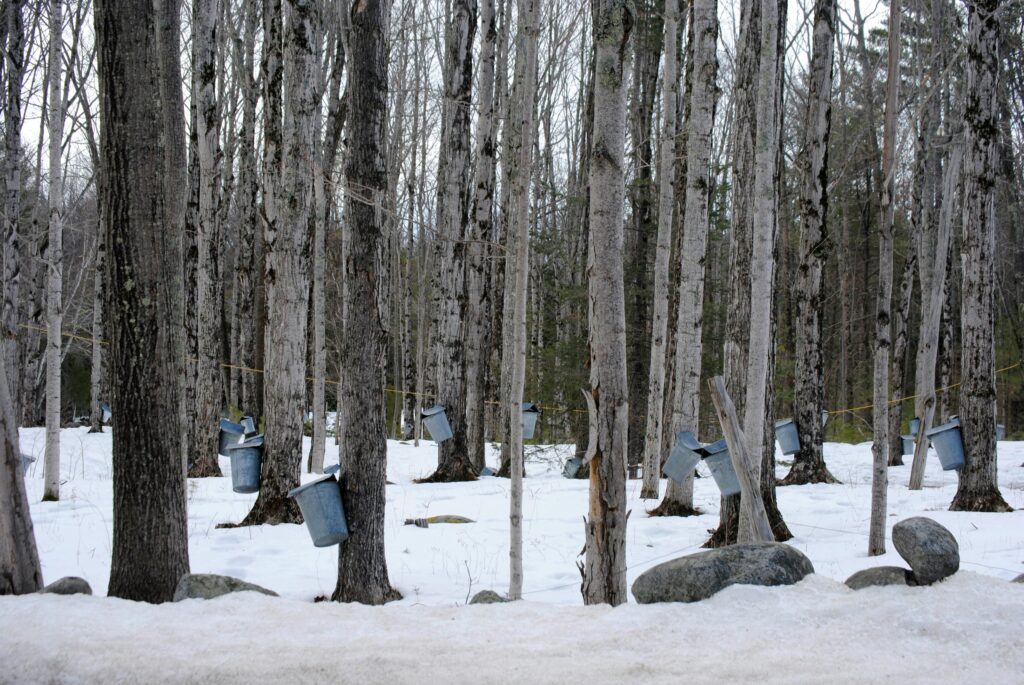
Maple forest with buckets attached to trees in winter. Photo by Matt Barnard.

While a bucket hanging from a tree with a wooden tap might be a picturesque icon of the past, it’s not practical at today’s scale. “You tapped one tree, right? Imagine doing that 6,499 more times,” Wild said. “And imagine having to walk up and down this hill in the snow, carrying all those buckets of sap, would that be fun?”

There was firm and universal consensus that it would not.

Noting that he is a maple tree scientist – at which point a student wanted to know if he’s the “mad” kind – Wild said he’s always involved in research projects. 

“I’m investigating and trying to find answers from the trees, so I’m measuring the amount of sap that comes from those trees; measuring the temperature using different probes in the trees; measuring the pressure [of the sap inside the trees]; and soil temperatures [surrounding the trees]. Collecting all this data is to get those answers.”

Those answers will help producers improve their yields.

“We’re a little unique here in that we do research to improve maple production, and then we share that with other maple producers, so they can be better maple producers,” Wild said. “Kind of neat, right?”

The AuSable second graders demonstrated a good classroom knowledge of science, understanding things like DNA and how trees are able to produce oxygen. The Rooted in Learning field trip with CCE Essex showed them how these concepts might be put to practical use.

They also offered up some burning questions for Adam about being a scientist:
● Second grader: “Do you create stuff when you’re a scientist?”
● Adam Wild: “Yes, sometimes.”
● Second Grader: “Like monsters?”
● Adam Wild: “No, no monsters yet. But maybe one day we’ll make a Maple Monster.” (General affirmation among the second graders that a Maple Monster would be a laudatory scientific pursuit.)

Uihlein processes up to 12,000 gallons of sap a day. The sap arrives at the sap house downhill from the forest, where separators create a vacuum effect by separating the sap from the air in the tubing.
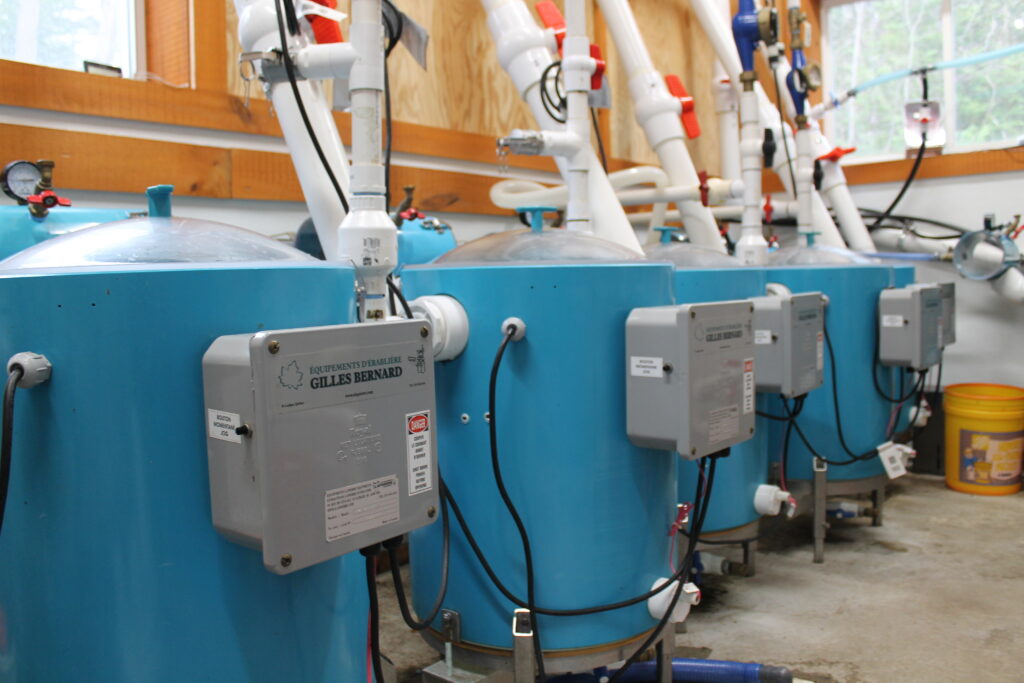
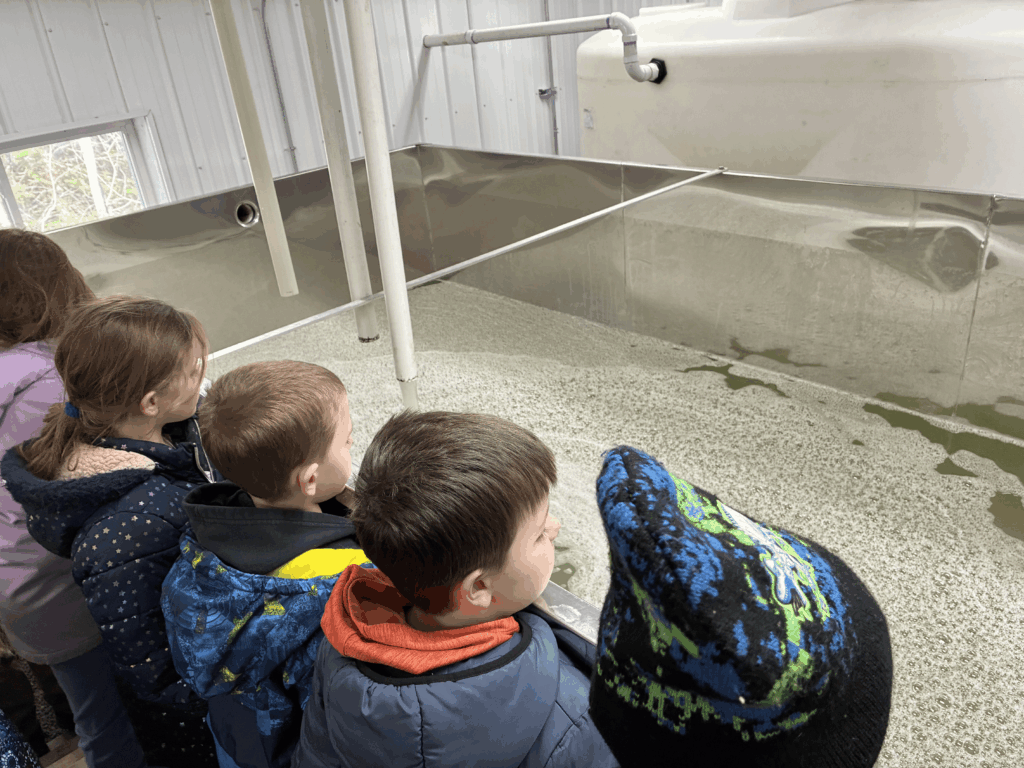
Sap separators at Uihlein Maple Research Forest. Photo by Isabella Susino.
Students watching raw sap flowing into the collection tanks. Photo by Liz Donahue.

The sap then transfers and collects in two enormous tanks, appropriately named Percy and Thomas. Wild watched the flow coming into the holding tanks and noted that it was good, but not as good as it could be. As the day warmed he hoped for an increase in sap volume. A good day will yield 150 gallons of syrup at Uihlein Maple Research Forest.
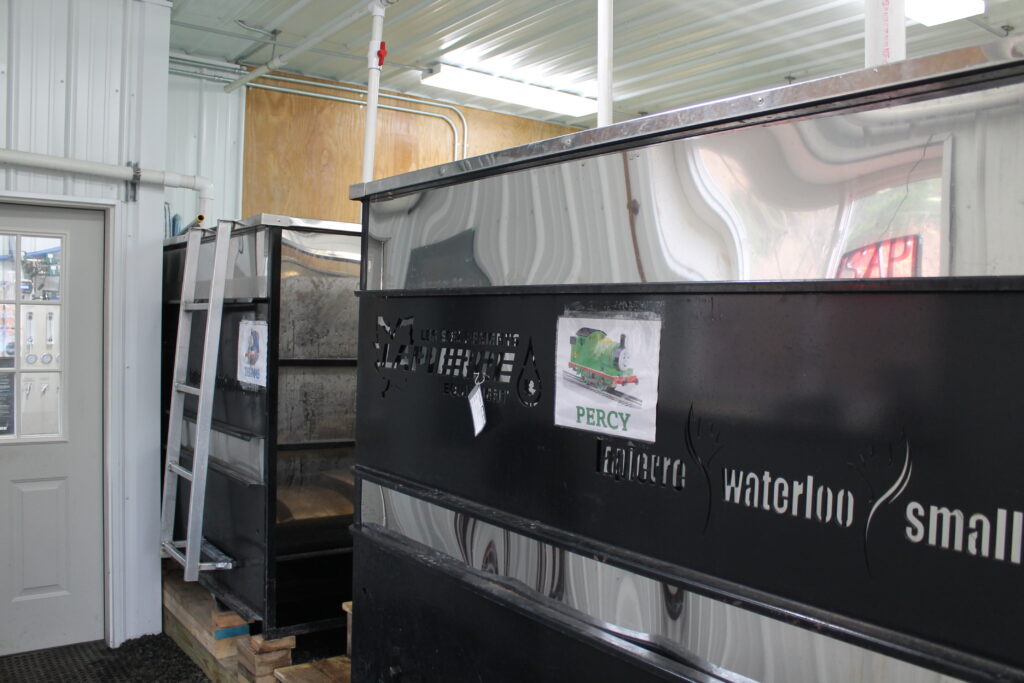
Percy and Thomas the sap collection tanks. Photo by Isabella Susino.

For the kids, it was a bit mind-bending to think that the droplets they saw seeping from the trees in the forest could add up to the gushers of sap filling Thomas and Percy.

They were also interested to learn about new terms, such as “reverse osmosis,” which has superseded much of the old process of boiling away the excess water. Sap now passes through filters that allow water molecules to flow through, while catching larger molecules of sugar and minerals.

Such sights make an impression, Donahue said, but students may also remember small, random details, like picking up a leaf, that will create a pleasant association with the forest.

“It’s nice for them to just get out and be outside for the day, doing something different,” she said. “Some of these kids may have family connections [to maple production] but some may not even go out on the weekends whatsoever — this lets them see what’s all around them in a different way.”
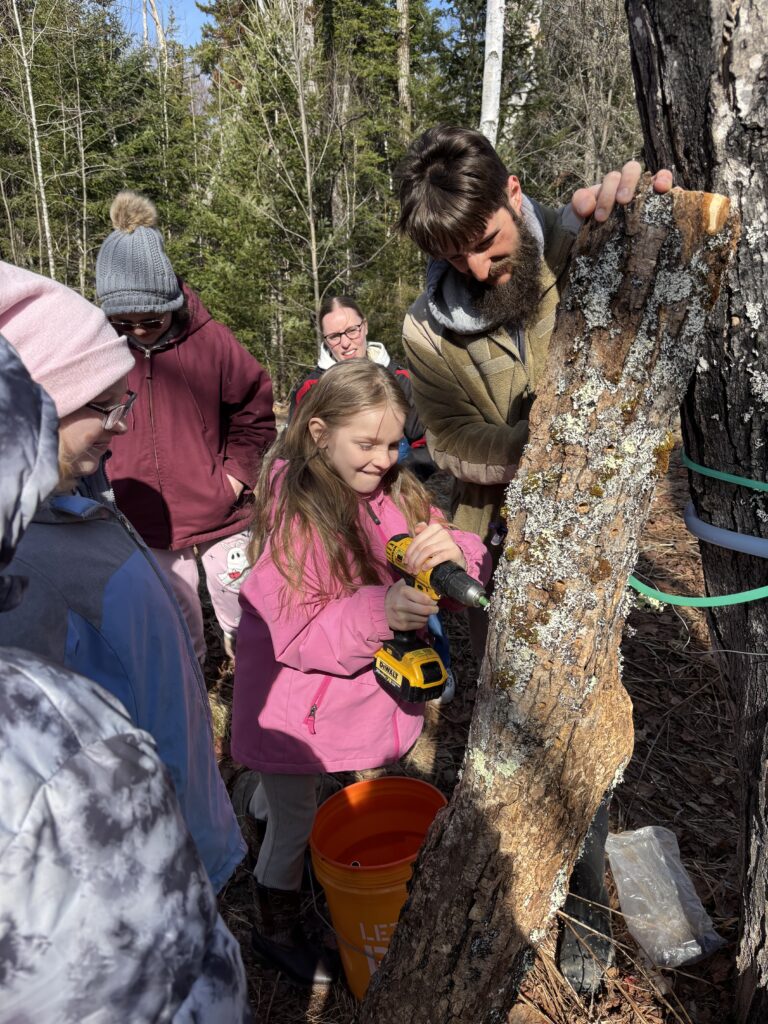
Tree tapping practice with Trever Sheehan, Technician II at Uihlein Maple Research Forest. Photo by Kim Chamberlain.
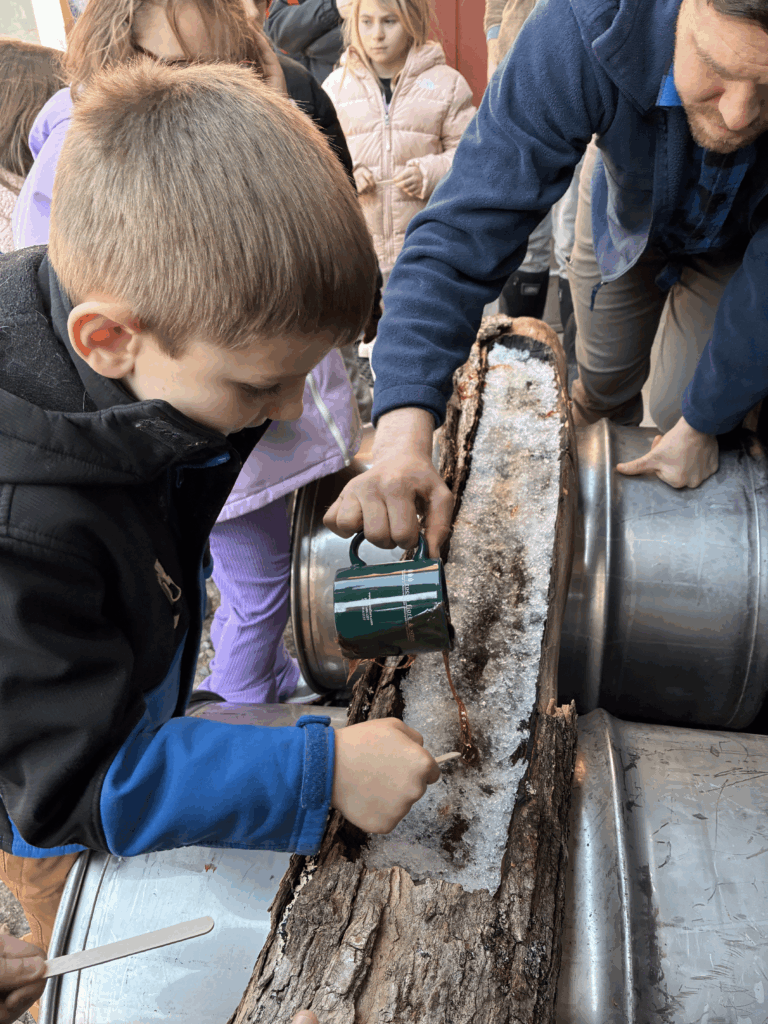
Director Adam Wild serving sugar on snow at Uihlein Maple Research Forest. Photo by Liz Donahue.

After practice tapping trees with a drill and a hammer, the students followed the process to the sugar shack, where a gleaming, stainless steel machine awaited to finish off the concentrating process.

“This machine is called an evaporator,” Wild said. “It’s basically a big, fancy stove, and the maple syrup is cooking down inside there.” 
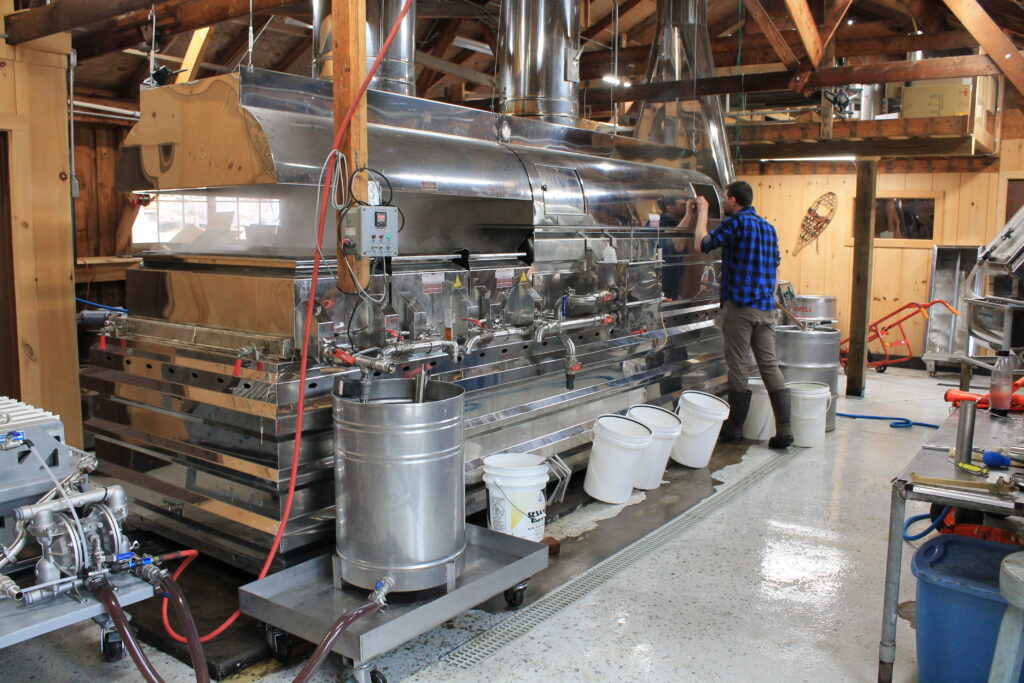
The sap evaporator at Uihlein Maple Research Forest. Photo by Isabella Susino.

The evaporator can make a gallon a minute, and by the end of the season, Wild hopes to have produced 3,000 gallons of syrup. And just to make sure it’s good, he had 19 quality control volunteers at his disposal, willing to give his latest batch a try. It was a sweet way to end an educational morning.

“By supporting schools in bringing kids to a farm for the day, we give students a chance to engage with the places where their food was grown, raised, or produced, and meet the farmers who made it possible,” Hoffman said. “It’s a place-based educational experience that connects the three C’s of Farm to School — classroom, cafeteria, and community — in a memorably adventurous way.”

Power Through National Nutrition Month with Cornell Cooperative Extension of Essex County

03/27/2026

By Kate Graziano | Public Health Corps Fellow, Cornell Cooperative Extension of Essex County

National Nutrition Month, established in 1973 by the National Academy of Nutrition and Dietetics, is upon us! The campaign invites people to celebrate nutritious foods by learning how to make informed food choices and develop healthy habits. This year’s theme is “Discover the Power of Nutrition,” with weekly activities relating to healthy choices and nutrition on a budget. Nutrition powers individuals and communities, and building nutritious habits into your day through this campaign can empower you to improve your health and well-being now and in the future.

Photo shows kids assembling POP Club owls
Kids at POP Club create apple owls. Photo by Ellie Hoffman.

Discovering the power of nutrition can be done at any age, but Cornell Cooperative Extension of Essex County (CCE Essex) will soon be debuting a way for kids in particular to do this via a nutrition superhero game. Through the support of the Hannaford 2024 Childhood Obesity Prevention Project, Ellie Hoffman, Jake Yambor, and Kate Graziano created a deck of cards that features 13 fruits, vegetables, and legumes – all of which grow locally in Northern New York – depicted as superheroes. Each food will have specific, nutrition-based powers to show kids what healthy foods can do for their bodies. For example, the Carrot Superhero will have Vitamin A Vision Powers to keep eyesight sharp, and the Spinach Superhero will have Iron and Calcium Powers for energy and strong bones. 

In addition to superhero cards, the game will also include “villains” such as germs, fatigue, hunger, and broken bones. To play the game, kids will have to use the combined powers of the different foods in their hand to fight the villains that appear throughout gameplay. So, if they’re fighting germs, they will need foods with Vitamins C and E powers to strengthen their immune systems. If they’re fighting hunger, they’ll need to find foods with carbohydrate, protein, fiber, and/or lipid powers to decrease hunger and keep them full.

The nutrition superheroes game will go beyond the lesson that fruits and vegetables are healthy to get kids excited about the specific ways that local produce can improve their health and power their bodies. By turning fruits and veggies into superheroes, the game puts nutrition into terms that many kids already know and love, making it more approachable and fun. The nutrition superheroes game is still in development, but keep an eye out for it at CCE-led Power of Produce Club (POP Club) events at local farmers’ markets this summer! 

In the meantime, CCE Essex is focused on local food and nutrition in many other ways, too. Ellie Hoffman, Kate Graziano, and Mina Weymouth-Little teach Agriculture in the Classroom lessons to over 400 K through 5 students throughout Essex County. Each month, participating classes learn about local, in-season foods with a fun activity and a taste test from a farm in the Adirondacks. 

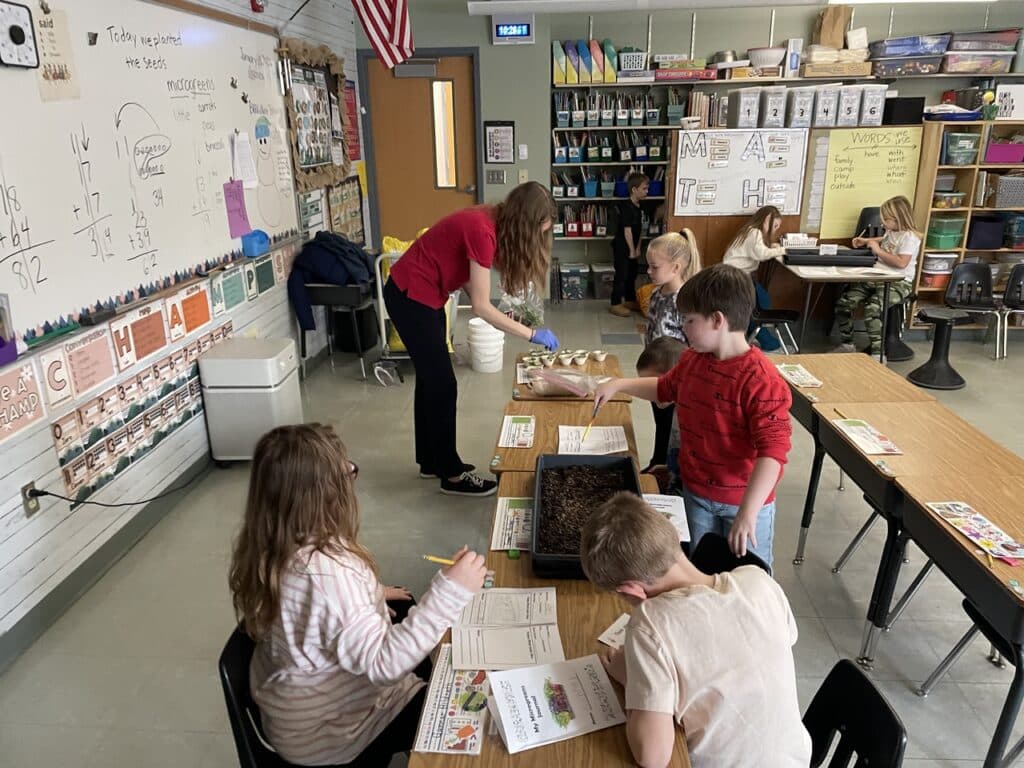
The photo depicts children sitting at their school table. Ellie Hoffman, local food educater through cornell cooperative extension of essex county, is shown planting seeds in cups.
Ellie Hoffman portioning microgreens for an Ag in the Classroom taste test.
Photo by Tim Rowland

Additionally, Samantha Davis and Kate Graziano lead senior health and wellness classes to older adults throughout the county and provide monthly healthy recipes and nutrition-based gatherings. Any questions or interest in setting up future events can be directed to Kate at kmg324@cornell.edu.

CCE Essex also collaborates with the Essex County Well Fed Collaborative to provide Essex County residents with information about places to source affordable healthy food. The Well Fed Collaborative website includes an interactive Food Resources Map with filters showing food pantries, stores accepting food assistance benefits, and locations offering free and low-cost meals (including Adirondack Community Action Programs, Inc.’s Aging Adults Nutrition Sites).

Furthermore, Alisha Thapa at Cornell Cooperative Extension of Clinton County (CCE Clinton) provides SNAP-Ed resources and workshops for residents of Clinton and Essex counties. SNAP-Ed workshops are designed to help participants learn how to make affordable nutritious choices. Any questions or interest in future events can be sent to Alisha at at996@cornell.edu. For more information about ongoing programs, visit the CCE Clinton SNAP-Ed page.

The North Country Fruit and Vegetable Prescription Program (FVRx) through Cornell Cooperative Extension of St. Lawrence County (CCE St. Lawrence) is another resource for residents of Clinton, Essex, Franklin, Jefferson, and St. Lawrence Counties. The FVRx program works with healthcare providers in the North Country to refer patients with chronic diseases or food insecurity to virtual and in-person nutrition workshops in which patients receive nutrition information and $25 in vouchers for healthy food purchased at select North Country businesses. Patients referred to the program can attend up to six nutrition workshops, where they receive $25 in vouchers at each workshop. If you live in Clinton, Essex, Franklin, Jefferson, or St. Lawrence County and are interested in participating in this program, ask your healthcare provider if they can refer you. If you are a healthcare provider and/or have any questions about the program, please contact Sarah Bentley-Garfinkel at sb2742@cornell.edu for more information.

Information about healthy, local, in-season food at Adirondack farmers’ markets and businesses is always accessible on the Adirondack Harvest website. Join us in celebrating National Nutrition Month by Discovering the Power of Nutrition in our community today!

Ag in the Classroom Sprouts Success with Microgreens

02/06/2026

By Tim Rowland | Contributing Writer

The second graders in Elizabeth Donahue’s classroom know what it’s like to grow their own food. Granted, they didn’t have to deal with drought, pests, crop failures or commodity prices, but on a chilly January day, they learned how to farm.

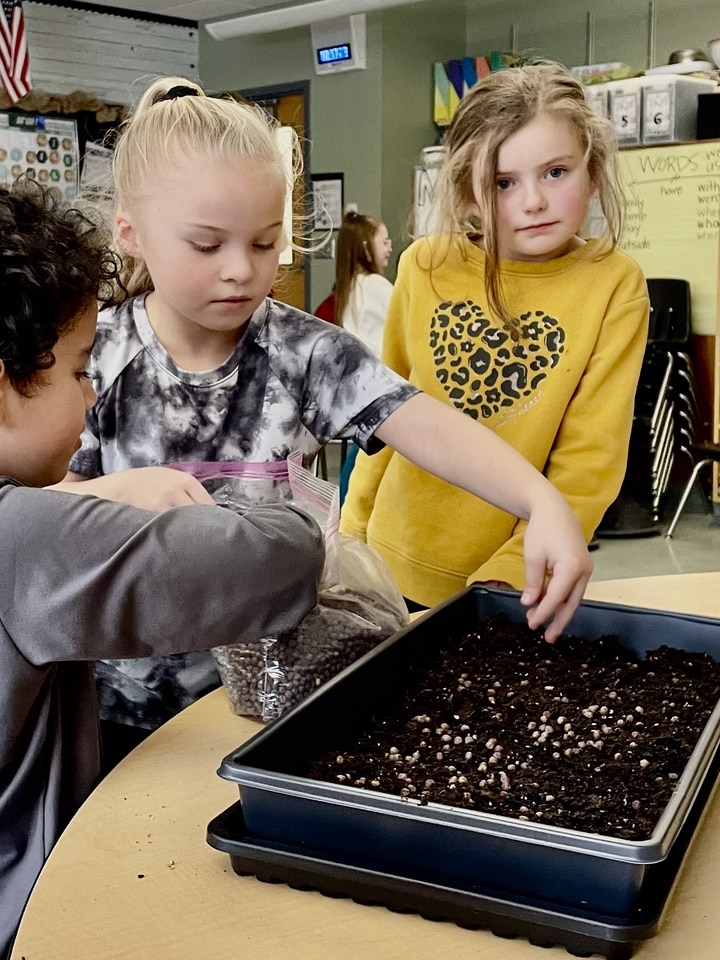
Under the guidance of Ellie Hoffman, Local Food Educator for Cornell Cooperative Extension of Essex County, the kids planted peas, broccoli and carrot microgreen seeds, watered them, and placed them in a sunny window. Within a week, the sprouts were ready to eat.

The photo depicts children sitting at their school table. Ellie Hoffman, local food educater through cornell cooperative extension of essex county, is shown planting seeds in cups.
Ellie Hoffman, Local Food Educator, portions microgreens sprouts for a taste test. Photo by Tim Rowland.

Through Cornell’s Agriculture in the Classroom program, Hoffman brought soil, seeds, trays and plenty of optimism into the AuSable Forks Elementary School classroom. “They’re growing already,” shouted a young man, whose excitement and imagination may have got the better of him. But he was not far off the mark. Sprouts are an effective teaching tool, because they pop out of the soil and are ready to consume within days. 

“Microgreens have been a popular Agriculture in the Classroom activity because they’re so hands-on,” Hoffman said. “Anyone can plant and care for microgreens — and they grow so quickly, every day brings something new to observe. It’s fun for the kids to grow different varieties of microgreens too, and to explore the similarities and differences between microgreens and full-size vegetable plants.”

Young agronomists sometimes need a little extra instruction, but Hoffman was generally successful at harnessing boundless enthusiasm for the project. And while several kids said they had helped their parents plant gardens at home, for others this was a whole new world. 

Hoffman showed them how to nest a porous seed tray inside one that trapped water, so that the soil would remain moist, but not soggy. “Make a little bird beak with your fingers to grab the seeds, and then sprinkle the seeds like cheese on a pizza,” she instructed. Too late in one case, where an overzealous planter had dumped the entire handful of seed into the middle of the tray – a fixable problem. 

The students learned lessons that even some long-time gardeners have trouble remembering. “Don’t pack the soil down, we want it to be loosey goosey,” Hoffman instructed. Also unlike many adults, these second graders have already come to learn the correct spelling of “broccoli.”

Agriculture in the Classroom lessons like these connect kids with food through classroom visits, demonstrations and farm tours. Food, they learn, is more than just a frozen brown thing put in the microwave. They also learn that there are a lot of edible goods being produced by farmers right in their own backyards, and that these foods are healthier and more efficiently brought to the table than boxes of highly processed products from the supermarket shelf.

The image depicts children planting seeds in a tray.
Children planting microgreens in trays. Photo by Tim Rowland.

For some, it’s a bit of a novel concept. “We’re going to eat a plant for no reason?” a child asked Hoffman before — without waiting for an answer — quickly transitioning to “Why are your gloves purple?” 

During the lesson, the kids are also encouraged to find some of their own answers through observation. They receive gardening journals, and record what they see each day.

Hoffman also brought some samplings of the sprouts that would soon be popping up for the students to taste. There is only one rule: Don’t use the “E-word” (Eww).

The results were cautiously, if not universally, positive. Young palates have been trained by the commercial food industry to be sated with sugar and fats, so appreciation of food in its natural state is something that must be learned as well. Hoffman does this by introducing them to pea shoots, a gateway sprout that is naturally sweet and will hopefully encourage kids to experiment with other microgreens. And they do.

“A lot of students discovered that they enjoyed the micro versions of larger vegetables they didn’t normally eat, like broccoli,” Hoffman said. “Next to apples, microgreens inspired the most requests for second helpings!”

This article is part of a series about activities supported by Harvest NY’s Rooted In Learning Grant. Harvest NY, a program of Cornell Cooperative Extension, champions the state’s farm and food economy through assistance with local food and supply chain management, urban agriculture, community gardens, emerging crops, and agriculture climate resiliency.

The Future of Farm to School in the Adirondack Region

05/30/2023

Most local activists will tell you they’re not out to save the world. Julie Holbrook and K’Cee Leavine will admit to no such thing.

They see child nutrition in schools as a fundamental building block to human health and happiness, and a fundamental right of everyone taken under the wing of public education. To them, the Farm to School movement is a moral obligation. “We have a responsibility to feed kids well,” Holbrook said.

And that responsibility doesn’t stop at local boundaries. “We would love to see (scratch cooking) go statewide, and nationwide,” Leavine said.

But first, there are still districts in the local school service area that have been reluctant to buy in. That’s understandable, said Holbrook: “It’s a mind-shift, letting go of the old way and trying something new.”

The new way isn’t always popular, and cafeteria workers have often treated it with distrust. Much of the Champlain Valley Educational Service’s model — scratch cooking, elimination of plastics — is essential to the program’s success. For cafeteria workers trained in the conventional ways, there’s not a lot of room for negotiation or control.

But these cooks ultimately want to please the students, and when they see that students are drawn to the new foods, they begin to become invested in the Farm to School program themselves.

“When you win them over is when they start to get feedback from the kids,” Leavine said. They begin to develop a food-related relationship with the students, bantering about the menu and what goes into it. The cafeteria staff take ownership over their work and pride themselves on delicious meals that support both the local economy and student nutrition.

Leavine recalled the case of the home-made alfredo sauce, when a thumbs up from a popular high school student was all it took for students and staff alike to give it their seal of approval. The Farm to School initiative views cafeteria time as quality time, a chance to talk and think about foods. If the ingredients of an alfredo sauce can be open for consideration, that’s a win.

Champlain Valley Educational Services’ food division will work with any district that expresses an interest. Through experience, they know it works, Leavine said, whether it’s a small district such as Keene with its 170 students, or a large district like Plattsburgh with 1,800.

This summer, CVES took its scratch cooking and Farm to School program on the road at a state educational conference, where it showed its work to administrators from across the state.

“This was born from a passion to ensure maximum potential for children’s health, wellness and learning,” food service managers said in their presentation. “We have grown to six school districts and the BOCES, totaling 13 campuses with over 3,700 students.”

They showed photos of their food — bright greens, oranges, and reds, representing fresh broccoli, carrots and potatoes in their natural state, real colors, not artificial ones that can often be found in processed products available in cafeterias.

Gone along with the dyes and preservatives were processed products like hot dogs, donuts, sugary cereals, instant potatoes, premade frozen meals, and bagged sauces.

In their place were local beef, yogurt, eggs, fruits, and vegetables. Mashed potatoes and gravy were made the old-fashioned way. So were biscuits, sauces, breads, granola, and muffins. Desserts were made from scratch, ensuring the quality of the ingredients.

These changes come with challenges, Holbrook said. Under Farm to School, food-service managers have to round up foods not from one giant distributor, but from a number of local, regional and state sources. And with the increase in scratch cooked items, and elimination of disposables, more jobs are created to staff the kitchen. To flourish, Holbrook said, school administrators must fully buy in, and expect that at first there may be some pushback.

“We’ve been told (by some systems) ‘we’re too big, we can’t do that,” Holbrook said. “We’ve been told that we can’t use raw eggs because they’re not safe unless they’ve been pasteurized. We’ve been told the kids won’t eat (natural foods).” To change minds requires both firmness and delicacy. “We’re not saying what anyone is doing is wrong,” Leavine said. In the end, it’s really the feedback from the kids themselves that moves the needle.

“Innate and intuitively, if something looks good and smells good, they will try it,” Holbrook said. “At the end of the day, this is not hard — this is logical, and it makes sense.”

This is the final installment in series. If this series has inspired you and you’d like to get involved in Farm to School in some way, please fill out the form at this link, or get in touch with Farm to Institution Educator, Meghan Dohman meb377@cornell.edu.

This is part five in a series of five articles; you can read the other stories in this series here.

Footer

  • Facebook
  • Instagram
  • Twitter
  • YouTube
alt-text

8487 U.S.Route 9, Lewis, NY 12950

Phone: (518) 962-4810

cornell-cooperative-logo

If you have a disability and are having trouble accessing information on this website or need materials in an alternate format, please contact the Cornell Cooperative Extension of Essex County office for assistance (518) 962-4810 or email essex@cornell.edu.

  • Browse
  • Markets
  • Events
  • Festival
  • Blog
  • Trails
  • Login | Join
  • Home
  • About Us
  • Harvest News
  • Local Food Guides
  • Contact Us
  • Get Listed or Renew
  • Make a Donation
  • Friends

Copyright© 2026 · Adirondack Harvest. All images to their original owners. adk-chair