
Egg Price Volatility Makes a Strong Case for Local Food
by Tim Rowland |

Farm supply stores are normally noisy places in the early spring, filled with the chirps and cheeps of layer chicks bound for backyard coops. But often today the galvanized tubs where the peeps reside were empty, as the steep price of eggs put a premium on the little birds.
“We were going through hundreds (of chicks),” said a spokesperson for Runnings in Plattsburgh. “Every retailer in the area was noticing the same thing.” And local egg producers were noticing something too: For the first time in the collective memory, a local farm product retailed for less than the commercial counterpart, not only leveling the agricultural playing field, but also providing a blueprint as to how a locally sustainable food chain might work.
Unlike cattle or hogs, a small laying flock is attainable for many people in the rural North Country. And attain they did, as stores sold out or pushed spring delivery times back into the summer. These chicks will not begin to lay until late fall at the earliest, but when they do they will almost certainly produce more than one family can use.
That’s good news for North Country egg-eaters and for retailers such as North Country Co-op in Plattsburgh which buys eggs from local producers. “I had someone call the store and see if they could drop off 24 dozen eggs. And then I’ve had a couple other people bring in, like 10,” said grocery manager Aleah Tanriverdi-Klein. “The only large egg seller place that we’ve ever really gotten anything from is Harmony Hill Farms. The rest is a network of hobby farmers with chickens, who have very, very small farms.”

These backyard flocks producing surplus eggs — even a coop with just 10-20 hens in top production months will leave the owner with dozens of more eggs a week than they can use — are an antidote to an industry where the five largest producers provide nearly 40% of the nation’s eggs, according to Egg Industry magazine.
This monoculture was rocked in 2022 when avian flu began to infect commercial flocks, eventually leading to the culling of more than 145 million laying hens. These hens were not immediately replaceable, as new chicks had to be hatched and raised to a laying age of about six months. (Meat birds were not similarly affected because they suffered fewer infections, and reach market age in just six weeks.)
So the price of large Grade A eggs, which according to the Federal Reserve were $2 a dozen in September 2023 spiked to well over $6 a dozen this past March, with some localized prices as high as $10 or more. Suddenly, local farm-fresh eggs were underselling the 60 commercial producers that supply almost 90% of the nation’s eggs — an unheard of phenomenon in the world of small-scale sustainable agriculture.
Given the chance to raise prices by a dollar or two from their typical $5 to $6.50 a dozen, most small producers and retailers in the North Country did not. Rob Hastings, owner of Rivermede farm and farm store in Keene Valley, said he is adding another 30 layers to his flock of 80 this year, but the price hasn’t budged.
“We don’t really care about the national price,” he said.
For local producers, the price is generally driven by the cost of feed, and if that cost doesn’t go up neither does the price of the eggs. Consumers noticed, and appreciated, that unlike mega-corporations, when the opportunity for price gouging presented itself, local producers refrained.
And they noticed something else, too. “They saw the color of that yolk,” said Hastings, referring to the plump orange of a hen raised on pasture or produce trimmings, in comparison with the runny, pale yellow of a commercial egg.
Hastings said his business tripled due to Covid and to a smaller degree, consumers responded to locally produced eggs, which were both cheaper and better.
Aleah Tanriverdi-Klein said the co-op had a similar experience. It posted its egg prices on social media, which drove customers to the store, motivated by the price but also their perception that big producers were taking advantage of the shortage to price-gouge.
Consumers might not realize it, but when they buy commercial eggs they are paying twice — once for the eggs, and again through taxpayer subsidies compensating agribusiness for infected hens and eggs. According to Sentient media, big producers have received $1.46 billion in government payouts compensating them for culled poultry and prevention measures.
Stock of Cal-Maine Foods, Inc., the nation’s largest egg producer, reached an all-time high this year as the price it received rose by nearly 60%, according to Investing.com.
Cal-Maine’s second-quarter profits for fiscal 2025 soared 82% over the previous year, even as it received $44 million in taxpayer bailouts. Critics say compensation for poultry that has to be destroyed is intended to encourage companies to report infected flocks, but has in actuality given them little incentive to do anything about it.
“The way we do these things is unfortunate,” said Sue McGarry, who with her husband Tim produces eggs and honey at the Boquet Valley Farm & Apiary. “Our (national) agricultural model doesn’t make a lot of sense.” The McGarry’s have 53 “happy hens,” she said, that eat organic food and can grow old in peace without risk of getting culled when their production flags. McGarry said she knows she could get more than the $5 to $5.50 she charges per dozen, selling at roadside and through a pipeline to some families in New York City.
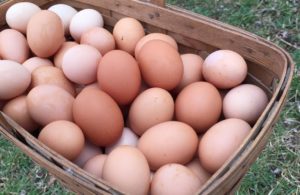
But she and her husband are retired, so, like many other small producers, the price reflects little more than compensating for feed costs. The recent egg shortage, she said, gave consumers a taste of what it really costs to produce food. The big producers “have always been subsidized, and the price of food has been artificially low,” she said.
As farms in the region add hens and more people invest in a backyard flock, more eggs will enter the local food supply, sold at roadside stands, given to friends and family or dropped off at local food banks.
“These small farms are really important,” McGarry said. These producers, like herself, want a wholesome food from birds that are treated with respect.
As the big producers’ flocks return to normal, the price, already off its highs, is likely to come down more. But after trying a dozen farm-fresh eggs, producers hope local consumers will never go back.


