
Schools Purchasing Local Food Helps Local Farmers
By Tim Rowland
Those who study global hunger note that the world produces plenty of food, the problem rests with getting that food to people in need. Something similar has been happening in public schools. A new generation of North Country farmers was producing a breadth of healthy food, but at the same time, school breakfasts and lunches didn’t represent the abundance of whole, local food available in the region.
Local parent groups saw school menus packed with refined sugar, bleached flour and highly processed meals that could be effortlessly heated and served. They also saw local farmers in need of reliable markets for food grown in and raised on Adirondack soil.
Children were “starving” for healthy food in an area where healthy food was bountiful, so the mission became matching farms with cafeterias.
Essex County farmers typically have strong markets for their products, relying on restaurants whose patrons love eating local foods, farmers’ markets, and Community Supported Agriculture programs. Still, farming is a fickle business from year to year, and producers can find themselves with surpluses from a particularly good season, or the abrupt dissolution of an outlet, as happened when COVID-19 shut down restaurants.
Farm to School, by contrast, offers “competitive pricing and regular, guaranteed markets for products,” said Essex County Board of Supervisors Chairman Shaun Gillilland, an advocate of the program whose Ben Wever Farm has provided schools with Black Angus Beef.
As farmers cobble together income from various sources, even dependable baseline sales of a few thousand dollars can be a meaningful piece of the puzzle, Gillilland said. Nor does it require getting out there and hustling for business or spending the day sitting at a booth at a farmers’ market.
The trick, said Gillilland and Julie Holbrook, who is Shared Food Service Director for Champlain Valley Educational Services, is to attune menus to accommodate seasonally available products. “Fresh food is seasonal, and it takes a while for schools and producers to get used to that,” Gillilland said.
Schools can rely on perishable fruits and vegetables spring through fall, and in the winter fall back on crops that can be stored, like apples, carrots, beets, and squash. Holbrook said she has 22 local farms to which she can send bids, but a smaller number of farms provide most of the product.
“Sometimes it can be hard to get farmers on board,” she said, in part because many already have dedicated markets, but as the program expands, she believes producers will learn the rhythm and needs of the schools, and that planting to meet those demands will become more worthwhile as the school market swells.
While feeding a cafeteria full of school kids might seem imposing, it’s small in terms of Adirondack food production. “To a farm like Juniper Hill, several pallets (of vegetables) is nothing to them,” Holbrook said. She believes local farmers will become more interested in schools as districts are added to the Farm to School program, and it represents a greater opportunity for substantial sales.
A flexible relationship is developing, where schools can order large quantities from a big producer, or one-time “micro purchases” from a small one. If a farmer has a surplus of a particular crop, schools can change their menus to absorb it. “If a farm looks like it will have a lot of melons, they’ll write me,” Holbrook said.
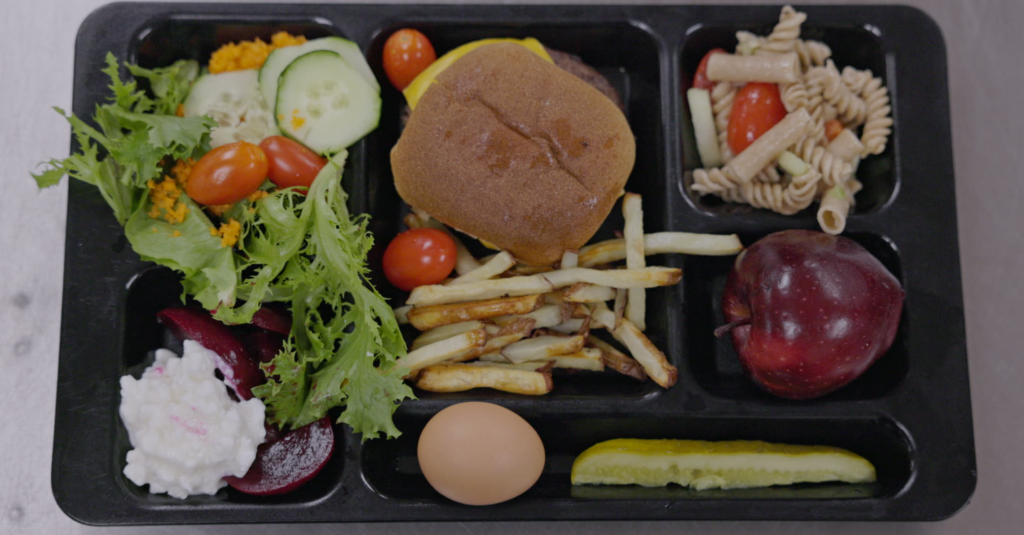
Meghan Dohman, Farm to Institution Educator for the Cornell Cooperative Extension office in Essex County, said that for most farmers, the program is about more than just sales. “They want to do it because they want to feed the kids,” she said. “We talk about how food is produced and have taste tests. We’re always searching for new farms to participate.”
The Hub on the Hill, a local food hub in Essex, is playing a role as well, and kids learn how milk is turned into yogurt or grains are turned into bread. Through the program children who never had the opportunity are learning about where their food comes from, and it’s changing their eating habits. To those involved in Farm to School, lunchtime has effectively become another class. “We’re as much a part of their school day as math and science,” said K’Cee Leavine, Assistant to the Food Service Director for Champlain Valley Educational Services.
With a degree in nutrition, Leavine had become a proponent of “scratch cooking,” in a day when school kitchens had come to lack even basic ingredients and cooking tools. But if kids wouldn’t eat it, scratch cooking would be a nonstarter. Farm tours and school gardens helped support the transition, while teaching lessons and habits that will hopefully last a lifetime.
This farm-school relationship also has potential to pay future dividends for the farmers too, as kids who have been educated in nutrition, local food, and agriculture grow into adults who will be more likely to patronize local farms when it comes time to feed their own children.
With a commitment from local producers, CVES food-service managers had a key component of the supply chain in hand. Now they just had to convince administrators that they could afford it.
This is part two in a series of five articles; you can read the other stories in this series here.


