
Farm to School Movement Gains Ground in the Adirondack Region
By Tim Rowland
In the United States, school lunch programs began in 1933 as a piece of Franklin D. Roosevelt’s New Deal agenda for combatting the Great Depression. Feeding kids was not necessarily the only goal. At the time the government was also concerned with finding work for the unemployed, and outlets for unsold crops.
Often, school meals take a back seat to other interests. Eating, our most essential activity, has in most school districts across the country, fallen victim to budgetary concerns, staff cuts and processed, sugar-filled menus that are easy on everything except a child’s physiology.
Seeking to break this unhealthy mold is the Farm-to-School movement, a national effort that began in the late 1990s and came to Essex County in 2007, when a group of Keene moms demanded better.
The movement is supported by Cornell Cooperative Extension in Essex County, as they operate a Farm to School program with a focus on bringing locally grown, healthy foods into meal programs, teaching curriculum about local food and agriculture, and assisting schools with cultivating productive school gardens. These programs are not unique to Essex County, as Farm to School programs are popping up throughout New York and all over the country.
What began in Keene has now become a key component of the Champlain Valley Educational Services BOCES, which, through cooperative service agreements, oversees the food service program in six North Country districts: Boquet Valley, Keene, Moriah, Plattsburgh, Schroon Lake, and Willsboro and two BOCES campuses in Plattsburgh and Mineville.
Gone are the empty-calorie pastries and heat-and-serve chicken nuggets. In their place are fresh eggs, fresh fruit, local yogurt, and salad bars. Schools buy pasta made from New York State wheat and prepare sauces from local tomatoes and local cheese. Meatloaf is made from ground beef raised just a few miles down the road. Chicken fajitas, shepherd’s pie, lasagna, enchiladas and even pizza are all made from scratch.
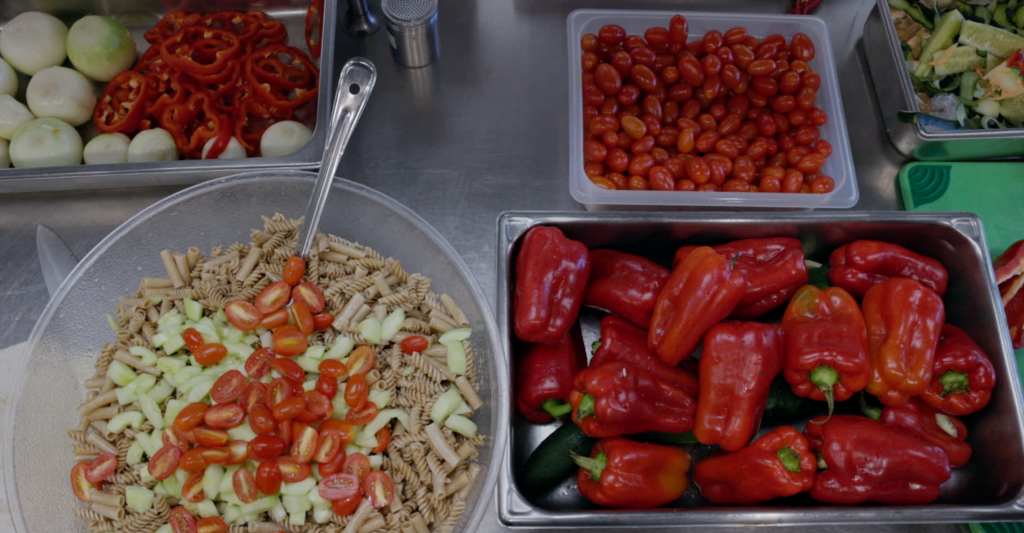
If such care and conscience in the kitchen sounds expensive, it’s not. Just the opposite. In one year, Plattsburgh City’s food budget went from $148,000 in the hole to $168,000 in the black. Farm to School also is a financial boon to local producers who need a dependable market.
But the main goals of Farm to School are child nutrition, health, and classroom performance — the same goals that were on the mind of Washington bureaucrats 80 years ago as the “hot lunch” programs began to focus on kids more than economic policy.
“Insufficient or improper food takes not only a physical toll, but a mental toll as well,” wrote Ellen S. Woodward, assistant administrator for Roosevelt’s Works Progress Administration.
In Keene, 15 years ago, Julie Holbrook had noticed the same thing.
But instead of poor food, society was apt to blame behavioral and learning deficiencies on bad parenting, failures with the educational system or mental disorders. Holbrook saw it differently. Kids arriving at school were given sugar-loaded pastries and no protein or complex carbs. “And we wondered why (the students) lash out and then crash,” Holbrook said.
With a group of other concerned moms at her back, Holbrook approached school Superintendent Cynthia Ford-Johnston and applied for the job of food services manager. “She took a chance on me,” said Holbrook.
Having gotten what she asked for, Holbrook experienced a simultaneous sense of fear and determination. “I did not have large-scale cooking (experience),” she said. “I spent a few years literally up to an hour or so every night trying to figure out how I would get through the next day.”
But it worked. Students ate better and performed better, all at a lower cost. By 2015, when the State of New York began emphasizing school lunch menus with locally grown foods, Holbrook was a natural fit to manage food services for the Champlain Valley Educational Services BOCES.
By this time, the local food movement had taken hold in Essex County, and Cornell Cooperative Extension saw a perfect chance for children not just to eat well, but to learn about nutrition and the source of the foods they consumed.
Farm visits gave kids curiosity and interest in the cafeteria; they wanted to taste the foods they had just seen in the fields. They began to talk to the cooks, to ask questions. Cafeteria employees, long overlooked, began to feel that they were a meaningful part of the program. Farmers had a new market and administrators saved money.
Yet even with all this, there was, and is, resistance to change. But with enough accumulated evidence on their side, Holbrook said that scratch cooking and the Farm to School movement has the power to sweep the nation — and no less than our children’s future hangs in the balance.
This is part one in a series of five articles; you can read the other stories in this series here.


