
Shady Hill Farm Steps Forward, and Backward, in Time
December 13, 2021
By Tim Rowland
Roger Hastings still has the hand-tooled wooden yoke his grandfather used to drive oxen. It’s not decorative. It will be fitted on Lewis and Clark, the latest yoke that Hastings has trained to pull firewood from the woodlot on the farm his ancestors came west from Brandon to settle in 1853.
One hundred and nineteen years before that, in 1634, the family had arrived from England on the ship Elizabeth to see what the New World held in the way of farming. Hastings said that for him there was never a thought of doing anything else, even though farming is just as trying now as it was then.
While his familial settlers would have spent an unfathomable amount of time just picking stones out of the fields and stacking them into fence lines, it is similarly distressing today to negotiate rocky commodities markets where the posted price of agricultural products seldom seems enough to sustain a family farm.
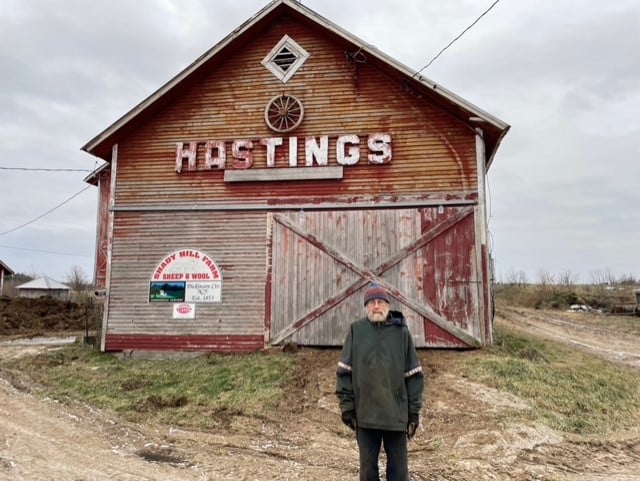
Hastings got the message earlier than most. It was 1995, and in three decades of milking his Jersey cattle the price he received for a pound of milk was essentially the same as it was when he began farming 30 years earlier. “And it’s the same now,” Hastings said.
Seeking a solution more than 25 years ago, Hastings reached back into the past and decided to switch from cows to sheep, which were a North Country staple through the heart of the 19th century.
Other dairy farmers were quitting altogether or switching to beef, which in part drove Hastings’ decision. “Sometimes you don’t want to do what everybody else is doing,” he said.
To make what became the Shady Hill Sheep and Wool Farm work, Roger Hastings and his wife Linda took outside jobs, Linda at Clarkson University during the day, Roger at what is now Citizen Advocates behavioral health center at night so one of them would always be home with their children. And they sold the Jerseys and began stringing sheep fence. “We decided to get everything ready before we brought them in,” Roger said. “So we didn’t have anything to sell for a while.”
Those 24 lambs would grow into a flock that at peak included 130 ewes. Unlike beef cattle, sheep require daily attention. It was hard, but Linda didn’t mind. “I knew I was marrying a farmer, and I knew what that meant,” she said. “He asked me to marry him in the barn.”
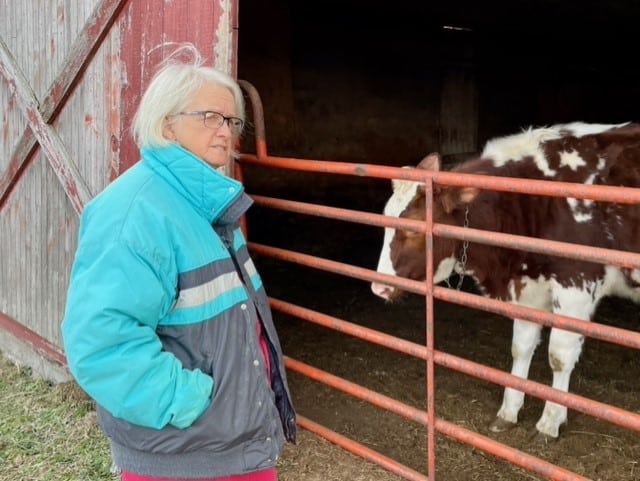
Hastings’ farm has thrived because he has taken a new approach to raising sheep, which, no surprise, is reminiscent of the old way of raising sheep. Rather than wean the lambs early, Hastings leaves them with their mothers as they graze through the summer, until the ewes naturally dry off. That greatly reduces the cases of mastitis in the flock, a common health problem in the ewe’s udder that comes with treatment and production costs.
The lambs get their nutrition from milk and grass, not from grain, making the overall process more natural, healthy and productive, as ewes are more likely to produce twins.
Hastings raises Dorsets, a storied breed of sheep native to Southwest England, where it’s thought that Spaniards — with an eye to conquering all of England — brought their Merinos to cross with Horned sheep of Wales.
The result was a good producer of meat and wool, and a copious breeder. Hastings attends each birth, putting the young animals in a pen for three to six days where they are tagged and their important initial nutrition ensured. Then they are returned with their moms to the flock, who know Hastings’ routine — they give birth at dawn or dusk, but never at night.
From its high point, Hastings’ flock has been reduced to about 70 to 75 ewes because a changing climate has increased the incidence of droughts, meaning that the pastures support fewer animals.
Because of the relative scarcity of sheep farms today, Hastings said the price of lamb remains consistently high. Most of the meat is dependably spoken for. “We’ve had the same customers for years,” Hastings said. The wool is mostly purchased by a Canadian broker that sells it to China, although Linda spins when time allows.
Roger does the shearing, not just at Shady Hill, but across the Northeast, from Lake Champlain to Lake Ontario. The number of commercial flocks has decreased through the years, good for the price of meat, but bad for the shearing business — from a high of 2,000 sheep a year, Hastings now shears about half that.
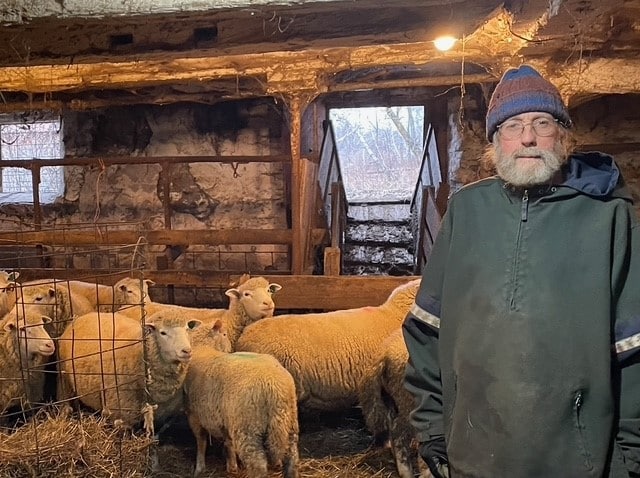
Still, this ancient art fits with the stepback in time that is Shady Hill. Linda said the couple was interested in having their house listed on the historic register, but when historians came to investigate, they didn’t want just the house on the register, they wanted the whole farm.
It is easy to see why, where oxen yokes and wheelbarrows in daily use appear as museum pieces.
Hastings said he likes that connection with the past, where the barn, his workplace, was built nearly 150 years ago, and pieces of it before that. His ancestors would never have taken old building materials to the dump, they would have reused, said Hastings, standing among the stonework and ancient timbers.
Roger and Linda like to farm the natural way, which, although not easy, is in some ways not as hard as keeping track of every new agricultural trend. “Something new comes along all the time,” Hastings said. “But we try to keep it as simple as possible.”
Learn more about Shady Hill Sheep & Wool Farm.
Like this story? Sign up for our email newsletter to receive future feature stories.


