
How Farms and Fine Dining Grow Together
By Tim Rowland
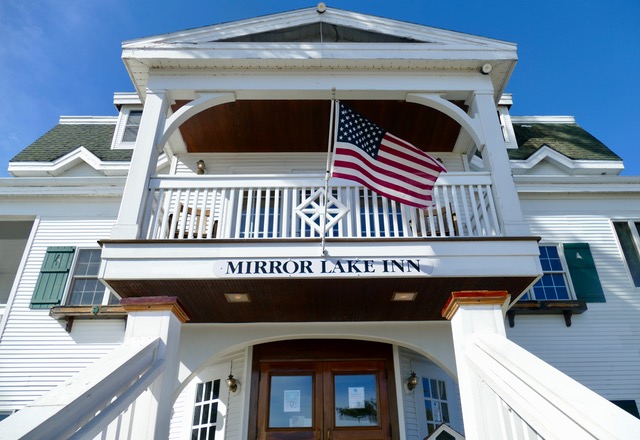
“Green shoots” has come to be synonymous with new beginnings, and for chef Jarrad Lang it was figuratively and literally how he introduced locally grown foods to his fine dining menu at the Mirror Lake Inn in Lake Placid.
Specifically, it was pea shoots from the Fledging Crow in Keeseville, mixed with arugula and tossed with a little lemon juice and olive oil. His guests, you could say with accuracy, ate it up.
Since then, Lang has incorporated a half dozen local producers into his regular rotation, fashioning his creations around the seasons and the harvests, and serving them to an upscale clientele that as a general thing is keenly aware and curious of local food movements.
“More and more, people want to know about where their food has come from, and that hasn’t gone away,” Lang said. Because they are frequently asked, servers are trained to be conversant about such farms as Asgaard, Juniper Hill, Sugar House Creamery or Harmony Hills.
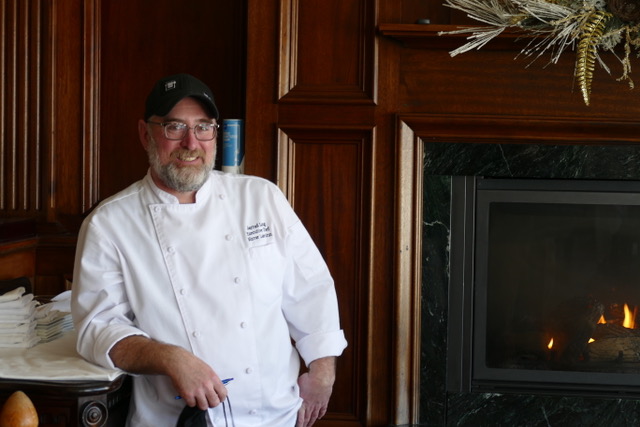
Chef Jarred Lang at the Mirror Lake Inn
The word “local” makes a frequent appearance on Mirror Lake’s AAA Four Diamond menu, which features feta, honey, pork, squash, beef, sausages — and that’s before the spring and summer seasons rich in local produce kicks in.
For a chef, the local food movement has challenges and opportunities, and restaurants themselves present challenges and opportunities for local producers. As basic as it is, food represents a tremendous balancing act, and nothing is as simple as it seems it should be.
Lang cultivates his suppliers as surely as his suppliers cultivate their crops, and knows who he can count on to deliver products in the quantities a restaurant requires.
The very nature of restaurants and their voracious appetite for meat, produce and dairy can scare away smaller producers who fear that they have no prayer of meeting demand. (The Inn can go through 200 to 400 pounds of russet potatoes and up to 300 pounds of beef tenderloin a week.) To get around that, Lang would create a special that would only run until the supply was used up.
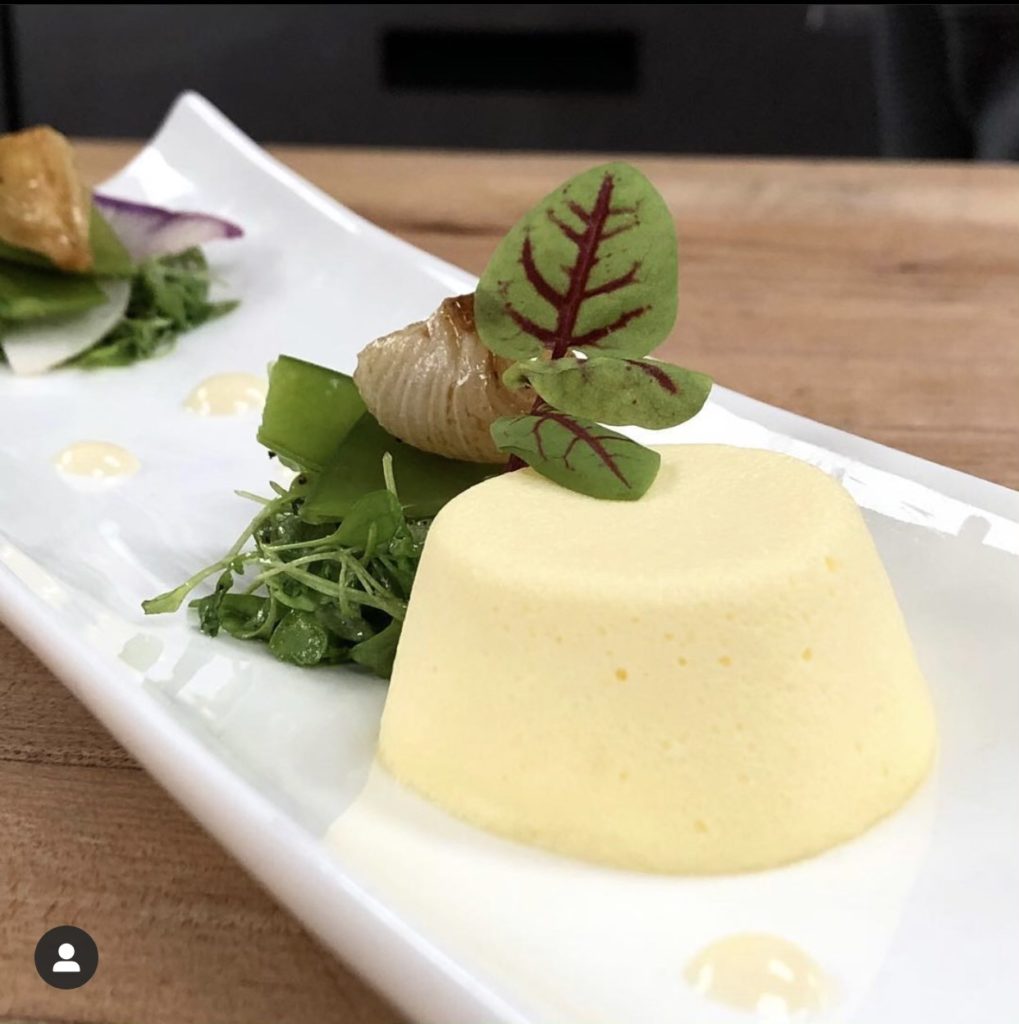
Farm to table at the Mirror Lake Inn 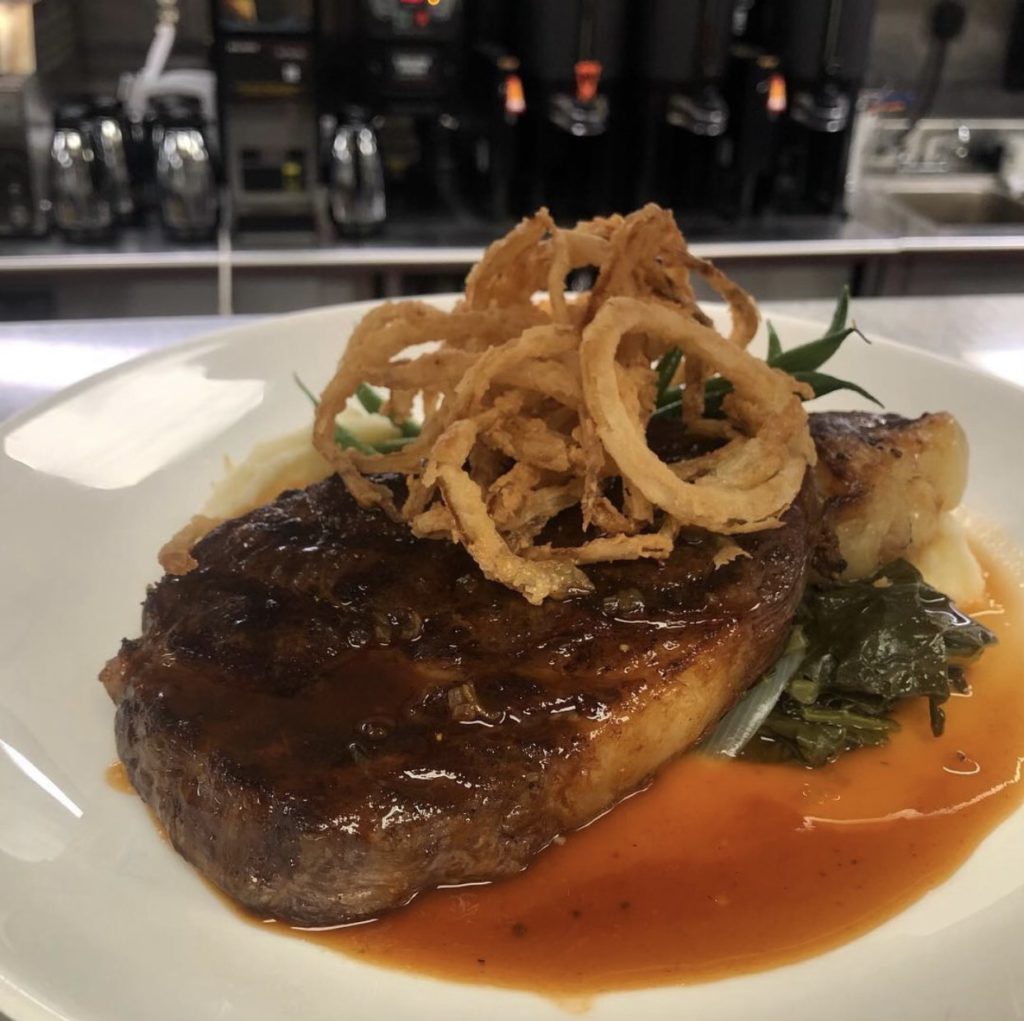
Sometimes too producers balk because they can get a higher price for a bunch of carrots at a farmers’ market than at a professional kitchen. “You may not get as much for your strawberries — but you will sell all your strawberries,” he said, which spares the producer long days sitting behind a table at a market.
The North Country’s lack of adequate slaughter facilities and skilled meat cutters can also be a hindrance. The eating public, which has still not gotten the message that the thigh is the tastiest part of the bird, demands breast meat, which would be fine except most producers sell only whole chickens. That leaves a kitchen with a freezer full of legs and thighs it can’t move. Same general principle holds for lamb. If Lang wants to feature lamb shanks, he’s left with a lot of sundry lamb cuts that customers may not be amenable to.
“They’re adventurous up to a point,” he said. “They may try one thing new, like the celery root puree, but then they go scrambling back to the tenderloin.”
But stumbling blocks aside, the Farm to Table movement is progressing nicely, and it is one that, increasingly, all chefs are wise to take into consideration when planning their menus.
Lang himself comes by it honestly, having grown up for a time on a farm in Crown Point where there was never a question of incorporating fresh dairy and garden vegetables into the daily diet.
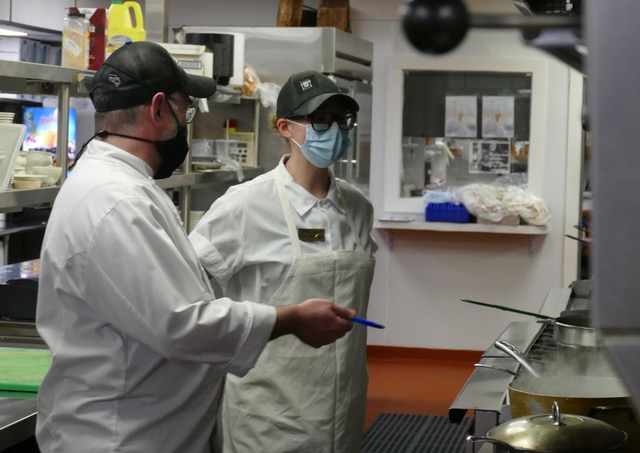
Chef Lang and team in the kitchen at the Mirror Lake Inn 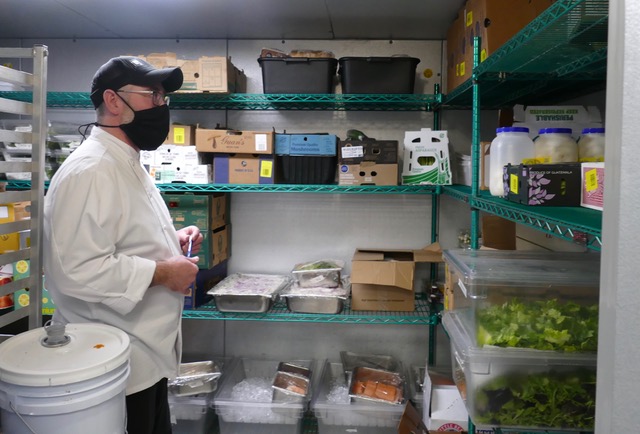
In the Adirondacks, it’s not unusual for young people to be drawn into the hospitality industry, because that’s where the summer jobs are, and by the time he was 18, Lang knew the kitchen was where he wanted to spend a career. “I always looked up to the cooks — they were the cool guys,” he said. His culinary career took him into the world of fine dining, from Chestertown to Paris and Boston to Lake Placid, where he became chef for the Mirror Lake Inn 2010.
The Farm to Table movement is largely traced to Alice Waters and her Chez Panisse, a restaurant that opened in Berkeley, Calif., In 1971, on the idea that the freshness and quality of the ingredients was as important as cooking techniques.
The trend had moved east by the time Lang arrived at Mirror Lake, but farming and the Adirondacks had always been a strained relationship. Memorable crops of potatoes and fine herds of Devons were produced in the land of harsh winters and stony soils, but in the end agriculture was easier elsewhere. Just as Minnesota’s Mesabi Range put Adirondack ironworks out of business, the deep rich soils of the Midwest enticed many small-scale producers to abandon the mountains for less stony pastures. Until, well, just about the time Lang came to Mirror Lake.
“Some (local production) was being done at the time, but it was still pretty new,” Lang said. In 2008, Ian Ater and Lucas Christenson had founded Fledging Crow, which Lang discovered when he began prowling local farmers’ markets. It was there he discovered the pea shoots and arugula, “and we just built on it from there,” he said. “I wanted to support something I believed in.”
Aside from satisfying diners’ demands for locally grown foods, Lang said dealing with local or regional farms is good business. “Quality is a big part of it,” he said. “I can buy corn from Florida, but it’s pretty much crap. The lettuce that’s shipped in has no shelf life and is poor quality; I’ll wind up throwing half of it away.”
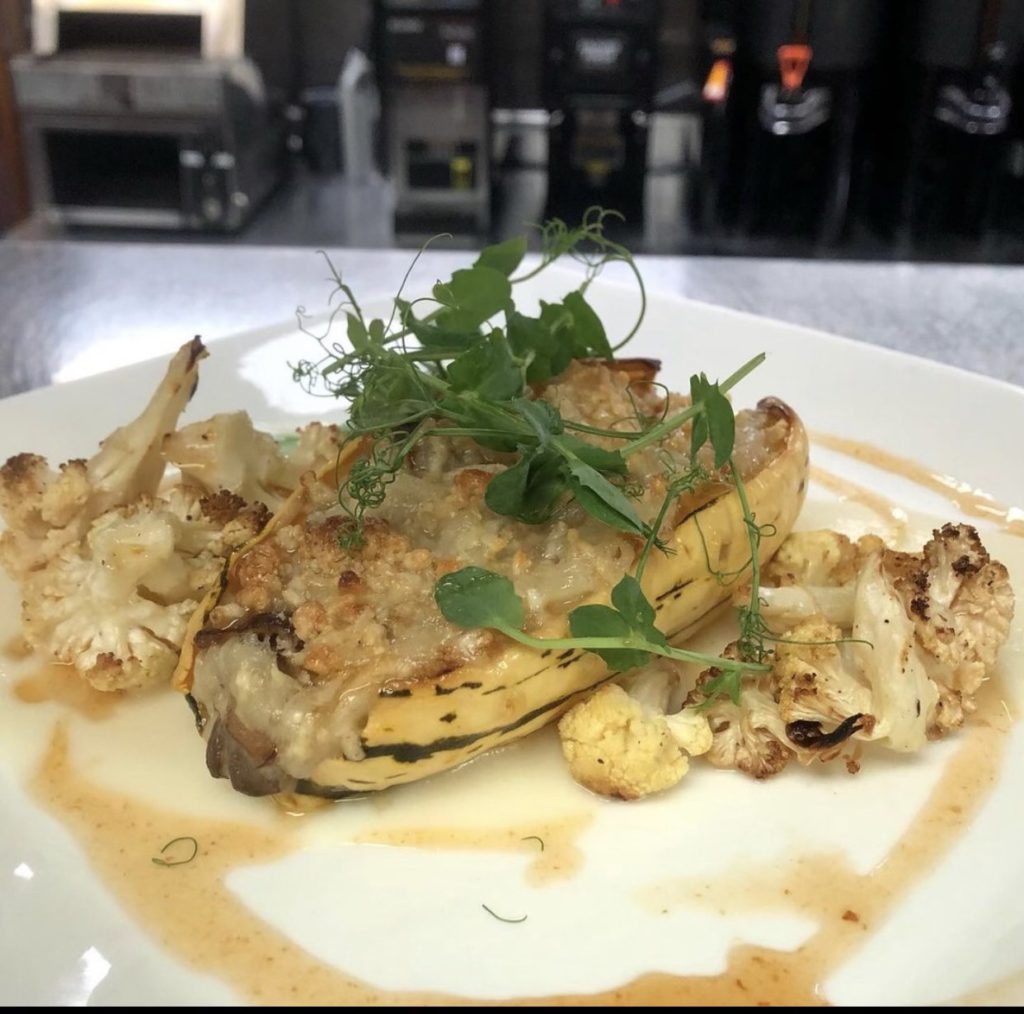
Stuffed delicata squash at the Mirror Lake Inn 
Local producers have learned what restaurants want, and restaurants in turn have learned to tailor their menus to the season. By summer, when farms are growing mountains of fresh vegetables, from tomatoes to garlic scapes, more than half of the produce that finds its way to Mirror Lake Inn’s tables is locally grown. A locally produced BLT “is probably the best you can ever get,” Lang said.
The bounty culminates with the Inn’s Thanksgiving buffet, which Lang has turned into a true celebration of the local harvest. From turkey on down, almost everything is locally produced. It is, he said the culmination of a success story for the restaurants, producers, chefs and the dining public. “Local food has become more and more of a thing, and it’s not going away,” Lang said.
If you are interested in buying or selling local food wholesale, sign up for our new wholesale newsletter, and see our online wholesale database.


