
New Creamery in the Works at Meier’s Artisan Cheese
By Tim Rowland | September 1, 2021
In Dan Meiers’ native Switzerland, land is more beautiful than it is plentiful, a fact that drove him, along with his wife Helen and four little children, first to eastern Ontario 31 years ago, and then, 23 years ago, to the tippy top of New York, where the land is flat as a wheel of cheddar, but the first risings of the Adirondack Mountains begin to appear just a few miles to the south.
In Switzerland they also know a thing or two about cheesemaking, and Dan recalls the consciousness and care that went into cheese production in his village of Geltwil, an agricultural community in the northern part of the country. There, he and his brother learned the craft by watching their cheesemaker every day, after delivering the milk from their small dairy farm — with 28 cows on 60 acres of land — twice a day in cans each containing 100 pounds of milk.
So Meier has imported this tradition and married it to the American tendency to go big. In 2011 they built a simple cheese plant and received the permit through the New York Department of Agriculture and Markets to make cheese.
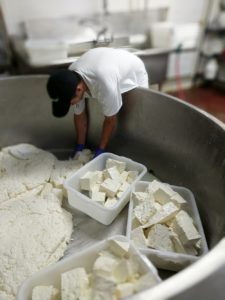 Twice a week, a small part of the milk from their 135 Holsteins and Jerseys gets pumped directly into the vat that produces Meier’s Artisan Cheese, a staple of innumerable North Country stores and restaurants.
In the spring of last year, Dan and his family launched the construction of Old Swiss Creamery, a new processing facility filled with cutting-edge equipment. Along with two new, bigger cheese vats, it also includes product lines for yogurt and bottling whole pasteurized milk, where the cream rises to the top, the way it did before the days of homogenization.
Almost all other cheese factories get their milk from outside farms, and sometimes it’s stored up to three days before processing.
But the Meiers use their own supply of milk, a particular point of pride, so they carefully control the quantity and quality of feed, with the main share being grass, which is ultimately the primary building block of good cheese. “We grow everything we feed on our farm; we really are self-sufficient,” he said.
 Dan’s wife Helen does the milking, and his son Dan Jr. is in charge of the field crops. They grow about 950 acres of corn and soybeans, all under minimum tillage to sustain soil health and water quality, plus raising about 1,300 acres of hay. “We are still a family farm,” Meier said, as the workforce includes four family members and two full-time and four part-time employees.
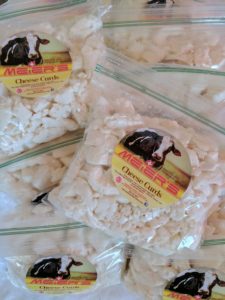
The cheese plant’s biggest seller is its cheese curd, a snackable finger food that is also a staple ingredient in the regional fries-and-gravy dish of poutine. It’s known as “squeaky cheese,” because when it’s super fresh it makes a sound on your teeth similar to rubbing a balloon. The cheese squeaks only for a couple of days, but the flavor remains and curd fans can enjoy it plain as well as flavored with garlic, pepper relish and dill.
Popular with restaurants is Meier’s halloumi style cheese that has its roots on the island of Cyprus—a cheese that can be grilled without melting. The plant also produces hard cheeses, including cheddar, alpine-style cheeses like gruyere and Parmesan, plus a smoked cheddar, cranberry port wine cheese, and a Bavaria made with stout beer and mustard seeds.
When asked about producing Swiss cheese he smiles and says he didn’t figure out yet how to put the holes in there, so that’s why it’s not among his offerings, but a taste of his homeland is represented with the nutty Mt. Titus. This cheese is their version of the original Gruyere, which won a silver medal at the 2019 New York State Fair. Their Snye, a pepper cheddar, also won a gold medal at the state fair, along with other award winners.
Distribution of the cheese runs the gamut from Stewart’s Shops to upscale Lake Placid restaurants, and from Lake Champlain west to Canton and Potsdam, making for long delivery days. The Meier’s expansion will allow them, through a change in processing technique, to quadruple the amount of cheese that can be produced in a day. The new process includes flash pasteurization, where milk is heated to temperatures of 165 degrees for 15 seconds and then rapidly cooled. This replaces the method known as batch pasteurization, in which milk has to be kept at 145 degrees for a half hour and then cools down with the help of well water to 90 degrees, the point where cheesemaking can begin. The new system will save a large amount of fresh water. Pasteurizing 2,500 pounds of milk was a six-hour endeavor, but with the new equipment, Meiers’ daily capacity could increase up to 10,000 pounds, or close to 1,200 gallons.
The new facility, including a new, shiny store, production center and cheese aging rooms is in the end phase of construction, and Meier hopes to have it open by this fall. Behind the storefront is a room filled with gleaming new milk processing equipment imported from Israel, as well as packaging equipment for yogurt and milk.
“We’re doing a lot of experimenting to make yogurt, and find people’s favorite flavors,” he said. A special piece of equipment was needed for automated packaging since he plans on selling a single-serving size.
The retail dairy features a glassed-in viewing balcony from which customers can watch the whole processing area. “It’s a major investment and a big change from the simple way we’re doing it now,” Meier said.
The Meiers have also started to change the genetics in their herd to producing milk containing the A2A2 protein, a trait that is more dominant in the Jersey breed and identifiable with a DNA test. The process is done through natural selection, not genetic modification.
While A2 milk is not an answer for lactose intolerance, Meier said, early indications are that it is better for people who experience mild digestive problems drinking traditional mixes of A1 and A2 cows’ milk.
The goal is to use new science and technology, combined with proven tradition, while keeping focus on local markets and tastes — and ultimately producing the best wholesome dairy products possible. “Our whole family loves cheese,” Meier said. “That’s why we got into it, and we also try to keep our carbon footprint as low as possible by staying local.”


