
Four Maples Vineyard Takes Advantage in Changing Climate, Tastes
By Tim Rowland
A grape is a fickle thing. It wants the right soil, the right climate, the right orientation to the sun — so when Erwin Kalmar and his wife Norliah Asma-Kalmar found all the necessary ingredients a dozen years ago in the Town of Champlain, they were both excited and ready to get to work.
 After a lengthy search throughout the U.S. and Canada for just the right spot, they began planting vines in 2010 at their newly minted Four Maples Vineyard, knowing it would be another five years before they would pop open an oaken barrel and begin to bottle their first vintage. It took less time for the medals to begin piling up, nationally and internationally.
Building on this success, Four Maples added another 1,800 vines this spring, bringing its total to 5,800 at New York’s northernmost vineyard.
It was the great explorer Samuel de Champlain who gave the town and valley its name centuries ago, but now Erwin and Norliah believe that name can be synonymous with fine wine as well. “We want this to be something Champlain is known for,” Norliah said.
The couple said it would be a fitting tribute to the community and organizations that helped them get established. “Every wine has a story, and the story of our first wine was all the help we had,” Norliah said. So they named it Cuvée Amitié, the friendship vintage.
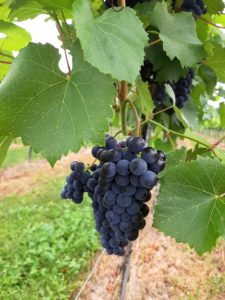 In 2016, the Champlain Valley was given its own designation as an American Viticultural Area, recognizing the distinctive character of its wines. In the industry, a strong sense of place is important for the reputation and marketing of the wines it produces. The Champlain Valley AVA notes its climate makes it dependent on special French-American hybrid vines developed in Minnesota. Its soils, once an ancient lakebed, add to the distinctiveness of the region.
Four Maples’ bread and butter is a Burgundy style blend of grapes from Marquette and Frontenac Red varieties. As they produced their first wine, “It was a bit scary and there was a learning curve,” Norliah said. But four years later the wine medaled at the Finger Lakes International Wine Competition.
Both Erwin and Norliah have agriculture in their families. Norliah grew up in Asia, where her grandmother had a coconut plantation. Erwin’s family had a winery in Hungary a century ago, and he grew up in Switzerland surrounded by vineyards.
 Erwin’s company — which makes metalworking fluids that cool and extend the life of cutting tools — brought him to Montreal. But along with his business, Erwin said he wanted to work more closely with the land, and suggested to Norliah that they start looking for land that would be hospitable to grapes.
“I love nature and I love the countryside, so I said yes, why not?” Norliah said.
Aside from finding just the right ground, today’s winemakers have to contend with changing climates and changing consumer tastes, neither of which is entirely predictable. Erwin said he believes there is an increasing appetite for Four Maples’ drier wines, which contrast with sweeter wines from California.
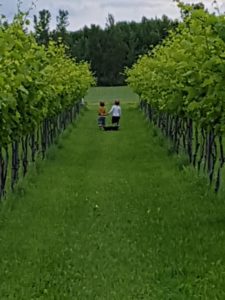 The climate is actually opening up more of an opportunity to grow grapes in the North Country. “The climate has changed — I never thought we would be able to have a vineyard here,” Erwin said. The vines still need to be hardy, Nordic varieties, but they do not stand to have as much damage from prolonged stretches of sub-zero temperatures that were more common in years past. “You cannot plant all the vines you might want, but the winters are not as harsh,” he said.
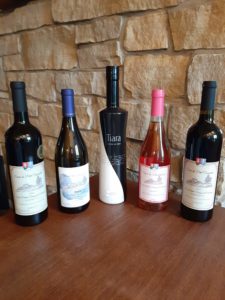
Four Maples now has a well-populated cellar of vintages including a Cuvée Du Petit Champlain to honor the region, and Blanc Du Champlain made from cold hardy La Crescent and St-Pépin grapes and a Rose du Champlain, along with a Tiara Creme de Paris liquor. More products are planned in the coming years.
The vineyard is a destination for tastings, a wedding venue and on its ample acreage, wine connoisseurs can go for a hike or a cross-country ski, then enjoy a glass of wine to cool down. Its plans are to offer activities that complement, not compete with, other winerys in the valley. “More and more people are coming,” Erwin said.
Its audience ranges from across New York to other states — one young man from Michigan was interested in starting his own vineyard, and was interested to hear what vine could grow in the North.
Erwin and Norliah believe in developing their products slowly and carefully. “We focus on quality over quantity,” Norliah said. The location, the history and, of course, the wines themselves have made Four Maples an increasingly popular spot to come and, say, raise a glass to an old explorer.


