Local farms, speciality vendors and agricultural organizations will be joining the Plattsburgh Farmers and Crafters Market Farm Day on August 29th.
The market is inviting a variety of local farms, nonprofits and vendors to join us and organizing not only a fun educational experience but a great event for local farmers to showcase their farms. This special event market will be held at the PFCM regular location at 26 Green Street Saturday August 29th from 9-2.
Call for Farms and Vendors: The market has multiple ways to take part in this event. Become a new market member and get a free event day with the benefit to join PFCM at other markets or apply for a one day event vendor. Nonprofits and local businesses welcome to join! Applications are handled by the PFCM market manager, Sue Carusone, sachipster4@gmail.com.
In northeastern agriculture, maple is the first harvest of the year. And even if some mushy snow is still hanging onto the hillsides, maple syrup revelers know in their sweet, sticky souls that if the sap’s on its way in, winter is on its way out.
This time of year can be celebrated during New York’s Maple Weekends, which are scheduled for March 21–22 and March 28–29, 2026. During these weekends, hundreds of maple producers across the state open their sugarhouses from 10 am to 4 pm for public tours, demonstrations, and pancake breakfasts.
For those who do not hail from these parts, they may be introduced to maple goodness for the first time. “I get so many people who have never tried maple syrup before in their life,” said Joy Herfurth, owner of Olde Tyme Winery at Brandy Brook Maple Farm in Ellenburg Center. “All they’ve had is corn syrup or something, and it’s amazing to see their faces when they try the pure product, because this is so good.”
But syrup as a pancake appliqué is not the only way it can be enjoyed, nor are maples the only trees that can be tapped.
“The forest has all these resources for us; we just have to take advantage of it,” Herfurth said. “We are innovative in that we’re making our wine using maple syrup as a fermenting sugar. So not only are we growing the fruit and the grapes, but we’re producing our own sugar, fermenting with it, start to finish. So basically, everything is made right here on site.”
Producers are also tapping other trees besides maple, including birch, aspen, beech and walnut. This adds interest and new flavors for the consumer, and helps producers diversify, said Adam Wild, director of Cornell University’s Uihlein Maple Research Forest in Lake Placid.
Maple became the gold standard not just for its high sugar content, but it’s also its strong flow of sap. Sap will flow out of a maple, but has to be suctioned out of a birch, Wild said. And it takes about three times the sap to make a gallon of birch syrup as it does maple.
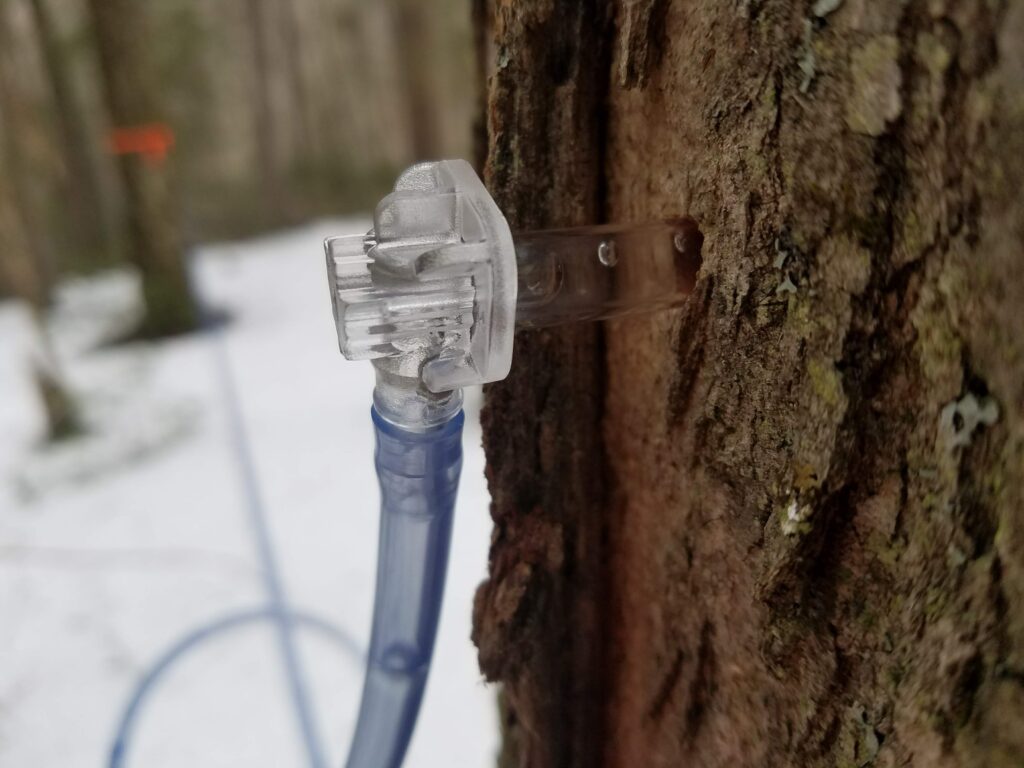
A tap in the maple tree filled with sap. Photo by Adam Wild.
“The traditional method of drilling a hole and putting a bucket on those trees doesn’t give you any sap,” Wild said. “You actually have to put a vacuum on and suck the sap from those trees.”
Despite it being harder to get the sap and needing more of it, advances in sap reduction using reverse osmosis have made the process efficient enough to be productive.
From a forestry aspect, a diverse sugarbush with multiple species is better than a monoculture represented only by maple. Birch sap doesn’t start running until the tail end of the maple season, extending this early spring harvest season for producers.
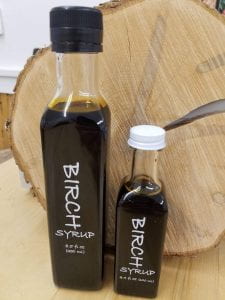
Birch Syrup sold at Uihlen Maple Research Forest.
“Why bother tapping these trees? One thing is that the flavors are different and unique,” Wild said. “Birch flavor can vary quite a bit. Early in the season you can get birch syrup that is fairly close to maple syrup, and is pretty sweet and not too far off from maple syrup — but most birch syrup tends to be what I like to compare as a balsamic vinegar reduction.”
Which can be an unwelcome surprise for someone putting it on their waffles.
“If you think about balsamic vinegar, you probably don’t want to put it in your yogurt or on your pancakes like you would with maple syrup,” Wild said. “But it’s great pairing it with salmon or roasted vegetables, or drizzling over fresh tomato, fresh mozzarella, goat cheese, or one of my favorites, using it with a white pizza.”
To help people understand the difference, Uihlein’s sugarbush bottles birch syrup in tall, slim bottles that resemble vinegar and olive oil vessels rather than the typical maple casks and jugs.
For producers, it can be interesting to experiment with other trees because of the variety. “Each is different,” Wild said. “Aspen and beech, I find, are kind of between the birch and the maple in that the beech flavors are closer to maple than the birch, so they’re not as strong. They’re more on the sweeter side, and have notes like raisin, dried pear or plums.”
Birch sap has also found its way into beverages, marketed as a health drink, and spirits.
“People are willing to give it a try, and it’s actually been selling fairly well,” WIld said. “We certainly don’t sell as much as we do maple syrup, or produce as much, but the last couple of years, we’ve actually been selling out of what we’ve made.”
Chef Robert Dumas, Director of the Institute of Adventure Hospitality and Food at Paul Smith’s College, said he appreciates maple as an ingredient, but also as an anchor to the North Country that is thousands of years old, according to American Indian Magazine.
“I think that the tradition of tapping and reducing sap to make a sweetener predates any kind of cooking that we would recognize as modern, which is largely a European influence,” he said. “As an Adirondack chef, or as a modern Adirondack chef, I think that maple syrup is a wonderful opportunity to give your food a sense of terroir — a French cooking term that refers to a sense of place.”
And unlike other sugars, the sweetener derived from trees does not disturb the soil or ecosystem, nor does it require fertilizers or pesticides. It’s minimally invasive to the land that the grove stands on.
Using maple in cooking is very approachable, from a quick sauce for a chicken breast – to salad dressing – to a glaze for grilling or chicken wings. “Alternatively, you could do a soft cheese, like brie or camembert, drizzle maple syrup over that and have that sweet and salty kind of combination, along with some crackers or bread,” Dumas said. “It’s a really lovely way to highlight maple syrup in a way that’s kind of unique.”
Maple, of course, has also found its way into creams and candies, seltzers, bacon and hot dogs and even peanut butter — giving producers plenty of ideas for product diversity.
While maples and a handful of other trees can be tapped, that’s not true of all tree species. Maples, birch and the like are “diffuse porous,” with uniform pores throughout the growth period that facilitate tapping, said Michael “Maple Mike” Rechlin, a lecturer at Paul Smith’s and expert on tree physiology. “Ring-porous” trees like oak ash and hickory, on the other hand, have pores that decrease in size during the growing season, cutting off the flow of sap.
This tidbit of tree physiology can lead to some curious discoveries.
“Sycamore is a diffuse-porous hardwood, so in theory, it will give sap, and in the spring you can boil it down and make syrup,” Rechlin said. “So I’m giving a talk down in West-by-God Virginia, the folk art capital of the east, and I said, you know, sycamore is a tree that should also make a syrup, but I’ve never heard of anybody doing it. Two ladies in that audience independently raise their hands and say, ‘we grew up on sycamore syrup.’”
The flavor is like butterscotch.
Rechlin spent 15 years in West Virginia, where walnut makes a popular syrup, one with a rich flavor that draws admiration even in the north. Sycamore and walnut are not prevalent in the north, but as the climate changes walnut is a particularly attractive possibility, considering its syrup sells for $360 a gallon, five or six times that of maple.
Of course maple season in itself is pretty hectic as producers greet the public and process the sap from tens of thousands of trees. Instead of tapping more trees, Herfurth said, “sometimes you just want to take a nap.”
Adirondack Harvest members with Maple Weekend events:
Ned and Wade Whitney are a father-son duo making maple in Adirondacks. It’s a family affair, and during the busy maple season the whole family is involved, including Ned’s wife Jennifer, and daughters Lauren (age 12) and Avery (age 9) in collecting, boiling, and bottling the sweet nectar of maple trees to be enjoyed year-round. We talked with Jennifer Whitney about how the family makes maple in the heart of the Adirondacks.
How did your family first get involved in making maple?
My husband Ned’s family has been making maple for three generations. In the 1970s his grandfather, great grandfather, and some other family members managed small-scale maple operations. His father and cousin also had a small maple operation in high school. His family’s maple business grew for years until the ice storm of 1998. The storm damaged many maple trees and went out of production until Ned and his father Wade brought the sugarbush back into production in 2009.
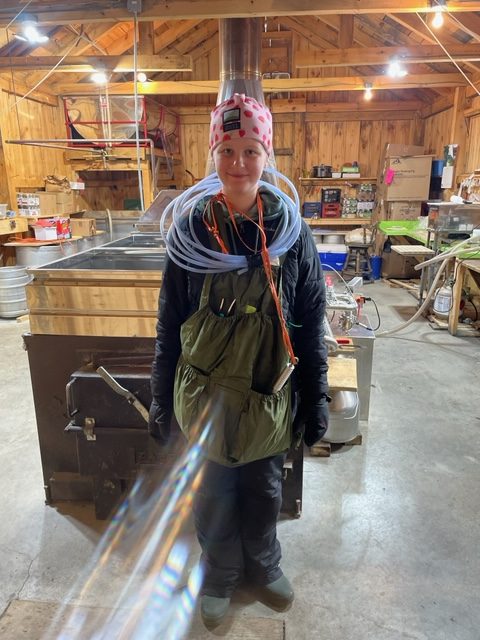
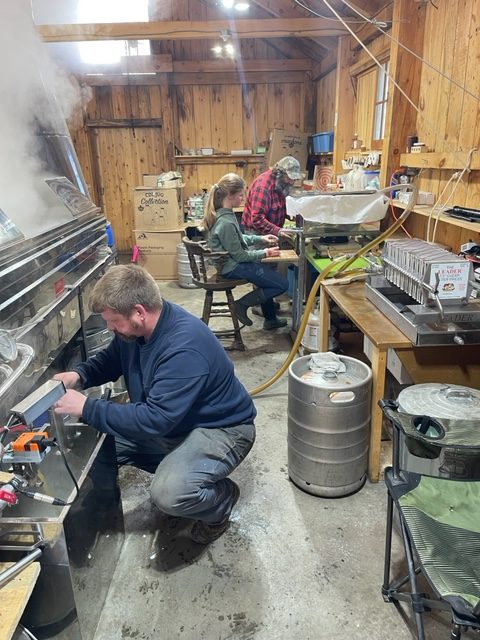
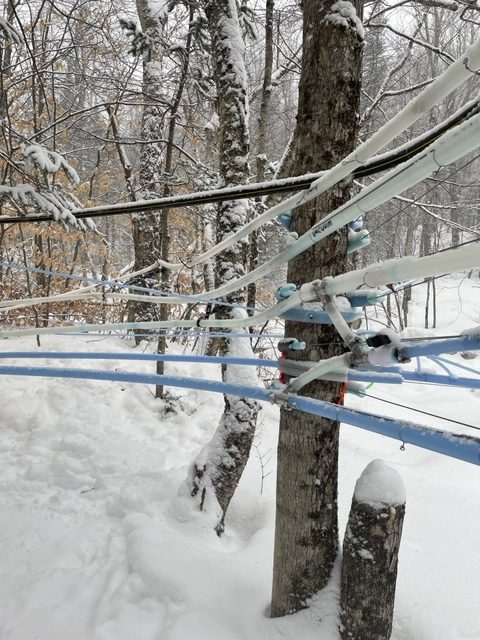
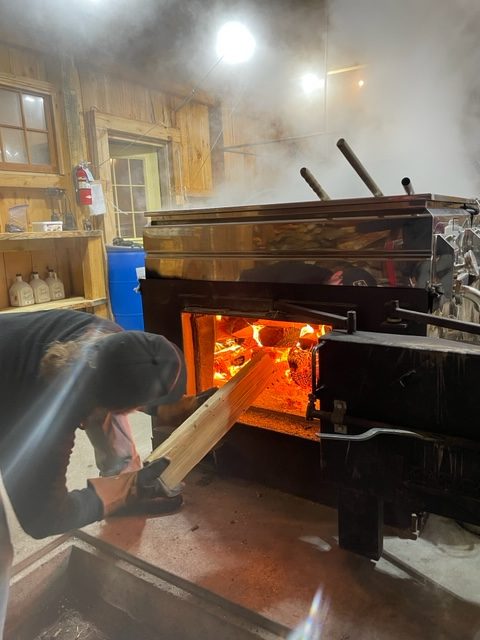
Lauren geared up and ready to repair the sap lines in the sugarbush.Ned works on the evaporator while his daughter Lauren and father Wade bottle syrup.
Tell me about your maple production.
We have 2,250 taps on Alstead Hill in Keene, NY. Plans are in place to double that for next year. The sap is collected through a network of tubing that connects the maple trees to a storage container. We then boil the sap in the sugar house with a wood-fired evaporator and use a reverse osmosis machine. We collect sap from a combination of Red Maple trees and Sugar Maple trees which gives our syrup an amazing flavor.
What does the maple season look like for your family?
For us, maple season is about six or so weeks of long days, seven days a week. Our whole family pitches in and helps where we can. We all go out into the woods and tap the trees, check the lines periodically for leaks, as soon as the kids Lauren and Avery get home from school we run right up to the sugar house and they help their dad and grandfather. The kids help label the syrup, run the blower for the evaporator, draw and filter the syrup and clean up at the end of the night. Many nights during Maple Season, we eat meals right in the sugar house. While Ned leads on making the maple and managing the equipment, I primarily manage our stock, sales, and deliveries. The kids walk to our farm stand and collect the money and restock it each day. Family friends also help during sugar season firing the evaporator, cutting and hauling wood, and keeping us stocked with snacks and drinks. At the end of the season, we all head out into the woods to untap the trees and clean it all up.
What is your favorite thing about making maple products?
The smell of the steam, the reward of the hard work and time spent with family.
A network of sap lines connect the trees to the sugar house.Colin Dowd, a friend and employee of the Whitney’s, is stocking the fire to keep the sap boiling.
What is your favorite way to enjoy maple?
On just about anything. On waffles, in our coffee, rib recipes, salad dressing, maple cream mixed with peanut butter on toast. The Whitney family is known for a maple cake with a fluffy maple frosting.
Where do you offer your products?
We have two self-serve farm stands open 24/7, 365 days a year on the corner of Alstead Hill and Route 73 in Keene and 11646 NYS Route 9n in Keene. We also have products for sale at the Valley Grocery in Keene Valley, where you can bring in a clean jug and it have it refilled for a discount. We also sell our products at Cedar Run Bakery, the Birch Store, Craigardan, Green Goddess, Enuf Chocolates, Twins Barn Farm and the Frontier Town Gateway. Keene Central School also uses our syrup for their pancake lunches.