
Closing the Loop: How Community Composting Builds a More Self-Sufficient Adirondacks
By Rebekah Pierce | Contributing Writer
A head of lettuce might be grown, sold, and eaten entirely within the Adirondacks. Then, the half-eaten salad goes into the garbage, and a truck hauls it miles away. Meanwhile, farmers and gardeners buy their compost, fertilizer, and other soil amendments at the local big box store to put nutrients back into the ground.
We grow food here. We eat it here. Then, we export part of its value as garbage and buy fertility back. The circle is broken, meal after meal, year after year.
Across the Adirondacks, a growing network is trying to close that loop with community-scale composting.
Food Scraps: Stop Calling them “Waste”
For John Culpepper, a co-founder of Compost for Good, closing the loop starts with reconsidering what we’re throwing away in the first place.
“We are awash in resources, and what it really takes is just a mind reset,” he says. “If we can get that term ‘waste’ out of our minds, we’ll be better off for it.
His preferred term is simpler: food scraps.
The small language change points to a much bigger shift in thinking. Banana peels, coffee grounds, and carrot tops haven’t necessarily reached the end of their useful lives. They still contain carbon, nutrients, and organic matter that can be returned to soil.
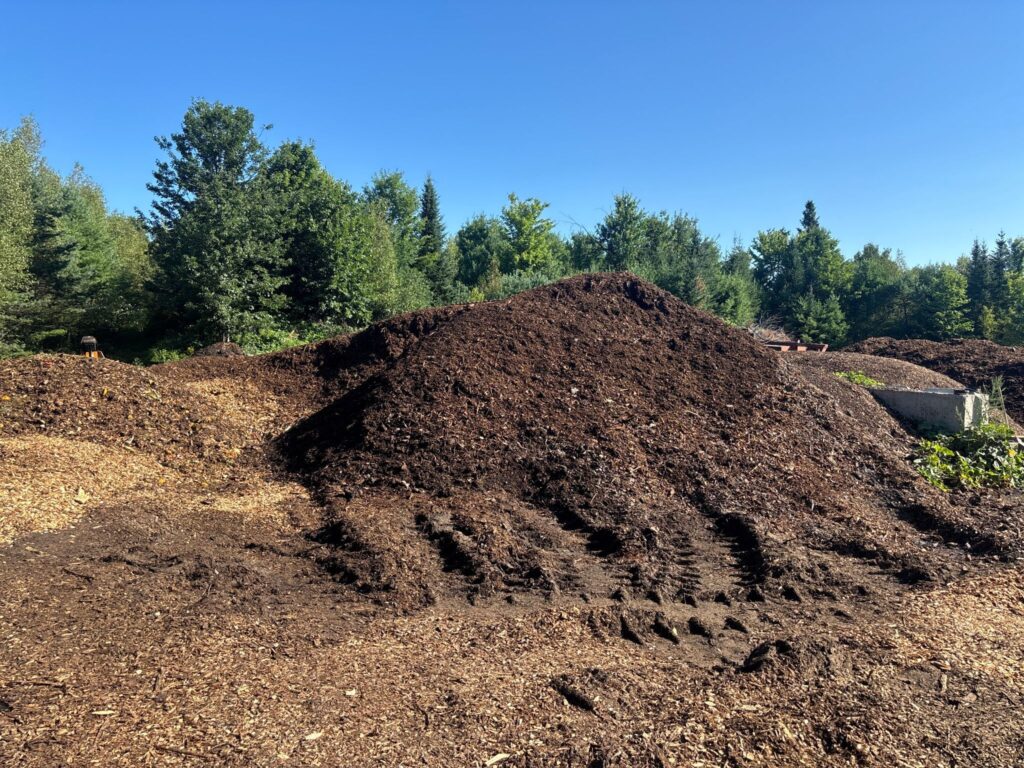
Composting makes that possible. In a managed composting system, organic materials break down under aerobic conditions while operators manage variables like moisture, temperature, oxygen, and the balance of carbon- and nitrogen-rich materials. The finished product can then be returned to gardens, farms, landscaping, and other soils.
While working on sustainability initiatives at North Country School and Camp Treetops, Culpepper became interested in building an affordable rotating drum composter capable of handling institutional volumes of food scraps. With grant support, he and local contractor Greg LeClair designed and built the school’s first system.
That work blossomed into Compost for Good. In 2020, Culpepper, Jennifer Perry, and Katie Culpepper brought the project to AdkAction to expand its reach across the region. The initiative has since moved to the Adirondack North Country Association, with continued support from AdkAction.
One of the group’s defining decisions was to make its composter designs open source. Instead of creating a proprietary system that communities would have to purchase from a single vendor, Compost for Good made its designs and operating information available so others could build and adapt them. A comparable commercial composter might cost between $40,000 and $150,000, while its original open-source design used roughly $15,000 in materials.
That philosophy still drives Compost for Good today. Rather than operating as a single composting business that collects the region’s food scraps, the organization helps communities build systems that work for them, providing education, technical assistance, grant support, project development, and compost and soil analysis.
Rural Solutions for Rural Problems
Community composting comes with challenges anywhere, but in rural areas, distance adds another layer. Homes, farms, and businesses may be miles apart, making it expensive to collect relatively small amounts of food scraps across such a broad geographic swath. A curbside system that can pick up hundreds of households along a few dense city blocks doesn’t translate as neatly to the Adirondacks.
Perry sees this as a challenge. But she also sees an opportunity to build differently. The North Country specifics, she says, include both the distances involved and a regional culture she describes as having “rugged individualism already baked into our type of being.” The region is also deeply agricultural, she said, which makes the soil-health side of composting resonate well.
The composting model emerging in the Adirondacks addresses this challenge by rethinking what it means to scale. Rather than building one enormous centralized operation, the idea is to scale laterally, with smaller composting systems distributed among neighborhoods, farms, camps, businesses, and other organizations. Collection, processing, and finished compost can then remain closer to where the food scraps are generated.
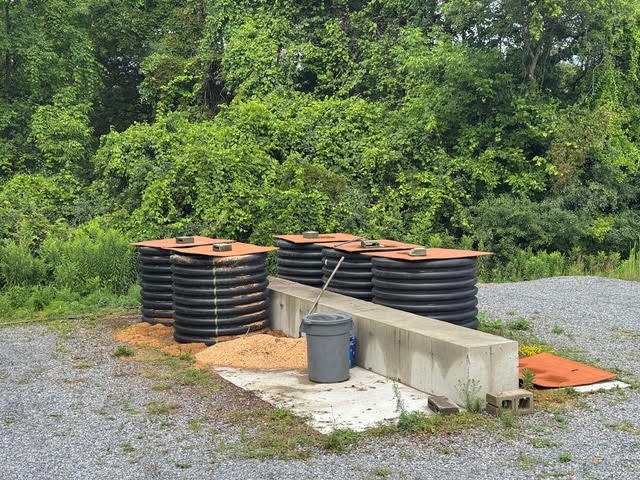
Camp Dudley in Westport offers one such example. When Camp Director Matt Storey arrived at Camp Dudley, one of his first projects was establishing a vegetable garden. Campers now participate in a rich farm-to-table program, which made composting a natural next step.
The camp feeds roughly 500 people three meals a day during its summer season, which means watching a tremendous amount of food, cardboard, and other materials move through the property. “We felt right away like we have to not put our waste in the garbage in a plastic bag,” he explains.
The camp started small, initially composting the way many households do: putting material in a pile and seeing how it went. Eventually, Storey wanted a more intentional system. With help from Culpepper and Perry, Camp Dudley adopted the neighborhood-scale drum design and kept refining it. Today, Storey said the camp has six drums and diverts roughly 25,000 to 30,000 pounds of food scraps during the summer.
“And then we use it all for our gardens,” he says. “All of our compost goes back into our own program.” The loop is visible enough for campers to experience firsthand. Meals are served family-style. Signs tell campers which parts of that day’s meal belong in compost and which don’t. Campers work in the garden, learn about soil, harvest crops, and cook.
Storey remembers the excitement of watching children who have never gardened before dig potatoes and suddenly connect the crop in their hands with something familiar on their plates.
“To see a kid dig potatoes … and then cut them up and see that that’s like a French fry, and see that excitement is unbelievable,” he said. “That’s all kind of part of the magic of it.”
The same network has helped Ben Wever Farm in Willsboro develop a system suited to a very different problem. Soil health already shaped much of the farm’s management, including its grazing practices, but the construction of a covered barnyard for overwintering calves created a new challenge: roughly 100 cubic yards of manure to manage each year.
The family had experimented with composting horse manure on a smaller scale, but the volume was another matter. Conversations with local Soil and Water staff eventually connected them to Compost for Good and helped them find technical assistance and financing to build a larger system.
Last year, the farm installed an aerated static pile, or ASP, composting system. Rather than repeatedly turning piles mechanically to introduce oxygen, the system uses pipes and a blower to aerate the pile. For Pierre-Luc Gélineau, an electrical engineer who’s been involved with his in-laws’ farm for about a decade, the technology held a special appeal.
It’s also substantially reduced the labor involved in managing the farm’s compost. And Ben Wever Farm has begun taking in food scraps from a few nearby restaurants, with room to accept more material if the collection side of the operation grows.
Building North Country Composters, Not Just Compost
Perry has watched community composting develop from several different vantage points.
She helped build Compost for Good, then launched River Valley Regeneratives, a commercial community composting operation that began with remarkably modest equipment: a Volvo, a small trailer, and a handful of collection bins.
They repeatedly outgrew the system. In roughly four and a half years, Perry says River Valley Regeneratives has diverted more than two million pounds of food scraps from restaurants, schools, residents, and other customers. The business has grown to the point where Perry described processing roughly 14 to 20 tons in a week, depending on volume.
But Perry doesn’t envision success as River Valley Regeneratives becoming the one company collecting every food scrap across the North Country. “We don’t want to be the centralized hauler,” she said.
That’s where another piece of the regional network comes in: the North Country Composting Coalition, or N4C.
Compost for Good and N4C overlap, but they aren’t the same thing. Compost for Good is the broader body that supports composting initiatives. N4C is a network of community composting businesses, including River Valley Regeneratives, that intentionally collaborate rather than compete for every opportunity. “We often back away from a proposal that we could compete with because we would rather support the business that is already in that community,” Perry says.
That may be one of the clearest answers to why the model is gaining momentum here: the people involved aren’t simply trying to build bigger compost piles.They’re trying to build more capacity, and importantly, more community.
Compost for Good’s approach begins with a question: “It’s not us prescribing something; it’s starting with the question of, ‘What do you need?'” Perry says, “and then building programs and projects that are grant-funded around that.”
That question can produce completely different answers from one community to the next. A town might need a food scrap drop-off location. A farm may want to improve how it composts manure. A school may need collection rather than its own composting operation. A neighborhood may be able to share a small system.
Compost for Good, ANCA, AdkAction, Clarkson University, farms, and other partners have created a network capable of helping those ideas move from interest to implementation. That’s particularly important in a rural region where asking every town to invent its own system from scratch would be slow, expensive, and unnecessary.
With this system, the scraps stay local, but the knowledge travels.
How Compost Transforms Scraps into Soil
Follow the cycle long enough, and you end up where the food started: back in the soil.
Culpepper, now a certified soil microscopist, studies the microbial communities in compost and soil and encourages people to become better “microbe farmers,” an important distinction from simply piling organic material somewhere and waiting for it to rot.
Perry puts it more bluntly: someone might throw food scraps into a backyard pile and say they compost, but her goal is to create “biologically robust, nutrient-dense material that goes back into the fertility of North Country growing lands.”
At Ben Wever Farm, Gélineau is beginning to see what that connection can look like in the field. Composting first solved the practical problem of managing accumulated manure, but it brought another benefit: the finished material is easier to manage and can wait until conditions are right for spreading, an important advantage on a farm with some waterlogged ground and a family balancing farm work with off-farm jobs.
The family has applied compost to some of its poorest-performing fields, including sandy ground with low organic matter. Gélineau says those fields have gradually begun producing more. In one informal test plot, the farm compared biomass from treated and untreated areas and found the yield in the compost-amended area was nearly double. “There seem to be a lot of indications that we’re going in the right direction,” he says.
Perry is doing something similar at River Valley Regeneratives: the property was essentially a demolition yard when the business arrived. Today, she’s using compost and other organic materials to build soil, with plans for gardens and additional agricultural production.
All of this raises an obvious question for an agricultural region like ours: farmers routinely purchase fertility and soil amendments. At the same time, communities pay to haul away organic materials containing carbon and nutrients. Why aren’t we connecting those two ends of the system more often?
Closing Another Loop With Biochar
Food scraps are far from the only organic resource the North Country has in abundance. Drive through any Adirondack town and you’ll see woody material somewhere: tree trimmings, wood chips, brush, and other biomass that may have relatively little value in its current form. Biochar offers another potential pathway for some of that material.
Deborah Aller is director of the New York Center for Organics Recycling and Education, or NYSCORE, at Cornell University. Her work focuses on finding productive uses for organic materials that might otherwise enter the waste stream, including composting, anaerobic digestion, and biochar. “I like to think about organic materials not as waste but as resources,” Aller says. “These are sources of carbon and nutrients for farmers in particular.”
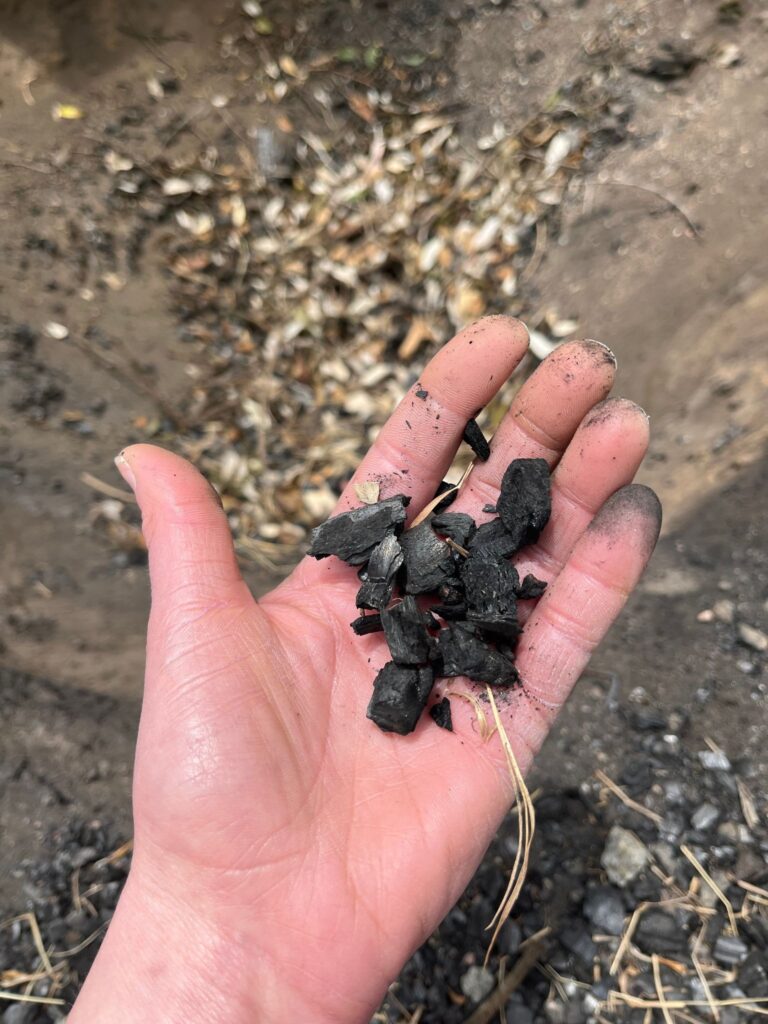
Biochar is a carbon-rich material produced by heating organic material under low-oxygen conditions through a process called pyrolysis. Unlike charcoal, which is primarily produced as a fuel, agricultural biochar is intended for use as a soil amendment.
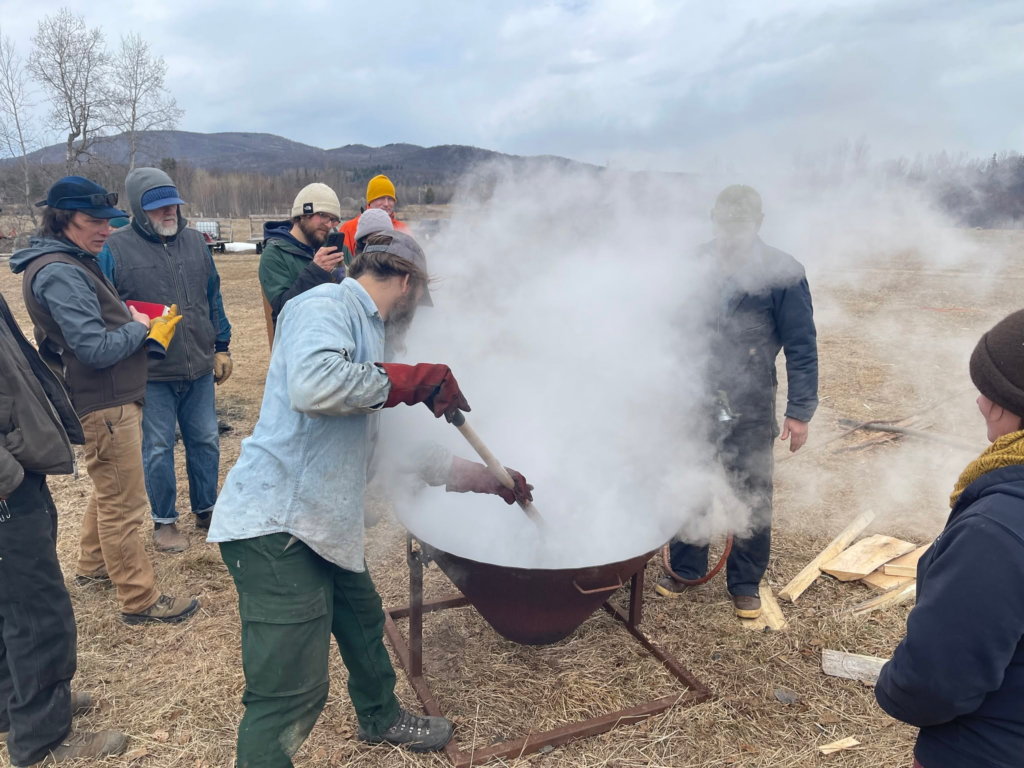
Perry is already helping put that idea into practice. Through grant-funded projects, portable flame-cap kilns are being placed on farms, where woody material can be converted into biochar.
Biochar and compost can complement one another, Aller said. Research has examined adding relatively small amounts of biochar to compost during production, where it can affect microbial activity and nutrient retention. Biochar can also be blended into finished compost before it is applied to fields or gardens. Aller describes compost as a relatively available source of carbon and nutrients for microbes and plants, while biochar provides a more stable carbon structure.
That doesn’t mean every farmer should start producing biochar, or that every load of brush should go into a kiln. Aller stresses that applications need to make agronomic and economic sense. Biochar tends to offer greater benefits in degraded, low-organic-matter, acidic, or sandy soils than in soils already rich in organic matter and functioning well.
The larger point is the same one running through the composting movement: look first at what you already have, then figure out where it can do the most good.
Why Here, and Why Now?
There’s no single reason why community-scale composting has gained momentum in the Adirondack region. Money could be part of it; more than $200,000 in USDA Rural Business Development Grant funding helped Compost for Good support community-scale composting businesses and equipment across Clinton, Essex, Franklin, and St. Lawrence counties. New York’s broader push to divert food scraps from landfills has created additional grants and policy incentives.
Infrastructure and research matter too; Culpepper’s design from the original North Country School project has expanded to at least eight operating in the region by 2024, and both Cornell and Clarkson Universities have provided expertise and partnerships.
But people may matter most. Aller sees something distinctive happening here. “I think it’s because there’s really great advocates for community composting in that area,” she said. She believes the Adirondacks are “really leading this effort for the state” and that other regions could learn from its efforts.
Storey reaches a similar conclusion from the ground level. “You have to have a hero or a champion, somebody that’s super psyched about it,” he said. “I think starting small is what it’s all about.”
That might be the most “Adirondack” part of this story: our communities rarely have unlimited money, staff, or infrastructure. Projects often begin because one or two people decide something needs doing, find someone in the next town who’s already tried it, borrow an idea, modify it, and keep going..
The Adirondacks aren’t becoming a composting success story because someone finally figured out how to make a rural place operate like a city. The progress is coming from doing something more characteristic of the region: working with the scale we have, the materials we have, and the people we have.
The result is a local food system beginning to close its own loop.Farm-to-table only follows the journey halfway. A truly local food system brings it full circle, from farm to table, back to soil, and eventually, right back to the farm.


