By Tim Rowland | Contributing Writer
The second graders in Elizabeth Donahue’s classroom know what it’s like to grow their own food. Granted, they didn’t have to deal with drought, pests, crop failures or commodity prices, but on a chilly January day, they learned how to farm.
Under the guidance of Ellie Hoffman, Local Food Educator for Cornell Cooperative Extension of Essex County, the kids planted peas, broccoli and carrot microgreen seeds, watered them, and placed them in a sunny window. Within a week, the sprouts were ready to eat.
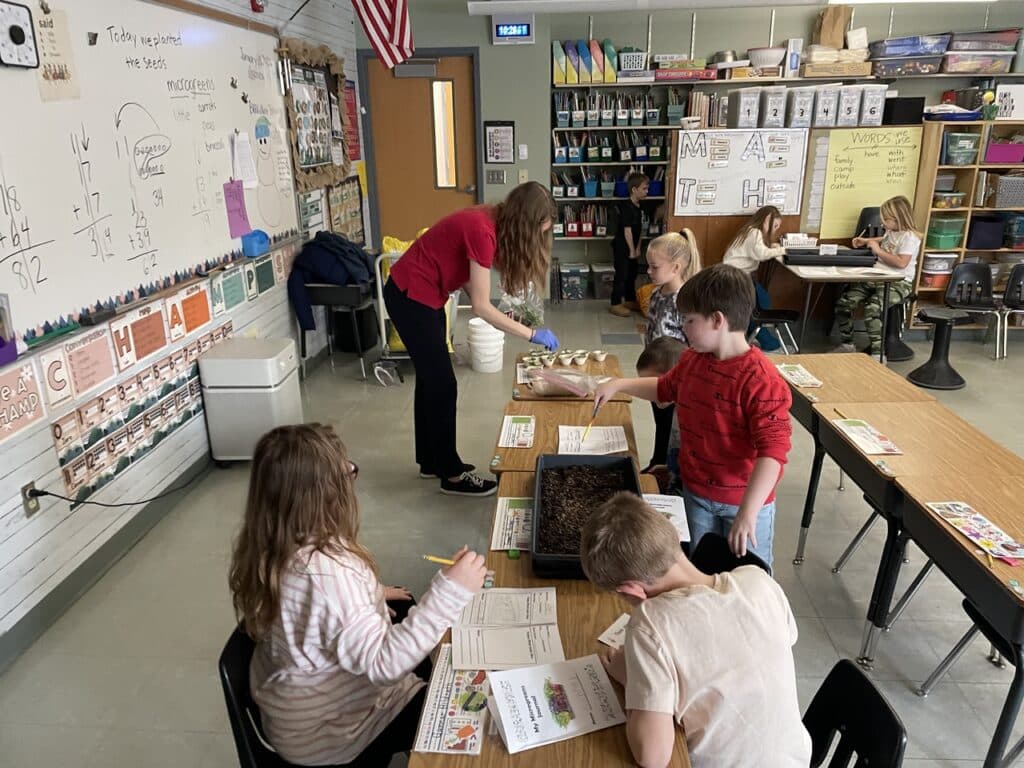
Through Cornell’s Agriculture in the Classroom program, Hoffman brought soil, seeds, trays and plenty of optimism into the AuSable Forks Elementary School classroom. “They’re growing already,” shouted a young man, whose excitement and imagination may have got the better of him. But he was not far off the mark. Sprouts are an effective teaching tool, because they pop out of the soil and are ready to consume within days.
“Microgreens have been a popular Agriculture in the Classroom activity because they’re so hands-on,” Hoffman said. “Anyone can plant and care for microgreens — and they grow so quickly, every day brings something new to observe. It’s fun for the kids to grow different varieties of microgreens too, and to explore the similarities and differences between microgreens and full-size vegetable plants.”
Young agronomists sometimes need a little extra instruction, but Hoffman was generally successful at harnessing boundless enthusiasm for the project. And while several kids said they had helped their parents plant gardens at home, for others this was a whole new world.
Hoffman showed them how to nest a porous seed tray inside one that trapped water, so that the soil would remain moist, but not soggy. “Make a little bird beak with your fingers to grab the seeds, and then sprinkle the seeds like cheese on a pizza,” she instructed. Too late in one case, where an overzealous planter had dumped the entire handful of seed into the middle of the tray – a fixable problem.
The students learned lessons that even some long-time gardeners have trouble remembering. “Don’t pack the soil down, we want it to be loosey goosey,” Hoffman instructed. Also unlike many adults, these second graders have already come to learn the correct spelling of “broccoli.”
Agriculture in the Classroom lessons like these connect kids with food through classroom visits, demonstrations and farm tours. Food, they learn, is more than just a frozen brown thing put in the microwave. They also learn that there are a lot of edible goods being produced by farmers right in their own backyards, and that these foods are healthier and more efficiently brought to the table than boxes of highly processed products from the supermarket shelf.
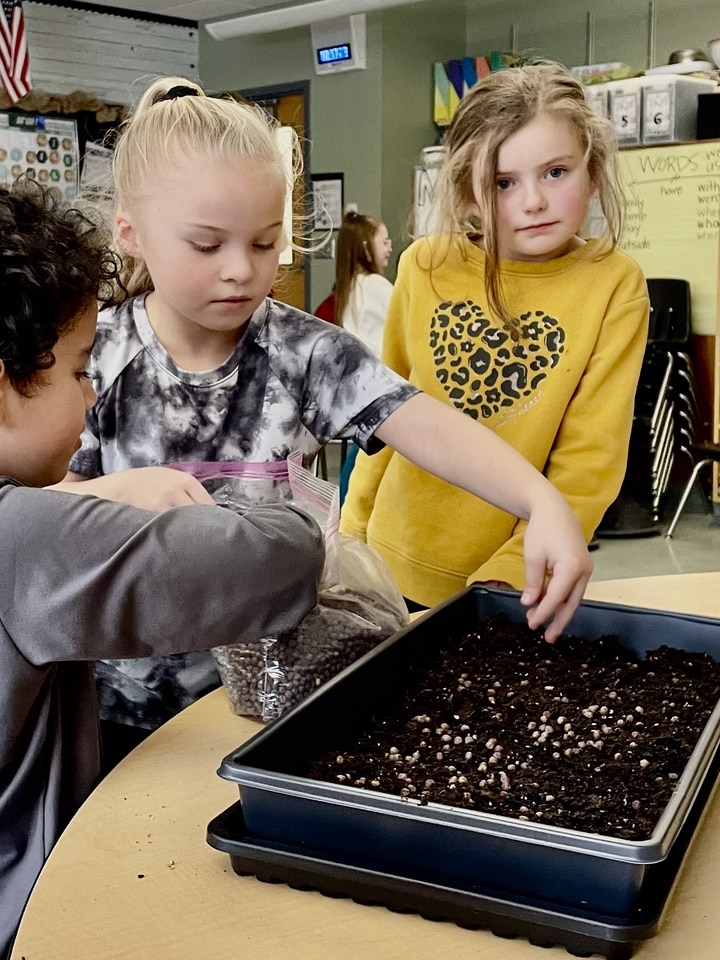
For some, it’s a bit of a novel concept. “We’re going to eat a plant for no reason?” a child asked Hoffman before — without waiting for an answer — quickly transitioning to “Why are your gloves purple?”
During the lesson, the kids are also encouraged to find some of their own answers through observation. They receive gardening journals, and record what they see each day.
Hoffman also brought some samplings of the sprouts that would soon be popping up for the students to taste. There is only one rule: Don’t use the “E-word” (Eww).
The results were cautiously, if not universally, positive. Young palates have been trained by the commercial food industry to be sated with sugar and fats, so appreciation of food in its natural state is something that must be learned as well. Hoffman does this by introducing them to pea shoots, a gateway sprout that is naturally sweet and will hopefully encourage kids to experiment with other microgreens. And they do.
“A lot of students discovered that they enjoyed the micro versions of larger vegetables they didn’t normally eat, like broccoli,” Hoffman said. “Next to apples, microgreens inspired the most requests for second helpings!”
This article is part of a series about activities supported by Harvest NY’s Rooted In Learning Grant. Harvest NY, a program of Cornell Cooperative Extension, champions the state’s farm and food economy through assistance with local food and supply chain management, urban agriculture, community gardens, emerging crops, and agriculture climate resiliency.